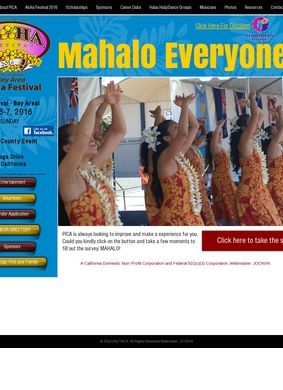
Bay Area Aloha Festival is what most people land here for, and the 2026 edition already has a fixed shape: two days in August at the San Mateo County Event Center on Saratoga Drive, with live entertainment, cultural performances, craft and food vendors, hands-on workshops, and a family zone called the Ohana Keiki Korner. Children twelve and under get in free. That one line of detail tells you more about who the event is for than any mission statement could, and it sets the tone for the rest of what the Pacific Islanders' Cultural Association puts on the table.
Mission and community focus
The Pacific Islanders' Cultural Association is a 501(c)(3) nonprofit, founded in 1995 and based in Pacifica, California. Its stated purpose is to develop and carry forward the histories, cultures, and traditions of Pacific Islander peoples through education and community support. That is a broad remit, and the festival is the most visible expression of it, but there is more besides. The Pacific Islanders' Cultural Association serves the San Francisco Bay Area Pacific Islander community first, while keeping the door open to the general public, which is exactly why the free admission for kids reads as deliberate.
Preserving seafaring traditions through canoe projects
The part of the work that caught my attention sits well away from the festival grounds. The Pacific Islanders' Cultural Association runs two heritage initiatives built around traditional seafaring: the Koa Canoe Project and the Voyaging Canoe Project. Both aim at preserving Pacific Islander seafaring culture, which is a far more specific and demanding goal than the usual cultural-festival fare. Canoe heritage work means physical craft, navigation knowledge, and the kind of intergenerational transfer that does not happen over a single weekend. A group willing to take that on is doing something concrete, and it gives the whole operation a backbone beyond the annual celebration.
Scholarship and education programs
Alongside the canoes there is a scholarship program and a dedicated education program, the latter carrying its own email address separate from general inquiries. Having a named route into the education side is a quiet sign of structure: education is handled as its own track, not folded into a generic info inbox. The scholarship program rounds out a picture of a group that funds people as well as events.
If you read the festival as the public-facing front and the canoe and education work as the substance underneath, that division is coherent. The vendor side of the festival reinforces it too. Booths come in several categories, crafts, food, retail, and community organization tables, so the event doubles as a marketplace and a gathering point for other groups in the same orbit. That breadth is genuinely useful for vendors and for visitors who want more than a stage and a snack stand.
From inquiries to vendor contacts
Reaching the Pacific Islanders' Cultural Association is fairly straightforward, with one notable absence. The site lists a mailing address, a post office box in Pacifica, and publishes several purpose-specific email addresses: general inquiries, education, entertainment, scholarships, and vendors. Routing a question to the right desk is therefore easy, and the separation suggests the people answering actually differ by function. What is missing is a phone number. There is no listed line at all, so anyone who prefers to call, or who needs a fast answer the day before the festival, has only email and the post to fall back on. For an in-person event with vendors and families coordinating logistics, that is a real gap.
Ratings across charity watchdog sites
Public reviews are sparse. The Facebook page shows as not yet rated, with two reviews attached. That is close to no outside sentiment to go on. On the institutional side, the Pacific Islanders' Cultural Association carries profiles on: both GuideStar, run by Candid, and Charity Navigator hold records tied to its EIN, 77-0398912. Charity Navigator shows no Encompass rating, because not enough data has been submitted to generate a score. GreatNonprofits lists a profile as well, but no review count came back from it. No Google, Yelp, or Trustpilot ratings turned up.
So the credibility here does not come from a wall of stars. It comes from registration and transparency. A live EIN, recognised nonprofit status going back to 1995, and presence on standard charity-vetting platforms say this is an accountable organization, even if donors cannot lean on a Charity Navigator score yet. The absence of that score is a data-submission gap, and the appearance on multiple watchdog sites counts in its favour. Anyone researching the Pacific Islanders' Cultural Association through a business directory or a charity-vetting site will find a traceable paper trail.
Who the festival serves
The audience question answers itself once you look at the programming. Families with young children are clearly the core: free entry for kids twelve and under, a dedicated keiki area, and workshops point straight at that group. Pacific Islander families in the Bay Area looking for a place to mark and pass on tradition are the other obvious fit, and the canoe projects give that crowd something to engage with year-round rather than one weekend in summer. The general public is welcome, and the food and craft vendors make it an easy outing even for someone with no prior connection to the culture.
Vendors are a third group the Pacific Islanders' Cultural Association serves directly. The festival offers booth space across crafts, food, and retail, plus slots for community organizations, so a small maker or a fellow nonprofit has a clear path to participate. The dedicated vendor email backs that up. This is the sort of practical detail that tells you the event is organized by people who have run it before and know what exhibitors need to ask about.
The scholarship and education programs widen the reach beyond event attendees. A student who never sets foot on the festival grounds can still benefit from the funding side, and that gives the Pacific Islanders' Cultural Association a reason to exist on the other fifty weekends of the year. The combination of a marquee event, ongoing heritage work, and direct financial support to individuals is a fuller offering than the festival alone would suggest.
Weighing the organization's track record
Weighed as a whole, the Pacific Islanders' Cultural Association comes across as a focused, established community nonprofit with a clear flagship event and real substance behind it. The strengths are concrete: a long track record, the canoe heritage projects, a scholarship and education arm with its own contact, and a festival that knows exactly who it is for. The weaknesses are honest: no phone number, almost no third-party review presence, and a charity-rating profile that lacks a score. None of those flip the verdict for the Pacific Islanders' Cultural Association.
Set it beside something like the Smithsonian's Asian Pacific American Center, which a curious reader might also turn to for Pacific Islander culture, and the difference in role is the point. The Smithsonian offers national scholarship, archives, and authority you consult from a screen. The Pacific Islanders' Cultural Association offers something you show up to in person, in San Mateo, where the canoe work and the performances happen in front of you. The published record is enough to act on; the August festival is the natural place to start.