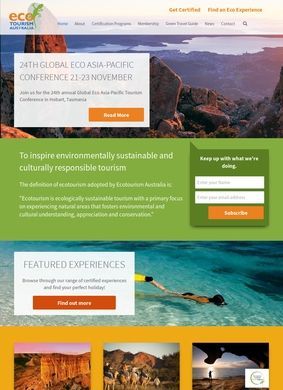
Ecotourism Australia has been certifying sustainable tourism operators since 1991, which makes its scheme one of the older ones of its kind anywhere in the world. Ecotourism Australia is a non-government, not-for-profit industry association, and it works as the country's peak body for ecotourism. That last part is the useful bit for a traveller or an operator. When a recognised body sets the standard and checks who meets it, the word "eco" carries whatever an outside party has actually verified, rather than whatever an operator wants to claim about itself.
The organisation does two things at once, and the pairing is the point. Ecotourism Australia certifies businesses and places against defined programs, and it then points the public toward the operators that have passed. Both halves run through the same set of standards, so the label a traveller sees connects directly to the assessment an operator went through. That is what keeps the Ecotourism Australia mark meaningful instead of decorative.
None of this reads as a quiet listing that has been left to gather dust. The programs are numerous, the standards are specific to what is being assessed, and the whole model rests on the assumption that a checked claim is worth more than a self-declared one. For a sector where greenwashing is a genuine problem, that is a reasonable bet to build an organisation around.
What its certification covers
Certification is the core of Ecotourism Australia, and it is not a single stamp handed out uniformly. The programs split by what is being assessed: the whole business, the individual guide, an entire destination, or a specific commitment such as climate. That granularity is unusual among sustainability schemes, and it is the main reason operators in the trade treat this certification as more substantial than one more badge to display.
ECO and Sustainable Tourism Certification for operators
For a tourism business, the two main tiers are ECO Certification and Sustainable Tourism Certification. Each assesses an operator against sustainability criteria and, once passed, lets the business carry a mark a customer can recognise at the point of booking. A Climate Action Certification sits alongside them for operators that want their carbon commitments assessed on their own terms. The value here is concrete. A certified operator has been measured against a written standard by a third party, which is a firmer thing to trust than an environmental claim the operator drafted about itself.
These tiers also give a business somewhere to aim. An operator that starts on the broader sustainability track has a clear next step toward the more demanding ecotourism criteria, so the certification works as a ladder and not a single pass-or-fail gate. For a customer, the presence of that gradient is quietly reassuring, because an Ecotourism Australia mark then reflects a standard a business chose to keep climbing toward, not a box it ticked once and forgot.
Guides, destinations and respecting culture
Ecotourism Australia reaches past the businesses themselves. ECO Guide Certification assesses individual tour guides, the people actually leading the trips, which is a sensible place to put a standard because the guide frequently is the experience a traveller remembers. Respecting Our Culture Certification addresses how operators engage with Indigenous and local culture, a dimension plenty of sustainability schemes skip over entirely. And ECO Destination Certification applies to whole regions and locations, so a council or a tourism region can hold certification in its own right, alongside the companies operating inside it.
Ecotourism Australia running a destination-level tier is genuinely uncommon. Certifying a place, with all the competing interests that sit inside any region, is far harder than certifying one operator, and it is one of the more ambitious things the body attempts. A destination that carries the mark is telling visitors the whole area has committed to standards, which is a stronger signal than any single lodge advertising its own credentials, and it gives a region a shared goal to organise around.
The Green Travel Guide and the Scorecard tool
Two tools connect the standards to real use, and they face in opposite directions. The Green Travel Guide is a public directory of certified operators, experiences and destinations, so a traveller can search for something that has already passed instead of taking an operator's word for it. The "Strive 4 Sustainability" Scorecard is a self-assessment tool an operator uses to see where it stands ahead of a full certification audit.
I found the pairing sensible: one tool faces the public and turns the standard into a booking decision, the other faces the business and gives it an honest look in the mirror before it is ready to be judged.
Around those two tools sit the supporting pieces. Ecotourism Australia keeps education and capacity-building resources for operators, a Hall of Fame that recognises long-standing performers, and case studies that show how others navigated the same process. A News section keeps the whole thing current. For an operator early in the journey, that scaffolding is the difference between a certification scheme that only judges and one that also helps a business get there.
A small tour company without a sustainability manager on staff can lean on those resources instead of hiring the expertise in, which lowers the barrier to even attempting certification.
The main site organises all of this under About Us, a Sustainability Pathway split for businesses and for destinations, Community and Resources, News, and GSTS26, the Global Sustainable Tourism Summit that gives the sector somewhere to gather. Partners listed on the Ecotourism Australia site include UN Tourism, UNESCO, Tourism Australia, Accor Pacific and WWF, which signals that the certification is taken seriously by bodies with real standing in tourism and conservation.
That company does more for credibility than any amount of self-description could, since a body backed by UNESCO and a national tourism agency is operating at a different level from a self-styled eco badge.
The audience splits across several groups, and Ecotourism Australia is built to speak to each. Tourism operators and businesses are the ones being certified; destinations and whole tourism regions are the more ambitious targets; individual travellers are the end users searching the Green Travel Guide for something credible to book; and industry partners and supporters sit around the edges funding and endorsing the work. That spread is broad, but the standards holding it together are what stop it fragmenting into a loose alliance with no teeth.
For a traveller deciding how to book a low-impact trip, the honest comparison is what the Green Travel Guide adds over simply browsing Tourism Australia's general listings. The difference comes down to the filter. Tourism Australia lists the whole country and everything in it; Ecotourism Australia lists only what has been certified against a defined standard, a smaller pool but a vetted one.
Whether that narrower, checked set beats the wider, unfiltered one depends on how much the certification itself matters to the person doing the booking, and it trades a shorter menu of options for a claim behind the word "eco" that someone other than the operator has actually checked.