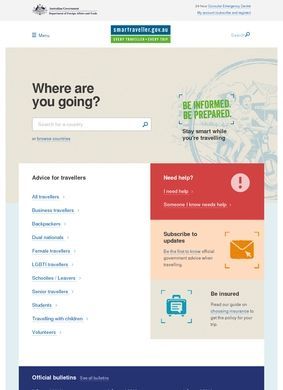
Smart Traveller is the Australian government's official travel-advisory website, run by the Department of Foreign Affairs and Trade for Australians who are planning a trip overseas or already standing in a foreign airport. That single sentence covers what it is; the useful part is what sits underneath it. The site publishes destination-specific advisories for somewhere over 170 countries and territories, and each destination is assigned an overall advice level on a four-tier scale, so a traveller can see at a glance whether the government considers a place ordinary, worth extra care, or somewhere to reconsider going at all.
Smart Traveller is listed in this business directory as Australia's official travel-advisory service. Those advice levels are the spine of the whole thing. A dedicated page, "What our advice levels mean," explains the four tiers and, more importantly, what shifts as the level climbs: whether standard travel insurance still holds, what precautions to take, and what help the Australian government can and cannot realistically provide once you are in a higher-risk place.
That last point is where Smart Traveller proves its worth, because it is candid about the limits of consular assistance instead of implying a rescue is always one phone call away.
Advice levels and the destination pages
What the four levels mean
The four-tier system is deliberately blunt, and that is a virtue. A level is a summary judgement, and the accompanying guidance tells you how to act on it, from checking that your insurance is valid at that level to understanding that assistance thins out as risk rises. Smart Traveller does not hide the ceiling on what an embassy can do for a citizen in trouble, which is the honest thing to publish even if it is not the reassuring thing.
Read one destination page and the pattern is clear. The advice level comes first, then the specifics behind it. It is a structure built for someone deciding whether to board a plane, not for someone browsing for entertainment, and Smart Traveller sticks to that discipline.
Browsing by country and region
The Destinations section is browsable by country and region, and it groups related places into hubs. An Asia travel-advice hub, for instance, pulls together health and safety topics that cut across the whole region, disease exposure and water safety among them, so a traveller comparing several countries in one trip is not forced to open a dozen pages cold.
About Us and a site Search round out the navigation. It is a lot of ground, and Smart Traveller keeps it organised around the question a traveller is actually asking, which is simply whether a given place is safe enough for them right now.
The consular services behind the advisories
Notarial help and passports
The services overview and the Consular Services material describe the practical machinery most people forget exists until they need it. Support is delivered through Australian embassies, high commissions, and consulates, and the notarial services listed include document legalisation and Certificates of No Impediment for Australians marrying overseas, the kind of paperwork that can quietly derail a wedding abroad if nobody sorts it in advance. Passport administration runs through the Australian Passport Office. This is the unglamorous half of Smart Traveller, and it is arguably the half that saves the most trips.
None of it is dramatic reading. A Certificate of No Impediment is a dry document until the day you cannot get married without one, at which point knowing where Smart Traveller explains it becomes worth a great deal.
Crisis response and the emergency line
For the worst days, there is crisis response, and a 24-hour consular emergency line staffed for Australians overseas who hit real trouble. The value of that channel is that it exists at all hours, which is precisely when things tend to go wrong far from home. Smart Traveller frames this soberly, as a backstop and not a guarantee, and that framing is the correct one.
What I find genuinely useful is how the crisis material sits next to the everyday advice, so the site reads as one continuous resource, from routine trip planning down to the moment someone is arrested, hospitalised, or caught in a disaster abroad. A traveller does not have to hunt across separate government websites to find the emergency route.
Resources, subscriptions, and the open data feed
The Resources section is where Smart Traveller quietly does more than the average visitor ever notices. It links to Smart Traveller news and DFAT media releases, and it exposes a free public API for programmatic access to the travel-advice data, through a destinations-export endpoint. That API is an easy thing to miss and a telling one. It means the government is content to let other apps, travel agents, and services pull its advice levels directly, which is a mark of a resource that wants its information used widely instead of hoarded.
For most travellers the API is invisible, but it widens the reach of Smart Traveller well beyond the people who think to visit the site. When a booking platform or an insurer can pull the current advice level straight from the source, the department's judgement follows the traveller into the tools they already use. It is an unshowy decision, and it says a good deal about how the people behind the site want the information to move.
A "Subscribe for updates" page lets travellers sign up for free notifications when an advisory changes, which is the feature most people should actually use, because an advice level is only helpful if you hear about it changing while you are still deciding, or already there. Set it once for your destination and the site does the watching for you.
None of these pieces is complicated on its own, which is rather the point. Smart Traveller is built so that a nervous first-time traveller and a seasoned one land in the same place and both get a straight answer, whether that answer is a green light, a warning about water safety and disease exposure in a particular region, or a flat suggestion to reconsider the trip entirely. The consistency across more than 170 destinations is the real achievement here, not any single dramatic page.
One honest gap sits in the history here. A pre-trip travel-registration feature the site used to run was discontinued, so travellers can no longer log their itinerary with the department the way they once could. The subscription notifications partly cover the same ground, but anyone who remembers registering a trip should know that particular door has closed and plan accordingly. It is a fair thing for the site to be upfront about, since a feature quietly vanishing is worse than one openly retired.
Taken together, the offering is coherent and unusually free of clutter for a government site. Smart Traveller does a handful of things, the advisories, the advice levels, the consular explainers, the subscriptions, and the open API, and it does them without padding. There is a directness to the writing that suggests it was built by people who expected it to be read under stress, on a phone, by someone who needed an answer quickly and in plain words. That is the right instinct for the job.
Where a critical eye lands is on reach rather than quality. The information is sound, but a resource like this only works if travellers consult it before they need it, and plenty of Australians have never opened Smart Traveller until something has already gone wrong. The site cannot fix that on its own; awareness is a habit, not a webpage. What it can do, it does well, and the free subscription and the open data feed are both sensible attempts to push the advice out to where people already are instead of waiting for them to come looking.
Smart Traveller grades more than 170 destinations and will email a subscriber the moment a destination's advice level shifts. Most people learn it exists only after something has already gone wrong, in a hospital corridor or a police station in a country whose emergency number they never bothered to learn. Checking it before a trip, rather than after a bad one, is the whole point of the site, and it costs nothing but a few minutes.