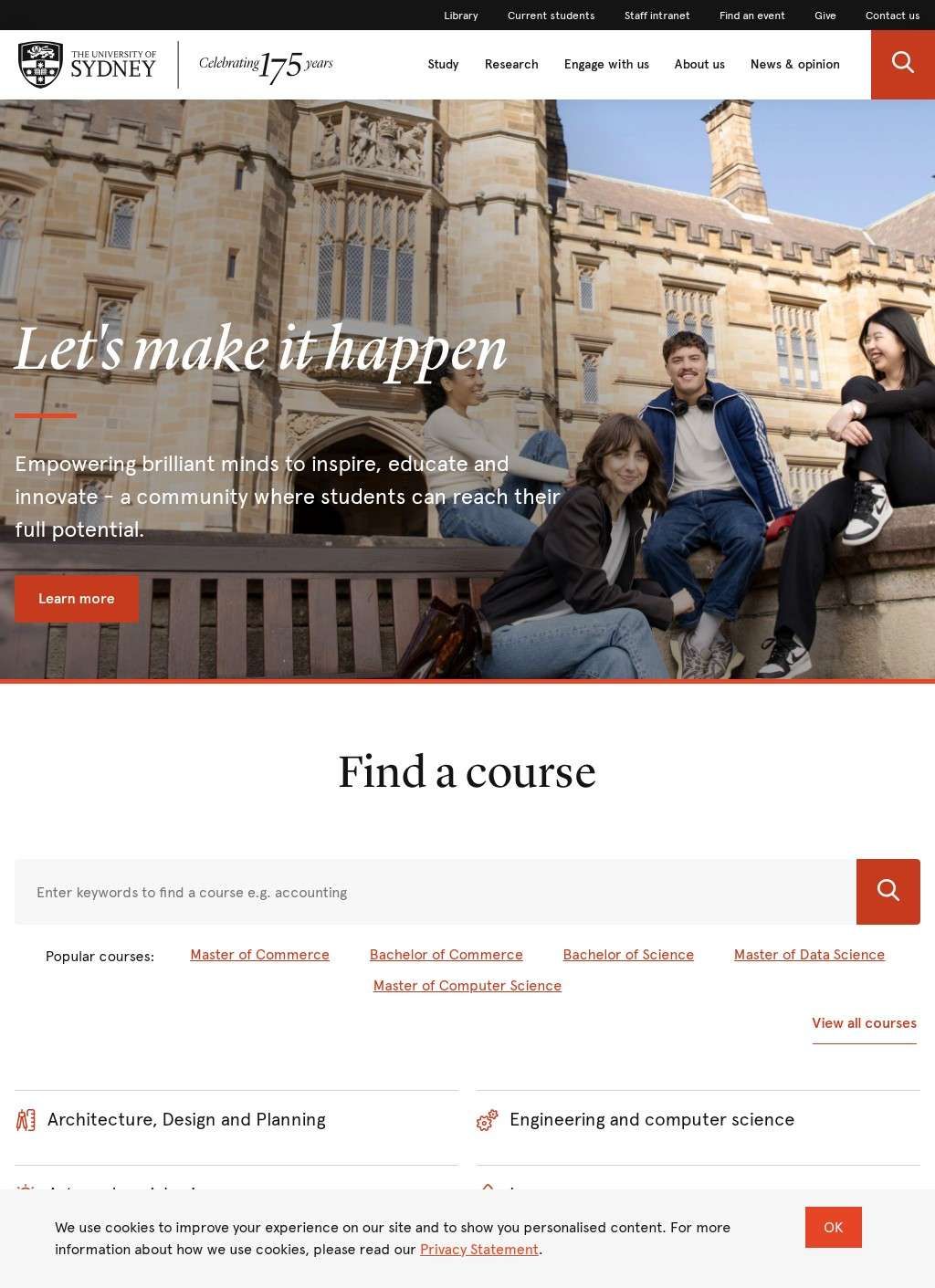
Founded in 1850, The University of Sydney is the oldest university in Australia, and that age shows in the breadth of what the institution now runs. It is a comprehensive research university spread across ten faculties: Architecture, Design and Planning; Arts and Social Sciences; Business; Economics; Education and Social Work; Engineering and Computer Science; Law; Medicine and Health; Music; and Science. The teaching ladder runs the full distance, from undergraduate bachelor's and honours degrees up through graduate certificates and diplomas, coursework and research master's, and doctoral programs. Professional development sits alongside the degree pathways for people already in work.
Research centres across sustainability and health
What gives the site its weight is the research operation behind the teaching. More than 150 research centres and networks run under the umbrella of The University of Sydney, with concentrations in sustainability, chronic disease treatment, and environmental challenges. Those are not vanity labels. The institution ranks 15th globally for sustainability, and ten of its subject areas sit inside the QS global top 25, which says the strength is distributed across disciplines instead of being propped up by a single famous department. The website organises this material so a prospective student can move from a faculty page to the specific centres and degree options under it without losing the thread.
The chronic disease and environmental work in particular ties the centres back to the teaching, so a doctoral candidate or a coursework master's student is not working in isolation from the labs that give the place its name. That linkage between research output and the degrees on offer is one of the clearer arguments for choosing The University of Sydney over a school that lists impressive centres but keeps undergraduates well away from them. The site does a reasonable job of making the connection visible instead of leaving it implied.
Ranking performance across multiple methodologies
The headline numbers are easy to state. The University of Sydney is placed 1st in Australia and 25th in the world in the QS World University Rankings 2026, and it also appears in the US News 2025 to 2026 global rankings. Numbers like these get quoted everywhere, so the more useful question is what they rest on, and here the answer is the spread of top-25 subjects plus the size of the research footprint. A single top placement can be narrow. Ten subjects in the global elite is harder to wave away, and it gives the rankings some substance behind the banner figures. The appearance in both the QS and US News tables means The University of Sydney performs consistently across two methodologies that weigh different things, which is more reassuring than a strong showing in one league table alone.
Worth saying plainly: rankings reward institutions that are already well resourced, and a school sitting near the top of them is partly being measured on inputs it has accumulated over more than a century and a half. The University of Sydney plainly clears that bar, but a prospective student should treat the 25th-in-the-world figure as one data point among several rather than a guarantee that any specific course will suit them. The faculty pages do more to answer that second question than the rankings ever could.
Degree pathways from bachelor to doctoral level
For anyone deciding where to study, the practical layer matters as much as the prestige. The University of Sydney publishes its student services plainly: library access, student portals, scholarship programs, career support, and a steady run of event programming. The scholarship side reaches beyond the obvious, including partnerships with Indonesian institutions, which points to the international intake being treated as a real constituency instead of an afterthought bolted onto a domestic operation. International and domestic students get separate inquiry routes, so the pathways do not blur into one generic form. For an institution drawing a large overseas intake, that separation is the sort of small structural choice that tends to reflect how seriously The University of Sydney takes the experience past the point of enrolment.
Campus location near Sydney hospitals
The main campus sits in Camperdown and Darlington, just south of the city centre, which keeps it close to Sydney's hospitals and the working life of the city. That proximity feeds directly into the Medicine and Health faculty and into the clinical and applied research the university leans on. Geography is doing real work here. A medical school next to major hospitals teaches and researches differently from one stranded on a greenfield site, and the location is part of why the health and science output reads as strong. For students weighing The University of Sydney against rivals in other cities, that urban setting is a concrete point in its favour and not a soft selling line.
The range of degree types deserves a second look, because it is wider than many people assume a single institution can carry well. The University of Sydney awards bachelor's, honours, graduate certificate, graduate diploma, master's, and doctoral qualifications, which means it serves the eighteen-year-old undergraduate and the mid-career professional returning for a short qualification with roughly equal seriousness. The Music faculty and the Law faculty are listed as peers to Engineering and Science, so a creative or professional path is not treated as a junior partner to the lab-based subjects. That balance is one of the more telling things about how the place is built.
Navigation demands of a large institution
If there is a caution to register, it is the familiar one for any institution of this scale: the website has to speak to undergraduates, postgraduate researchers, international applicants, and professional learners all at once, and material aimed at one group can read as noise to another.
A prospective doctoral candidate and a school leaver want very different things, and a site this large inevitably asks each visitor to do some hunting to reach the part that concerns them. That is a navigation cost, not a flaw in the substance, and it adds up. Anyone arriving without a clear sense of which faculty or degree level they want will spend time orienting themselves before the useful pages surface. The breadth that makes The University of Sydney impressive is the same breadth that makes its website hard to take in at a single sitting.
Weighing it up, The University of Sydney comes across as exactly what its history and rankings suggest: a large, genuinely research-led institution with depth spread across ten faculties and real strength in sustainability, health, and a clutch of top-25 subjects. The verdict is not blind enthusiasm, because the sheer scale that makes it strong also makes the site demanding to navigate, and the headline rankings will mean more to some applicants than the day-to-day reality of a given department. The offering is deep for a student or researcher who already knows roughly what they are after, and the evidence on the page supports the standing rather than merely asserting it. That is about as much as a published website can do, and The University of Sydney does it well.