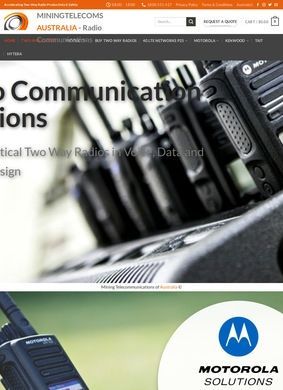
Mining crews have a specific problem with radios: the device has to survive dust, immersion, and the constant threat of ignition in a potentially explosive atmosphere. MiningTelecoms: Two Way Radio Communications addresses that directly with a catalogue built for the rough end of Australian industry. Intrinsically safe handsets, IP68 and MIL-STD-810H sealing, mine-site-exclusive UHF, VHF and 700/800 MHz models, and ACMA approval across the range: these specifications do not appear in a general electronics reseller's brochure. They emerge when a supplier has spent time on actual mine sites and understood what hazardous-area compliance audits require.
Hardware built for hazardous environments
Trading as Mining Telecommunications Australia, the company positions itself as both a dealer and a network integrator. That distinction is worth dwelling on. A dealer sells you the radio; an integrator designs the infrastructure those radios talk over. The brand list spanning Hytera, Kenwood, Tait and Motorola, in portable, mobile and repeater forms, means a buyer does not arrive committed to one manufacturer's ecosystem. That flexibility tends to matter when a site has legacy equipment from two or three vendors already installed.
The hardware end of MiningTelecoms: Two Way Radio Communications is where the listing builds its credibility. Mining, energy and construction are environments where a communications failure is a safety event, not a nuisance, and the emphasis on intrinsically safe units and ruggedised sealing reads like it was written by people who understand what a hazardous-area compliance audit actually involves. The 700/800 MHz and mine-exclusive frequency options are granular enough to suggest genuine familiarity with the sector, beyond a broad sweep at any buyer with a budget.
Alongside the radios sit batteries, accessories and body cameras. The body camera line is an interesting inclusion. It points at security, emergency services and lone-worker scenarios as much as at the underground environment, which rounds out the picture of a supplier expecting to kit out a whole team across multiple roles, not fill a single equipment order.
One question that lingers when reading the sector list is how evenly the depth is distributed. MiningTelecoms: Two Way Radio Communications names mining, energy, construction, healthcare, schools, security, emergency services, agriculture and retail logistics as markets it covers. A radio for a school corridor and a radio for a Pilbara mine are genuinely different engineering problems, and a vendor claiming both has to demonstrate depth in each. The mining and energy claims here are backed by specific hardware detail that gives them substance. The lighter commercial sectors get less texture on the page, which does not mean the capability is absent but does mean the evidence is thinner there.
Network design and trunked systems
Beyond the handsets, MiningTelecoms: Two Way Radio Communications moves into network design, and this is where the company starts to look more like an engineering firm than a reseller. DMR Tier 3 trunked networks and P25 systems are the serious end of fleet radio: these are the architecture a large dispersed workforce needs when radio channels get crowded and channel management has to be automatic. Adding 4G LTE, hybrid networks and 5G deployments alongside the traditional land mobile radio offering reflects where this field is genuinely heading, and a company that can straddle both is more useful to a large operation than one that handles only one side.
Remote sites and satellite connectivity
The remote-connectivity layer adds satellite communications for camps and pipeline operations, Wi-Fi 6 broadband, and NBN-designed networks. For an operation sitting hundreds of kilometres from the nearest tower, satellite is often the only practical answer, and MiningTelecoms: Two Way Radio Communications lists it plainly. The named coverage areas (Karratha, Pilbara and Tasmania) reinforce the remote-site focus.
The IoT material is the section that would need the closest examination before a buyer committed budget to it. Smart agriculture, water monitoring, environmental tracking, freight tracking and building systems are listed under one offering. Each of those is a discipline of its own. A firm with solid radio and network engineering credentials can plausibly extend into sensor and telemetry territory, so the connection is coherent. But whether MiningTelecoms: Two Way Radio Communications handles all of it directly or relies on partners at the edges is a question the site does not settle, and the answer shapes how much of that breadth a procurement team should treat as proven rather than prospective.
Geographic reach is wide and specific. Offices in Brisbane and the Gold Coast, Sydney, Melbourne and Perth give MiningTelecoms: Two Way Radio Communications a presence across four major markets, with shipping extending to Adelaide and the remote Western Australian and Tasmanian sites the equipment is designed for. Four physical locations is a meaningful footprint for a specialist supplier in this space, and it makes the national service claims considerably more believable than a single-warehouse operation could.
Checking the evidence trail
A search for third-party reviews of MiningTelecoms: Two Way Radio Communications turns up no Google or Trustpilot trail, no public accounts of how an installation performed or how the after-sales support handled a fault. That absence is not automatically damning. Specialist industrial suppliers in this market tend to live by tender, reference and direct relationships; their clients are not the type to leave star ratings on consumer review platforms. But it does leave a gap the website cannot fill on its own, however well-stocked the catalogue pages are.
MiningTelecoms: Two Way Radio Communications sits in an uneasy middle ground. The hardware specifics are convincing. The network engineering claims are coherent and consistent with where the industry is heading. The multi-city office presence removes any doubt about whether a real company stands behind the catalogue. What MiningTelecoms: Two Way Radio Communications cannot yet show a stranger is evidence from the people it has equipped: how a DMR Tier 3 rollout performed once it was live, whether a satellite link held up at a remote camp over a wet season, how quickly a fault on a hazardous site got resolved. Those are the questions that separate a credible vendor from a proven one. The published record makes the technical case competently; the operational case is still waiting on public evidence to support it.
Business address
Mining Telecommunications Australia