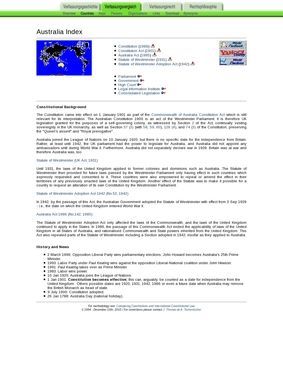
Australia does not have one constitution; it has a small stack of them, and the ICL - Australia Index lays that fact out before anything else. The page gathers the 1988 consolidated Australian Constitution alongside the original Constitution Act of 1901, then adds the Australia Act of 1985 and the Westminster statutes that sit behind the whole arrangement, including the Colonial Laws Validity Act of 1865 and the United Kingdom's own Australia Act of 1986. For anyone who has tried to trace where Australian sovereign legal authority came from and when London finally let go of it, having those documents listed side by side on a single page does real work.
Inside the international constitutional law project
The resource is part of the International Constitutional Law project running on the University of Bern's law faculty server in Switzerland. That host matters in a quiet way: the texts are presented as plain static HTML, with individual provisions linked for navigation, and there is no login wall or paywall sitting between a reader and the primary material. The ICL - Australia Index is one node in a comparative collection covering constitutional texts for more than a hundred countries, so the formatting and structure here mirror what a researcher would find when pulling up France, Brazil, or Japan from the same project. That consistency is the point. Comparative constitutional work depends on being able to read one country's foundational documents in the same shape as another's.
What the ICL - Australia Index does beyond simply hosting the texts is provide context around them. There is a constitutional background narrative and a historical timeline tracing how Australia's constitutional framework developed, from colonial dependency through federation and on to full legislative independence. A student encountering the Australia Act for the first time often has no idea why both an Australian version and a UK version exist, or why a statute from 1865 still gets cited in discussions of constitutional validity. The timeline and background notes answer those questions in the same place the documents live, which spares the reader from chasing the story across separate textbooks.
Tracing constitutional history from federation
The page also curates external links to the institutions that carry the constitution forward in practice: the Parliament, the Federal Government, the High Court, and major Australian legal databases. Pointing a researcher toward the High Court is exactly right, because Australian constitutional meaning is shaped as much by that court's interpretation as by the printed text of the document. Linking the legal databases acknowledges that the static texts on the Bern server are a starting reference, not the live, amended, case-annotated version a practising lawyer would need. The ICL - Australia Index does not pretend to be the last word; it sends you onward to the official Australian sources when you need currency and case law.
It is worth being clear about what kind of tool this is and is not. The ICL - Australia Index is a reference and study resource, built for legal scholars, comparative law researchers, and law students, plus the occasional curious reader trying to understand how a federal constitutional system actually fits together. It is not a news service, it is not interactive, and it is not going to give you commentary on yesterday's ruling. The consolidated text dates from a fixed point, which means someone relying on it for a current legal question would need to confirm later amendments elsewhere. For a reader who understands that limitation, the trade is a fair one: clean access to the foundational documents, organized intelligently, with the historical scaffolding to make sense of them.
What kind of resource is this?
The strength of the ICL - Australia Index sits in its restraint. Constitutional texts can be hard to find in a form that is both authoritative in origin and easy to read on a screen. Government portals often bury foundational documents under layers of navigation or present them as scanned PDFs that resist quick reference. A comparative academic project that puts the marked-up text on one page, with provisions linked and a background note attached, solves a genuinely annoying problem for the people who do this kind of reading regularly. The absence of advertising and tracking, a natural consequence of the university hosting, adds to that.
For a law student preparing for an exam on Australian federalism, the value is immediate. The student can read the constitutional text, follow the timeline through the Constitution Act, the Statute of Westminster era, and the Australia Acts, then jump out to the High Court when a case reference comes up. The ICL - Australia Index arranges its material along the natural path of constitutional study. A researcher comparing Australia's path to independence with, say, Canada's can stay inside the same project and pull up the equivalent index for another country, reading both in the same template.
Using the index for exam preparation
There are genuine limits worth naming plainly. The static content will lag behind any constitutional amendment or significant reinterpretation, and the project depends on whoever maintains it keeping the texts and links current. Dead external links are a perennial hazard for any curated collection that has been online for years, and some pointers to government pages may have moved. None of this undermines the core function. Constitutional texts do not change often, and the historical material is settled by definition. The ICL - Australia Index works best as a stable reference for the documents and their backstory, with the understanding that anything time-sensitive belongs to the official Australian sources it points toward.
Credibility flows from the academic origin and the editorial care visible in the selection. The decision to include the Colonial Laws Validity Act and both Australia Acts, the British and the Australian, shows that whoever built the ICL - Australia Index understood the legal mechanics of how Australia became fully independent, which is not obvious and not something a casual compilation would get right. The pairing of primary text with a narrative explanation and a timeline reflects a teaching sensibility, an awareness that the documents alone are inert without the story that connects them. That is the difference between a file repository and a reference tool, and the ICL - Australia Index lands on the right side of it.
Editorial care behind document selection
A search turns up no consumer reviews or ratings for the ICL - Australia Index on any major platform. That is expected for an academic legal reference site; the feedback loop is library syllabuses and citation lists, not star ratings. The project's credibility is institutional, and the University of Bern affiliation carries more meaning for that audience than any aggregate score would.
Comparing constitutions across countries
The comparative framing is the feature that sets the ICL - Australia Index apart from a simple government text dump. Reading the Australian Constitution in isolation tells you how Australia is governed. Reading it inside a project that presents a hundred-plus constitutions in a shared structure invites a different kind of thinking: why Australia chose a federal model, how its relationship with Westminster differs from other former colonies, what its founders borrowed and what they rejected. The page itself is modest, but the Bern project's scope gives it lasting usefulness, and the ICL - Australia Index holds its position in that collection by doing the document selection and contextual framing with evident care.