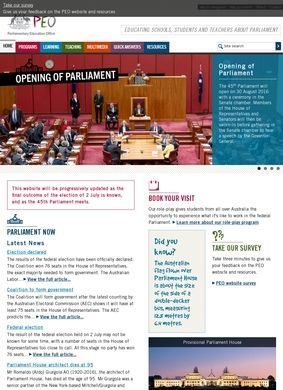
Parliamentary Education Office is the education arm of the Parliament of Australia, a parliamentary department charged with teaching people across the country how their system of government works and, with any luck, building some enthusiasm for it along the way. Civics is a hard sell. Its audience is the classroom: teachers, students, and the single lesson that has to explain how a bill becomes law without losing thirty teenagers halfway through.
The Parliamentary Education Office splits its material into three plain-language areas, understanding Parliament, teaching Parliament, and connecting with the office directly, and each area is built to do a different job for a different reader.
Explaining how Parliament works
The first two areas carry most of the teaching load, and the division between them is sensible. One explains the machinery of Parliament to whoever wants to understand it; the other hands teachers the finished tools to run a lesson on that machinery. Between them they cover the federal, state and local layers of government and the people who sit at the top of each.
The Parliamentary Education Office treats explaining and teaching as two separate jobs, because a student browsing for an answer and a teacher planning a Tuesday morning class need very different things, and the split shows in how each area is written.
Understand our Parliament
The "Understand our Parliament" section is the explainer, pitched at anyone who wants to know how the system runs. It lays out the roles and responsibilities across federal, state and local government, the three tiers that Australians vote for and often confuse, and it keeps the language plain enough for a school student to follow without a teacher standing over the page. Local government, the tier most people ignore until a pothole or a rates notice forces the issue, gets covered alongside the federal and state levels.
Its sharpest piece is an interactive feature that follows one bill, a proposal to lower the voting age to 16, all the way through Parliament. That is a shrewd choice of example. A voting-age bill is something a sixteen-year-old has a direct personal stake in, so the dry procedural steps of readings, debate and committee scrutiny suddenly carry a reason to matter, and the Parliamentary Education Office clearly picked it on purpose.
Following the same bill from first reading to assent also does something a static diagram cannot: it shows the sequence as a sequence, so a student sees that the order is deliberate and each stage has a purpose. A companion strand, "Parliament and its people," profiles the current leaders, the Presiding Officers and the head of state, which keeps the institution from reading as a row of empty chairs and job titles.
Students get to see who does what, and why the order of the steps is the whole point, which is the Parliamentary Education Office's underlying pitch.
Teach our Parliament
"Teach our Parliament" is the working teacher's shelf. It gathers printed and digital resources for both teachers and students, so a class can use physical handouts or screens depending on the room, and it adds a "Professional learning" program aimed at practising teachers and the pre-service teachers still training at university. The mix of printed and digital also means a lesson survives a broken projector or a patchy wifi connection, which any teacher who has lost a class to buffering will appreciate.
Building the training of teachers into the same offering is a smart move, since a teacher who understands the material teaches it with more confidence than one reading a worksheet cold.
Two facts about the Parliamentary Education Office material here stand above the rest: it is free, and it is aligned to version 9.0 of the Australian Curriculum. Free removes the budget conversation that quietly sinks so much good classroom material before it is ever tried. For a school in a stretched district, free is close to the whole ballgame, and a national body absorbing that cost is one of the clearer public goods on display here.
Curriculum alignment matters just as much, because it means a teacher can drop a Parliamentary Education Office resource straight into a unit plan without reverse-engineering how it meets the required standards. For someone marking papers at nine at night, that saved step is the difference between using a resource and closing the tab.
Getting classrooms into the room
The third area, "Connect with the PEO," is where the Parliamentary Education Office stops being a static library and starts acting like a correspondent.
It exists to keep a live line open between the Parliamentary Education Office and a classroom anywhere in the country, and it works through a handful of specific tools that invite the user to do something instead of just read. None of this reads like an entry in a business directory built around opening hours and star counts; the office has no custom to chase and nothing to sell, so what follows is simply an account of the tools themselves. The design assumes a user who is bored by a lecture and won over by doing.
Questions on notice and session notes
Two of those tools stand out. "Questions on Notice" is an interactive feature that lets a user put a genuine question about the Australian Parliament and how the system of government works, borrowing its name from the real parliamentary practice where members question ministers on the record. Submitting a real question pulls a student from passive reading into active curiosity, and curiosity is most of the battle in civics.
It turns a one-way resource into something closer to a conversation, which is rare for a government explainer. "Session Notes" is a newsletter for teachers, the sort of regular contact that stops a resource from being downloaded once and then forgotten in a folder.
The Parliamentary Education Office also keeps an "at a glance" overview that maps the programs, resources and projects in one place, useful when a teacher has fifteen minutes to find something usable. A "Get to know the PEO" page describes the team, experienced educators who pair knowledge of parliamentary process with real classroom pedagogy. Educators who hold both halves of that job are harder to find than they ought to be, and having them write the material is a quiet advantage that shows in how the resources are pitched.
That pairing is the combination the Parliamentary Education Office is betting on, and it answers a common weakness in civics material: plenty of it is written by people who know the subject inside out but have never had to hold the attention of a room full of fourteen-year-olds.
Simulated parliament and national reach
The programs go past reading and clicking. The Parliamentary Education Office runs immersive, experiential activities, including simulated-parliament exercises where students take the roles and push a mock bill through the motions themselves, standing to speak, voting, and playing the part of a member or a minister. A student who has stood up and argued a mock amendment tends to remember how a committee stage works long after the worksheet is lost.
Acting out a debate lands differently than reading about one, and for a subject that can feel remote from a teenager's everyday life, the role-play is probably the office's most effective instrument.
These programs reach schools, teachers and students nationally, so a school in a remote country town gets the same access to the material as one in a major city. Distance usually decides who gets good civics teaching and who does not, and a national program flattens that a little. Everything the Parliamentary Education Office puts out here is free, and each resource is mapped to version 9.0 of the Australian Curriculum.