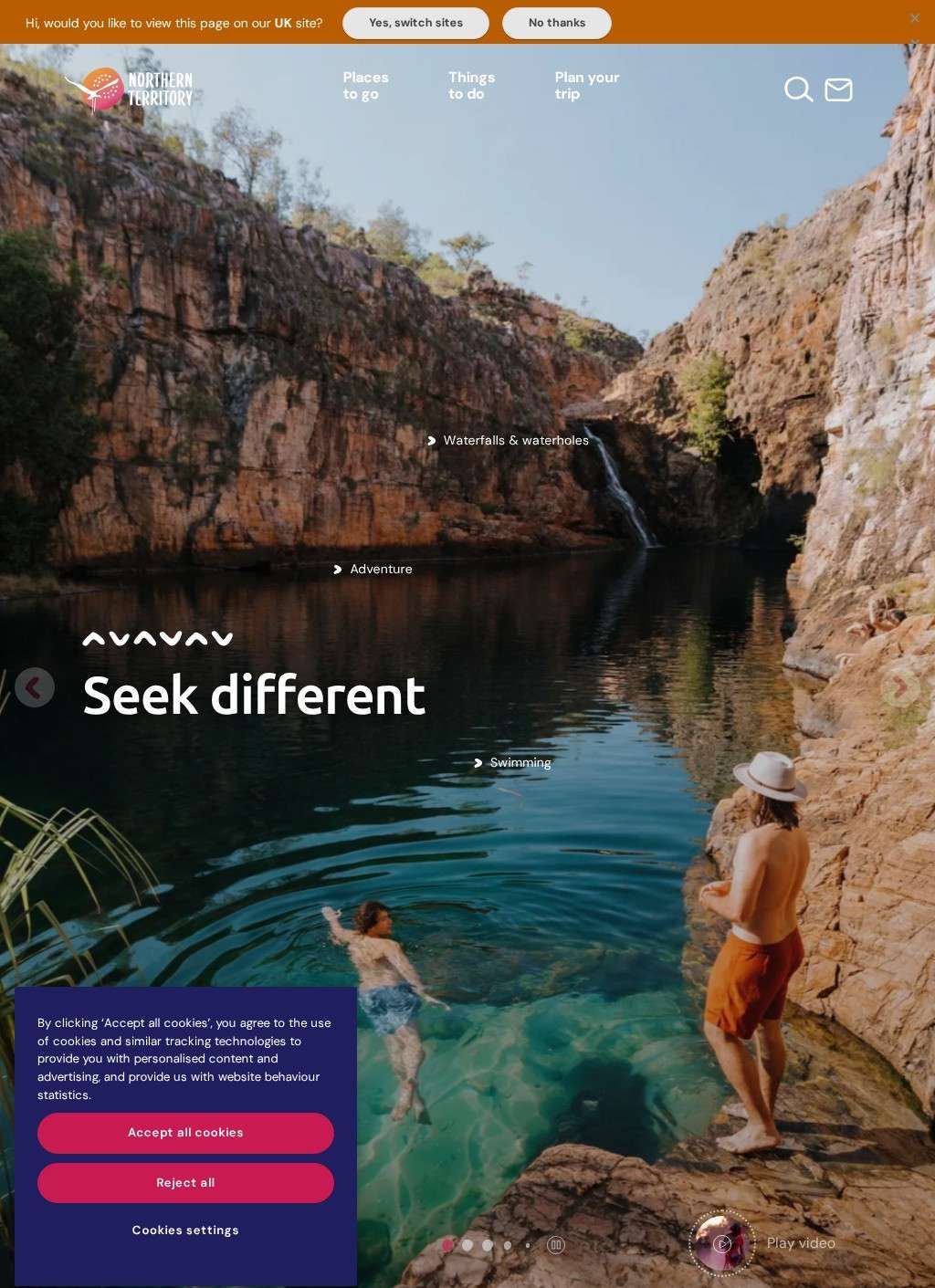
Someone planning a first trip to the Top End usually hits the same wall within ten minutes of searching: the Northern Territory is enormous, the distances are deceptive, and the season you travel in changes almost everything about what you can do. A road that is open and dusty in July can be underwater in February. A waterhole safe to swim one month is a saltwater crocodile habitat the next. Northern Territory Tourism builds its whole site around that exact confusion, and it does a respectable job of turning a vague "I want to see Uluru and maybe Darwin" into something resembling a workable plan.
Geography splits the territory into two distinct regions
The structure starts with geography, which is the right call. The territory is split into two halves that feel like different countries. The Top End covers Darwin, Kakadu National Park, Katherine Gorge and Arnhem Land, all monsoon-fed and tropical. The Red Centre holds Alice Springs, Uluru, Tennant Creek and the Barkly region, dry and red and far more remote than most visitors expect. By making that distinction up front, Northern Territory Tourism stops people from assuming Darwin and Uluru are a short hop apart. They are roughly fifteen hundred kilometres of desert apart, and pretending otherwise wrecks itineraries. Northern Territory Tourism leans into the divide instead of papering over it.
Experience categories guide planning across the landscape
From there the content fans out into experience categories, and this is where Northern Territory Tourism becomes a real planning tool. Aboriginal cultural experiences get their own thread, and that placement is right in a place where Indigenous land, art and history are the central story rather than a side attraction. There are sections on wildlife encounters, adventure activities, food and drink, luxury stays, road trips and the national parks. The road trip material reads like it was written by people who have driven these routes, with self-drive guidance sitting alongside information on flights and The Ghan, the rail line that runs the spine of the continent. A traveller who has never considered that the journey itself might be the holiday gets nudged toward that idea without much sales pressure.
Interactive tools match travelers to suitable itineraries
The interactive holiday quiz is the kind of feature that could easily have been a gimmick, and I went in expecting to dismiss it. It matches travellers to suggested itineraries based on their answers, and while it is no substitute for real research, it gives an undecided visitor a starting frame instead of a blank map. That is genuinely useful here, where the audience spans domestic Australians who know the basics and international visitors who arrive with almost no mental model of the place. Both groups are catered for across budget levels, from backpacker trips to high-end lodges near Uluru. Accommodation resources sit alongside the quiz, so a visitor who lands on a suggested itinerary can immediately see where they might stay along it.
Remote areas receive equal coverage with popular stops
Northern Territory Tourism does not treat Darwin as the only worthwhile stop, even though Darwin is the obvious gateway and the busiest entry point. Kakadu, Katherine, Arnhem Land and the parks of the Red Centre all get substantive coverage, with enough depth to help a planner decide whether a place deserves a day or a week. Tennant Creek and the Barkly region, which most itineraries skip entirely, still get a fair hearing here. That even-handedness is one of the quieter strengths of the site, and it pays off for anyone trying to move beyond the postcard highlights into parts of the territory that fewer visitors reach.
Seasonal and weather information shapes trip timing
Where Northern Territory Tourism becomes more than a glossy brochure is the practical layer underneath the inspiration. Seasonal and weather guides spell out the wet and dry season divide, which in this part of Australia is the single most important piece of trip-planning knowledge. The site does not hide the awkward truth that visiting in the wrong season can mean closed roads, flooded parks and oppressive humidity. Safety advisories are present too, and given that the territory contains genuine hazards, from crocodiles to extreme heat to vast stretches with no phone signal, that information is not decoration. A government tourism body has every incentive to make the place sound effortless. To its credit, Northern Territory Tourism tells you when to be careful.
Editorial features support repeat visits to the site
The editorial content rounds things out and gives the site repeat-visit value. There are top-ten activity lists, swimming-spot guides that flag where it is and is not safe to get in the water, and an events calendar that covers fixtures like the Garma Festival and the Darwin Aboriginal Art Fair. Those are not throwaway listings. The Garma Festival is one of the most significant Indigenous cultural gatherings in the country, and surfacing it prominently shows that Northern Territory Tourism treats the territory's living culture as a headline draw, not an afterthought. The event coverage gives a reason to come back and check timing before booking, which is exactly what a destination portal should encourage.
Booking partnerships connect readers to tour operators
On the booking side, Northern Territory Tourism stops short of being a full travel agency, and that is a sensible boundary. It curates deals and packages from third-party operators, naming NT Now, AAT Kings and Ayers Rock Resort, so a visitor can move from reading about a region to pricing a trip without too much friction. The handoff to commercial operators is transparent enough that nobody should be confused about who they are buying from. This keeps the portal in its proper lane: it informs and points, then lets the operators transact.
Logistical depth falls short for detailed planners
There is one reservation, and it applies to almost every official tourism site of this size. The inspirational framing occasionally outpaces the hard logistics a serious planner wants. Someone trying to nail down precise driving times, fuel-stop spacing on remote routes, or the fine print of park permits for Arnhem Land will need to dig into more specialised sources or contact operators directly. The site is excellent at the "what and why" and good but not exhaustive on the granular "how".
What lifts Northern Territory Tourism above a generic promotional shell is that it respects the place it represents. The territory is harsh, remote and culturally layered, and the site reflects that instead of sanding it down into a postcard. The emphasis on Aboriginal experiences and festivals, the honest seasonal warnings, the acknowledgement of distance and isolation, all of it reads as genuine local knowledge rather than stock copy. For a first-time visitor, that honesty is more valuable than another round of superlatives.
As a verdict, Northern Territory Tourism is a strong, well-organised starting point and a slightly weaker finishing one. It will take you from "I have heard Uluru is impressive" to a structured sense of which region to visit, in which season, doing which kind of trip, and it will hand you off to operators when you are ready to book. The two-region split, the quiz, the seasonal guidance and the cultural event coverage are the most practically useful parts. The deeper logistical planning is where the coverage runs out, and detail-driven travellers will outgrow it before their itinerary is locked. Most people researching the Northern Territory will find this the obvious first stop, and a credible one. It is honest enough about the hard parts that you will not arrive unprepared.