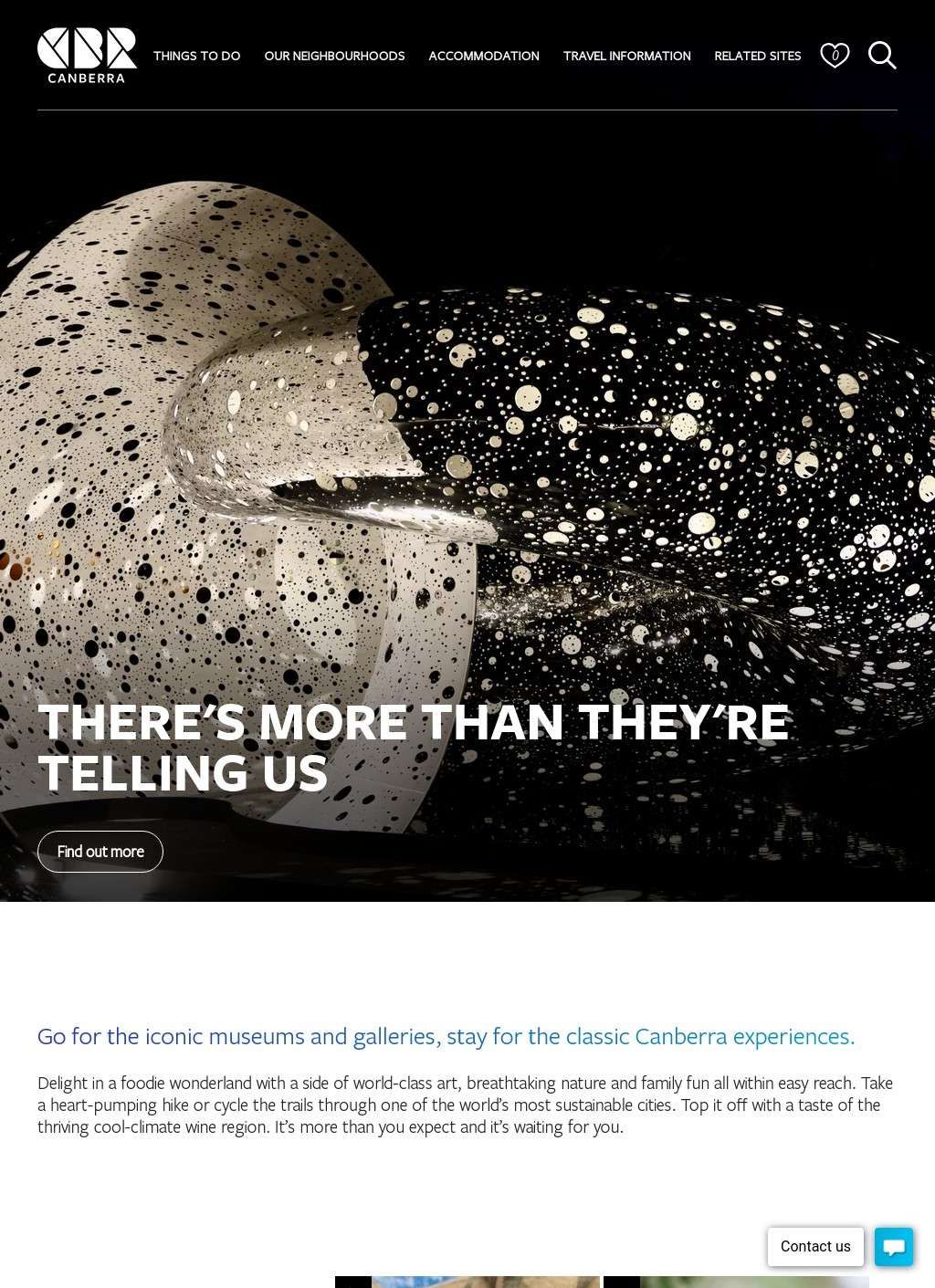
VisitCanberra is the official tourism portal run by the ACT Government for Australia's capital, and it works as the planning hub for anyone heading to Canberra for a holiday, a long weekend, or a specific event. The site is built around the broad questions a traveller asks: what is there to do, where to stay, how to get there, and what is on while visiting. Each of those gets its own well-developed section, and the structure stays sensible once you start clicking through.
Things to do beyond monuments
The Things To Do area carries the most coverage, and it spreads further than the usual list of headline attractions. There are the museums and galleries you would expect from a capital city, but VisitCanberra pushes past them into First Nations cultural experiences, family activities, and a decent run of outdoor options: cycling trails, recreation on and around the lake, and water-based activities. The wine region and food tours get their own attention too, which fits a city that sits close to cool-climate vineyards. A visitor who thinks of Canberra purely as a place of monuments and institutions will find the editorial pushing back against that, pointing toward the bushland, the cellar doors, and the day trips on the edge of the territory.
Neighbourhood guides and accommodation search
Where VisitCanberra becomes genuinely useful, beyond inspiration, is the practical layer underneath. The neighbourhood guides split the city into Inner North, Inner South, North Canberra, and South Canberra, which is a sane way to break down a place that does not have one obvious tourist strip. Someone deciding where to base themselves can read about the character of each area, then jump straight to the accommodation search and listings, which sit close enough that the transition from reading to booking is short. That linkage between guidance and the act of booking is handled cleanly across the portal.
Events and festivals as planning anchors
Events are treated as a first-class part of the planning rather than an afterthought. VisitCanberra keeps an event and festival calendar with booking links, so a trip can be built around a particular festival or exhibition instead of being slotted in afterward. This is more consequential in Canberra than in many cities, because so much of what draws people there is timed: rotating exhibitions at the national institutions, seasonal highlights, and festivals that come and go through the year. The site leans into that rhythm, surfacing what is current and feeding it into the calendar. That approach gives VisitCanberra an editorial purpose that a flat directory of attractions would not have.
Transport information for arrival and movement
Getting to and around the city is covered in its own right. VisitCanberra provides transport and travel information for arrival and for moving about once you are there. For a capital that many Australians reach by road or short flight, and that international visitors often tack onto a wider trip, having this spelled out saves a lot of guesswork. The Guides to Canberra, available to browse online or download, give a more curated version of the same material, which suits travellers who prefer to plan offline or carry something on the road.
Editorial voice and practical coverage
The editorial articles with recommendations are a pleasant surprise for an official site, which often default to flat listings. Here the writing does some work, pulling together themed suggestions and seasonal angles so VisitCanberra reads less like a database and more like a guide with a point of view. Whether that voice is consistent across the whole site, or only present in the featured pieces, is harder to judge from the outside. A reader who values that editorial tone might find it less pronounced once they drill into the deeper listings, where the writing tends to be drier and more categorical. The gap between the curated front-end material and the back-end directory entries is noticeable, and VisitCanberra would benefit from closing it.
Links to government portals for other audiences
VisitCanberra also positions itself inside a wider family of ACT Government portals, linking out to sibling sites that cover studying, working, living, and doing business in Canberra. For a tourist this is mostly peripheral, though it is genuinely handy for the slice of visitors who come to look and end up considering a move, or who are visiting for work and want to understand the place beyond the holiday lens. The connection is logical, since the same government body wants a single front door to the city across very different audiences. It does mean a visitor occasionally has to check they are still on the tourism portal and have not drifted into the relocation or business material, which serve a different purpose entirely.
Taken as a whole, VisitCanberra covers the full arc of a trip from first idea to packed bag, and it does so with more editorial care than a typical government tourism portal. The Things To Do depth, the neighbourhood breakdown, the events calendar, and the transport detail together give a traveller almost everything needed to plan without leaving the site. The First Nations content and the food-and-wine focus suggest a portal trying to represent the city honestly rather than just listing its landmarks.
Maintaining accuracy across many sections
The harder question is depth versus breadth. A site that promises this much across attractions, accommodation, events, neighbourhoods, transport, downloadable guides, and a visitor information centre has a lot of surface to keep accurate and meaningful. Breadth is easy to claim and expensive to maintain.
How often content gets updated
What VisitCanberra does not answer is how often each of those sections is refreshed. A government tourism portal lives or dies on freshness: an exhibition that has closed, a festival date that has slipped, or an accommodation listing that is out of date does more damage on an official site than on a casual blog, because visitors arrive trusting it completely. On the published evidence, VisitCanberra covers the right ground, structures it well, and brings more editorial care than most official portals manage. The freshness question is the one gap the site cannot answer from its own pages.