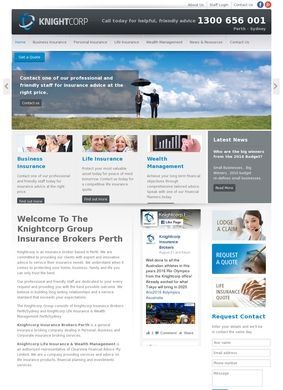
Knightcorp is an Australian insurance brokerage that arranges business cover and advises on the risks sitting behind it. The fuller trading name is Knightcorp Insurance Brokers, and the operation runs from offices in Perth, Sydney and Adelaide, aimed squarely at companies rather than households. Above its offering it prints a tagline, "Forerunners in the unforeseeable," which tells you it wants to be read as a specialist in the awkward, low-probability risks that generic insurers shy away from.
The list of what Knightcorp will insure is long, and it leans commercial from top to bottom.
The policies on offer
Standard business lines are all present: workers compensation, public and products liability, motor fleet and trade cover, plant and equipment, professional and medical risk. Construction gets its own product for contract works, useful on job sites where a half-finished build carries risk that a normal property policy will not touch.
Farming is covered separately too, and the dedicated plant and equipment line reads as aimed at the mining, construction and agriculture clients the site keeps returning to. Motor fleet cover, rather than single-vehicle policies, points the same way: this is built for businesses running many assets, not one person's car. For a broker that claims to serve everything from technology to mining, breadth like this is the baseline you would expect, and Knightcorp meets it.
Cover for the harder-to-place risks
Where it gets more interesting is the specialist end. Cyber insurance, directors and officers cover, marine and cargo, and surety bonds bundled with trade credit insurance are not lines every general broker handles well, and Knightcorp keeping them front and centre backs up the "unforeseeable" framing. Cyber cover in particular has shifted from optional to close to essential for any business holding customer data, and treating it as a headline line reads the market correctly.
Trade credit is a niche skill: it protects a business against customers who do not pay, and it needs an underwriter who understands the client's debtor book. Listing it alongside the routine policies suggests a broker comfortable past the easy, high-volume products.
Advice, claims and the consulting side
Insurance is only half of what Knightcorp puts on the table. The other half is advisory, and the spread is wide: risk management and workplace health and safety guidance, risk analytics and benchmarking, business interruption analysis with its own calculators, global insurance placement, premium funding, and an employee benefits arm.
Premium funding is a quietly useful one for cash-flow reasons: it lets a company spread the cost of an annual premium instead of paying it in a single lump, and global insurance placement matters to any Australian firm with operations or suppliers offshore. A business interruption calculator is a practical touch. Working out how long a company could survive with its doors shut, and insuring to that number, is exactly the sum most owners get wrong, and a tool that forces the calculation is worth having.
Claims advocacy and contract review
Two services here are worth singling out. Claims advocacy means the broker fights the client's corner when a claim is disputed, which is the moment insurance either proves its worth or falls apart, and it is a service that separates an active broker from a policy vending machine.
Contract review is the quieter one: checking the insurance and liability clauses in a commercial contract before it is signed, so a client does not accidentally carry a risk they were never paid to hold. Neither is flashy. Both are the sort of unglamorous work that saves a company real money when something goes wrong. For a mid-sized company without an in-house risk manager, that pairing is arguably the best reason to use Knightcorp at all.
Reach, offices and outside opinion
Knightcorp says it works across a long list of sectors: technology, construction, transport and logistics, mining and resources, agriculture, healthcare, hospitality, financial services, and by its own count more than sixteen others. That is either genuine range or a wide net, and a prospective client should ask which. Risk analytics and benchmarking, if it does what the name suggests, would let a client compare its cover and premiums against similar businesses, which is the sort of thing larger firms pay consultants for and smaller ones rarely get to see.
The site also cites an 86 percent employee engagement figure, which is an internal number about staff satisfaction, not a customer outcome, so it says more about the workplace than about how claims get handled.
Contact with Knightcorp is straightforward. A national 1300 phone line and an email address sit plainly on the site, backed by the three office locations, so reaching a real person takes no effort. The three offices are physical addresses in three states, which for a broker signals a national reach that many single-city rivals cannot match. That is exactly what you want from a broker handling something as time-sensitive as a claim.
The weak spot is independent feedback. A Yelp listing for Knightcorp Insurance Brokers exists, tied to a Perth address, but it carries no star rating and no review count. Searches across Google, Trustpilot, Facebook, Tripadvisor, Glassdoor and the BBB come back empty as well, and the review-shaped results that do surface belong either to unrelated firms with similar names or to Knightcorp's own pages about reviewing insurance policies.
So there is effectively no public verdict from actual clients to weigh. For a brokerage of this apparent size and spread, I find that quietly surprising, and it is the one thing a careful buyer cannot check before picking up the phone.
So the picture is mixed but readable. The offering is deep and clearly commercial, the specialist lines and the advisory work give Knightcorp a real reason to exist beyond selling standard policies, and the contact side is clean. Against that sits a near-total absence of client reviews anywhere public, which for an insurance broker, a business built on trust at the worst moment, is a fair thing to hold against it until word of mouth or a first meeting fills the gap.