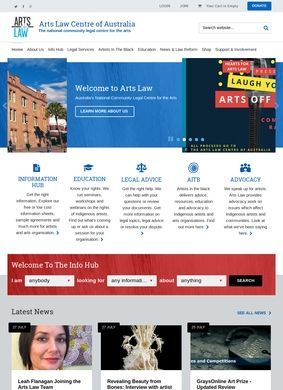
Where does an Australian musician turn when a record label sends over a contract full of clauses she cannot parse, and she has no budget for a commercial lawyer to read it? For a lot of creative people stuck in exactly that spot, the answer has been the Arts Law Centre of Australia, a registered not-for-profit charity that calls itself the country's only national community legal centre built around the arts. The site lays out plainly who it helps and how, and the offering is narrow in scope but deep in the one thing it does.
Legal advice for creative professionals
The core is legal advice and document review for creative professionals, and the list of who that covers is wide: artists, writers, musicians, performers, filmmakers, designers, and the organisations that employ or represent them. The advice is free or low-cost, which is the whole reason a centre like this needs to exist. A freelance illustrator with a licensing dispute is rarely going to pay hundreds of dollars an hour to learn whether a clause is normal, so a service that reads the contract and explains it changes the calculation entirely. The Arts Law Centre of Australia is set up to absorb that cost so the artist does not have to.
Copyright, contracts, intellectual property
The subject matter is the part working creatives will recognise from their own headaches. The centre handles copyright, contracts, intellectual property, moral rights, defamation, and questions about business structures, essentially the legal problems that follow an artist around whether or not they ever expected to deal with the law. Moral rights in particular is a corner most general practitioners barely touch, and seeing it named plainly shows that the people answering queries know the territory their callers live in. The Arts Law Centre of Australia is built for those recurring arts-specific snags, not for general legal work.
Templates, information sheets, subscription library
Beyond one-on-one advice there is a library of practical material. Contract templates and sample agreements hand an artist a starting draft instead of a blank page, and information sheets cover a broad spread of arts law topics so someone can read up before ever submitting a question. A template you can adapt yourself answers the simple cases, and the advice line is left free for the genuinely tricky ones. An extended template library sits behind a subscription, which is a fair way for a charity to fund the free tier without locking the basics away.
Seminars, workshops, webinars
Education runs alongside the advice. The Arts Law Centre of Australia puts on seminars, workshops, and webinars, the sort of thing that turns a one-off legal scare into something an artist can understand for next time. A lot of trouble in creative careers comes from not knowing the question to ask in the first place, and teaching the shape of copyright and contracts before a crisis lands is cheaper for everyone than untangling the mess afterward.
Programs for Aboriginal artists and disabled creators
Two programs stand out for reaching people the law usually leaves behind. Artists in the Black is a dedicated stream of legal support for Aboriginal and Torres Strait Islander artists, a group whose work raises specific and serious questions around cultural rights and ownership that a generic service would fumble. Indigenous cultural and intellectual property sits awkwardly inside mainstream copyright law, and a stream staffed to understand that context beats generic advice stretched to fit. The Arts Law Centre of Australia also provides resources tailored to artists with disabilities. Neither is a token line; each is a named program with its own focus, and that says a fair amount about where the organisation puts its attention.
Advocacy on arts-related legal policy
There is an advocacy side too. The Arts Law Centre of Australia works on arts-related legal and policy issues at the national level, which means it does more than answer individual queries: it tries to shape the rules those queries keep running into. For an artist that is a slower benefit, but it is the difference between treating symptoms and arguing about the underlying law. Part of the work happens upstream, where the conditions that make legal trouble common in creative life get set.
Single intake channel through online form
One practical thing is worth flagging before anyone goes looking. Legal queries go through a single channel, an online application form. The centre does not take them by email, by post, or through social media. That is a deliberate funnel, and it is worth knowing in advance so you do not waste time hunting for a faster door that does not open. For a charity with limited capacity, one controlled form keeps the queue orderly and lets a small team triage requests from a population spread across an entire continent. An artist more comfortable explaining a problem out loud than typing it will feel that friction.
Limited public ratings or reviews
Searches across review platforms turn up very little in the way of public ratings or user comments. The Arts Law Centre of Australia does not have a Google Business profile loaded with reviews, and no Trustpilot entries came up either. That absence is not unusual for a charity working in a legal context; clients dealing with contract disputes are unlikely to leave public feedback, and the organisation's standing in the arts sector comes more from decades of operation and its listed partnerships than from any rating count.
Who this service suits best
Who is this genuinely for? It helps to be honest about the edges. This is not a service for a large production company with its own legal department, and it is not a general legal clinic. The Arts Law Centre of Australia is built for the individual creator and the small arts organisation, the people for whom a few hundred dollars of legal cost is the thing standing between them and a fair deal. Read against that purpose, the offering is well matched. Templates handle the routine, the advice line handles the unusual, the seminars spread understanding, and the targeted programs reach communities mainstream legal help tends to miss.
How the charity structures free resources
The mix also reflects the realities of running a charity. Free advice has to be rationed somehow, and the Arts Law Centre of Australia rations it through structure: self-serve information sheets first, templates next, a paid tier for the heavier template library, and human advice channelled through that one form. The site is upfront about which parts cost money and which do not, so an artist can work out fairly quickly whether their problem is one the free resources solve or one that needs the application form. The Arts Law Centre of Australia keeps those boundaries clear, more useful than a vague promise of help.
What is on offer is coherent, specialised, and aimed squarely at people the commercial legal market underserves. The copyright and moral rights focus is genuinely useful to the working artist, the Artists in the Black program gives the Arts Law Centre of Australia a purpose few other bodies cover, and the template-plus-advice structure makes limited free help stretch further. The single intake channel is the one friction worth knowing about in advance, though the reasoning behind it is plain enough. Set against the breadth of what is provided, it is a small thing, and the overall picture is of a service doing exactly what it says it does.