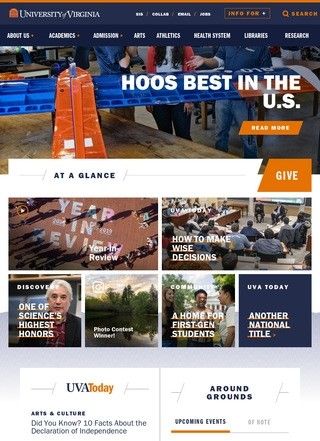
Prospective students, working physicians, and curious members of the public are all plausible visitors to the University of Virginia website, and the site knows it. Built to serve a wide range of audiences at once, it routes applicants toward admissions, enrolled students toward registration and coursework, faculty and staff toward their working tools, and alumni toward a thread back to Charlottesville. Founded in 1819 by Thomas Jefferson, the institution carries a long academic record, and the site treats that breadth as a navigation problem more than a marketing one.
Degree paths across schools and formats
The academic core is the obvious starting point. Degrees run across undergraduate, graduate, and professional levels, spread over schools that include liberal arts, engineering, business, law, medicine, education, and architecture. The University of Virginia does not stop at the standard residential model. Online learning, continuing and executive education, a compressed January Term, and Summer Session courses all sit alongside the regular calendar. A student looking for a non-traditional path, or a professional wanting a shorter executive format, can find an entry point without leaving the main site.
Reaching different types of visitors
That range changes who the site is for in practice. A high schooler weighing a four-year degree and a mid-career manager hunting an executive course are reading the same domain for very different reasons, and the University of Virginia has to answer both. The summer and January offerings widen the audience further, pulling in students from elsewhere who want a single term. The site spends real effort labelling all these paths, and on the whole it succeeds.
Checking student information systems
Where the site proves its usefulness to current students is the operational layer. The University of Virginia runs a Student Information System for registration and records, the UVACanvas platform for coursework, university email, and a searchable people directory. These are the unglamorous tools that decide whether a term goes smoothly, and having them surfaced from the same hub matters to anyone who lives inside them daily. An academic calendar and a job listings portal round out the day-to-day utility, giving the University of Virginia's site a dual character: recruiting front and working campus infrastructure.
Guiding applicants from visit to enrollment
For applicants, campus visit information and links to admissions paths give a concrete next step. The structure is sensible: the marketing-facing material and the working systems are connected, so someone who arrives to browse can move toward applying, and someone already enrolled can drop straight into the platforms they need. Keeping those systems close to the homepage, rather than buried behind a login wall, is a small sign of a site designed around how people use it day to day.
Research themes and university institutes
Research gets real attention, and the framing is specific. The University of Virginia organizes its work around five strategic themes: Brain and Neuroscience, Democracy, Digital Technology and Society, Environmental Resilience, and Precision Medicine and Health. Six pan-university institutes at the University of Virginia back that effort, covering biocomplexity, brain science, environment, democracy, biotechnology, and national security. For a prospective graduate student or a research partner, this section is worth reading closely, because it tells you where the institution is putting weight. Naming themes instead of listing every department is a clearer way to say it.
Health system and top-ranked hospital
The medical side is substantial. The University of Virginia operates the UVA Health System, which includes University Medical Center, named the top hospital in Virginia by Newsweek for 2025. That is not a minor footnote, and it changes how the medicine and health-related research themes read, since the clinical operation and the academic mission are tied together. A patient, a medical applicant, and a health researcher are all plausible visitors to that part of the site, and each is pointed somewhere different.
Rankings that measure student success
The rankings the site leans on are concrete. Forbes placed it as the top college in Virginia for 2024 to 2025, and U.S. News ranked the University of Virginia first among public universities for graduation rate for 2026. Graduation rate is a more telling number than a headline prestige score, because it speaks to whether students who enroll finish. Foregrounding that figure says something about what the institution wants to be measured on, and it is a harder metric to game than reputation surveys.
Beyond academics into campus life
Beyond academics and medicine, the site covers UVA Libraries, Arts, Athletics, and Student Life. These sections fill in the texture of being on campus, the parts of university life that do not appear on a transcript but shape the experience. Alumni resources get their own links too, closing the loop from prospective student to graduate. The full arc of a relationship with the institution is mapped on a single domain, which is more than many large universities manage to do cleanly.
The honest tension sits in that very breadth. A site asked to be a recruiting brochure, a course portal, a hospital front door, a research hub, and an alumni home all at once risks serving each audience adequately without fully satisfying any of them. The University of Virginia clearly has depth behind every section, and the strategic themes and graduation-rate ranking point to an institution confident about its priorities. Whether a first-time visitor can move from a sprawling homepage to the one thing they came for without getting lost is harder to judge from the outside, but the underlying material is there and the architecture mostly supports it.