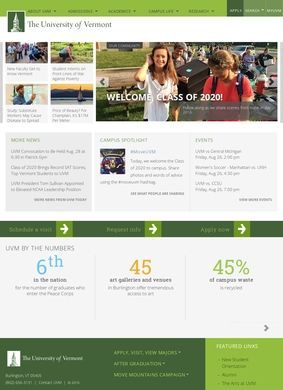
Burlington, Vermont is not a place most people associate with a sprawling research university, yet that is exactly what sits at the top of the hill. Founded in 1791, The University of Vermont runs nine colleges and schools covering ground from agriculture and life sciences through engineering, nursing and health sciences, education and social services, and on to the Larner College of Medicine. The Grossman School of Business and the Rubenstein School of Environment and Natural Resources sit alongside a College of Arts and Sciences and a dedicated Graduate College. That is a wide academic base for a school this size, and a prospective student picking a direction is choosing from a full menu rather than a handful of narrow tracks.
Nine colleges spanning agriculture through medicine
The numbers behind The University of Vermont's catalog are concrete. More than 100 bachelor's degree programs, plus minors, master's and doctoral degrees, and a stack of graduate and undergraduate certificates. Add the professional programs run through Larner, and the academic offering reaches most career directions a person might be weighing. The undergraduate student-faculty ratio sits at 17 to 1, which is reasonable for a research university and means classes are not uniformly enormous lecture halls.
Over 100 bachelor's programs plus graduate degrees
One detail worth pulling out is the set of 33 accelerated master's pathways. These let undergraduates move into a master's track without the usual full reset between degrees, and for students who already know they want the graduate credential, that compression saves both time and money. It is a structural choice that rewards planning early, and not every comparable school bothers to build it out across so many fields.
Accelerated master's pathways for early planners
For students who want a stretch beyond the standard route, the Patrick Leahy Honors College serves high achievers with its own track. At the other stage of life, Professional and Continuing Education, known as PACE, is aimed at adult learners: people changing careers, picking up enrichment, or laying groundwork before entering a full degree. Having both an honors track and a serious continuing-education arm means The University of Vermont is not built solely around the traditional eighteen-year-old freshman, which matters in practice for anyone returning to study later.
Honors track and continuing education for adults
International reach gets attention too, with more than 100 study abroad opportunities and a listed set of international partnerships. Pair that with rural community engagement initiatives and the picture is of a school rooted in Vermont but not contained by it.
Study abroad opportunities and international partnerships
The reported outcomes are the part most families will read twice. According to the figures on the site, 92 percent of undergraduates receive scholarships or financial aid, and 94 percent of graduates were employed or continuing their education within six months of finishing. Those are strong numbers, and the financial-aid figure in particular says something concrete about how the cost question plays out for the large majority of students. The University of Vermont also points to a Princeton Review ranking that put it first for "Best School for Making an Impact" two years running, a recognition consistent with the environmental and community threads running through its programs.
Employment and financial aid outcomes
What backs those outcome figures is a fairly deep support layer. The Center for Health and Wellbeing handles the medical and mental-health side. The Center for Academic Success covers tutoring and study help, and the Office of Accessibility Services together with the Center on Disability and Community Inclusion addresses access needs that can otherwise quietly sink a student's progress. A Career Center carries the link between coursework and that six-month employment statistic, and housing and dining round out the day-to-day living side. Coursework itself is delivered through Brightspace, which ties assignments, materials and grades together.
Support services from health to career placement
None of these services is unusual on its own, but the breadth assembled in one place gives the support claim more ground to stand on. A student who hits trouble has somewhere specific to go for almost any kind of difficulty, and that specificity is what separates a genuine support framework from a page of reassuring bullet points.
Research commercialization through the Innovations program
There is also a research-commercialization angle through The University of Vermont's Innovations program, which helps move work out of the lab and toward real-world application. For graduate students and faculty oriented toward applied research, that is a meaningful piece of infrastructure, and it points to the school taking the practical end of its research seriously rather than leaving discoveries sitting in journals.
Verify aid and employment statistics independently
A fair caution applies to any institution presenting its own outcome statistics: the 92 and 94 percent figures come from The University of Vermont's own reporting, so a careful applicant should ask exactly how each is calculated, which graduating cohorts they cover, and how aid breaks down between grants and loans.
That is due diligence regardless of the source, and it does not undercut the overall impression. The program range is broad, the accelerated pathways are a genuine structural advantage, and the support framework is detailed enough that the student-experience claims carry more weight than a typical admissions brochure. The University of Vermont comes out as a full-service public research university with particular depth in environmental, health, and agricultural fields. Graduate students and returning adults have specific infrastructure built for them. That combination is harder to find than it looks on paper, and the site lays out the evidence clearly enough to make a considered judgment without needing to dig elsewhere first.