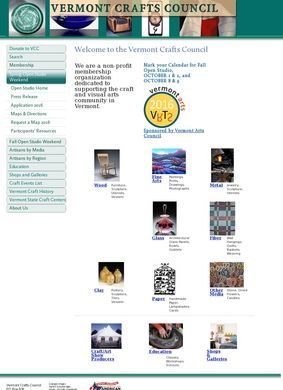
Vermont Crafts Council is a nonprofit that supports and advocates for the craft and visual-arts community across Vermont, governed by a board drawn from the state's own artists. Its membership runs past 250 makers working in clay, fiber, glass, jewelry, metal, and wood, alongside member galleries, art centers, and teaching artists. Through its public programs it also serves a wider audience: tourists and Vermonters who want to see how the work gets made, and buyers looking for pieces they cannot find in a chain store.
The board matters here. An organization run by practicing artists tends to understand the practical problems of the people it represents, and the mix of programs shows it.
A membership built around working makers
What the Vermont Crafts Council offers members is practical support for running a craft business. Professional development sits at the center, with networking, marketing opportunities, and seminars and conferences aimed at the unglamorous side of an art career, the marketing and selling that decide whether a studio stays open.
Arts advocacy runs alongside it, the organization pressing on behalf of the state's craft sector as a whole. Member galleries and art centers are part of the network too, which links solo makers to the physical spaces that show and sell their work. Teaching artists in the membership add another layer, connecting the Vermont Crafts Council to students and hobbyists who may become the next generation of members.
For an artist deciding whether to join, the pitch is concrete. Membership buys exposure through the Vermont Crafts Council's channels and a place in a searchable directory that the buying public and wholesale buyers can browse by medium.
Professional development and arts advocacy
The professional-development and advocacy programs are where the Vermont Crafts Council does its least visible and most useful work. Marketing seminars and conferences give members the business skills that art school rarely teaches, and the advocacy work gives a scattered population of solo makers a single collective voice at the state level. Networking events connect artists who would otherwise work in isolation in separate corners of Vermont.
None of this shows up in a gallery window, but it is the scaffolding that keeps individual careers standing, and it is the part of the offering that a casual visitor to the site would miss entirely.
Open Studio Weekend, twice a year
The flagship program is Open Studio Weekend, and it is the part of the Vermont Crafts Council most of the public actually encounters. Twice a year, once around Memorial Day and again in the autumn, member artists open their studios to visitors, who can drive a self-guided route from workshop to workshop and watch the work happen where it is made. The autumn weekend lands in Vermont's foliage season, which brings its own flow of visitors through the state.
For a maker, it is a direct sales channel and a chance to build a following face to face. For a visitor, it is a look behind a curtain that most craft buying never gets: the tools, the mess, the half-finished pieces, the person at the bench. The event turns a static list of names into something a person can walk through in a single weekend, and it spreads that traffic across studios that would rarely draw a crowd on an ordinary day.
How the weekend route works
The mechanics are simple and that is the strength. Studios are listed and mapped by location, a visitor picks a region of Vermont and threads together a day of stops, and admission is the drive itself. Because the studios are spread across the state, the weekend doubles as a reason to travel through parts of Vermont a tourist might otherwise skip, which is part of why the Council frames it for travelers as much as for buyers.
The same setup gives rural makers, far from any gallery district, a weekend when the public comes to them. For a first-time visitor, the mapped route removes the usual guesswork of finding working studios that are often unmarked and off the main roads.
Resources kept on the site itself
Beyond the events, the site works as a standing reference. The searchable directory of more than 250 members can be filtered by medium, so a buyer hunting for a glassblower or a furniture maker can go straight to the relevant names instead of scrolling through everyone. Wholesale-opportunity listings point makers toward buyers looking to stock their work at volume, which is a different kind of sale from the one-off studio visit and one that can keep a workshop busy through a slow season.
Two less obvious resources round it out. A green-design initiative gathers information for artists working toward more sustainable practices, and a flood-recovery section collects help for makers hit by Vermont's flooding, a real and recurring hazard for studios full of equipment and inventory. The Vermont Crafts Council also publishes governance details about the board, so members and the public can see who steers the organization and how.
Flood-recovery and green-design resources
The flood-recovery material is the detail that says the most about how the Vermont Crafts Council reads its own community. Vermont floods, studios and kilns and stockrooms sit in harm's way, and an advocacy body that keeps standing recovery resources for its members is answering a problem its artists genuinely face.
The green-design initiative works along similar lines, pointing members toward practices that fit a state where environmental values run deep. Both sit a click away in the site's navigation, next to the member directory and the wholesale listings.