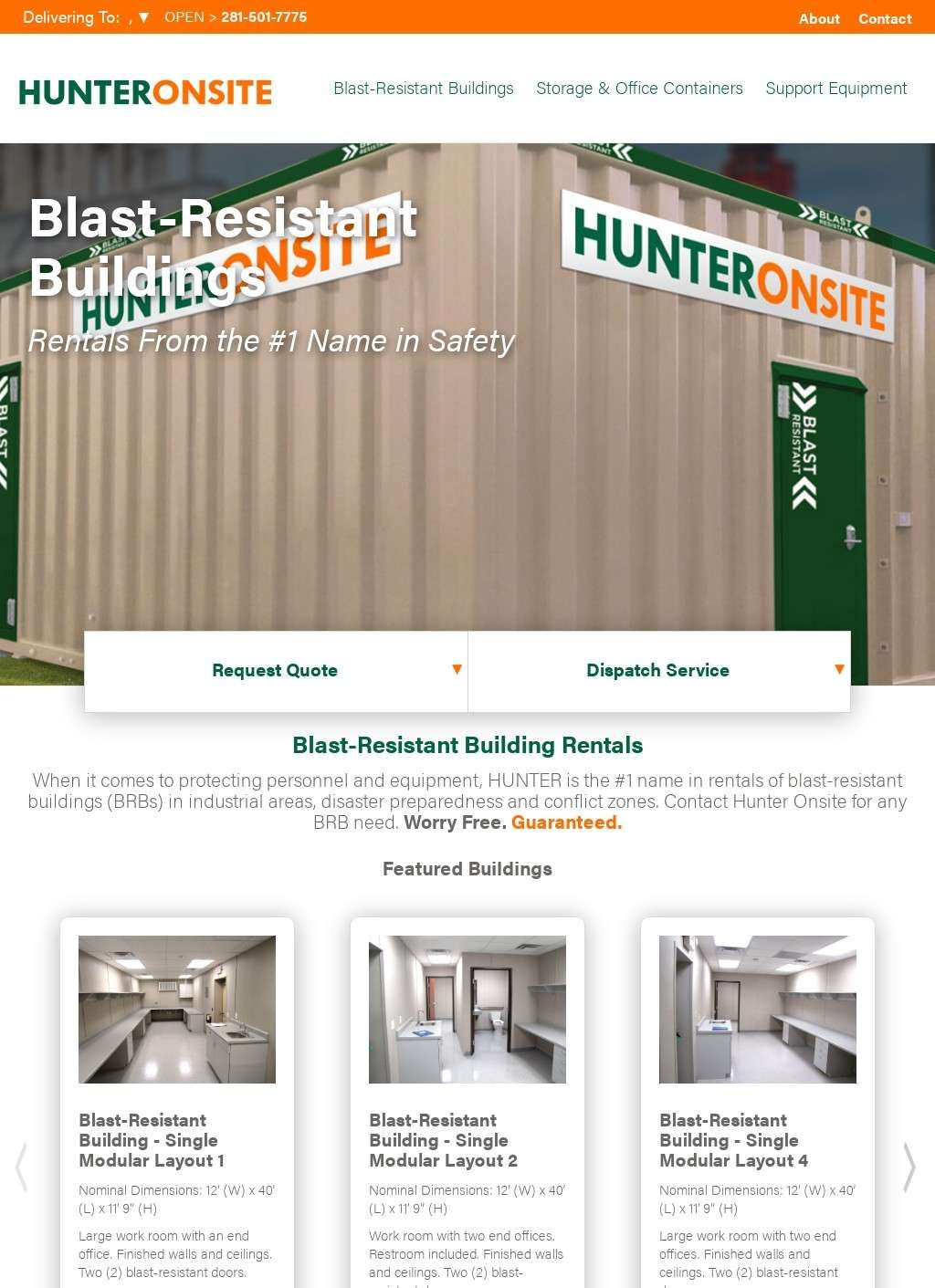
What does a company actually sell when its product is a building meant to survive an explosion? Hunter Onsite answers that question without much fuss: it rents and supplies blast-resistant modules and other portable protective structures for industrial sites, disaster-response work, and other high-risk settings. The headquarters sits at 14935 Jacintoport Boulevard in Houston, in the eastern industrial belt of the city where refineries and petrochemical plants make this kind of equipment a practical necessity, not a precaution on paper.
Blast-resistant modules and building layouts
The core of the catalog is the blast-resistant module, or BRM. These come as single modular units in 20-foot and 40-foot sizes, and Hunter Onsite lays out several floor plan layouts for each, so a buyer can match the interior to whatever the job needs, whether that is a crew break area, an office, or a control point. Beyond the single units there are multi-unit duplex complexes for larger crews, and a run of specialty blast-resistant buildings: permit buildings, tool cribs, and even restrooms built to the same protective standard. That last detail is the sort of thing that tells you Hunter Onsite has spent real time on plant sites, where a hardened restroom is not a luxury but part of keeping people inside a safe perimeter during a turnaround.
Standard offices and site accessories
Hunter Onsite does not stop at blast-rated equipment. The product gallery also covers standard container offices in 20-foot and 40-foot configurations, which serve the more ordinary side of a worksite where blast protection is not the requirement. There are turnstiles for controlling who comes and goes, light towers, furniture to fit out the interiors, and stair platforms to make multi-unit setups usable. Taken together it reads less like a single-product rental shop and more like an outfit that can equip a temporary site from the ground up, from the protective shell down to the chairs inside it.
Why one supplier covers a whole site
The breadth here is Hunter Onsite's strongest selling point. A contractor planning a shutdown or a relief organization standing up a base camp does not want to source a hardened module from one vendor, offices from another, and access control from a third. Having container offices alongside the blast-resistant line means a single supplier can handle both the protected and unprotected parts of a layout. That kind of one-stop range is genuinely useful in a field where logistics eat into budgets fast, and it is the detail that would most likely bring a planner back for a second project.
Behind the twenty-year track record
Hunter Onsite says it has been doing this for over 20 years, a figure that appears on its LinkedIn profile, where it has a following of around 760. Two decades in a specialized niche like protective structures is meaningful: this is not a sector with a low barrier to entry, since the products have to meet engineering standards that buyers in petrochemicals take seriously. There is also an ownership thread worth noting, in that Crossplane Capital, a Dallas private equity firm, lists Hunter Onsite among its portfolio companies. That backing points to a business with the capital to maintain a rental fleet of heavy modules, which is no small undertaking.
Rental transactions and support tools
Where many equipment sites leave a visitor guessing about next steps, Hunter Onsite builds out the transactional side properly. There is a quote request form, a dispatch service link, and a pick-up request system, which together cover the full arc of a rental: getting a price, getting the unit delivered, and getting it collected when the job ends. A separate credit application process is available too, which matters for the kind of commercial customer who runs purchases through accounts payable instead of a card. These are practical tools, and their presence indicates that Hunter Onsite expects to do real volume, not the occasional one-off.
For someone trying to learn before they buy, Hunter Onsite offers a knowledge base and a video and product gallery. The gallery in particular does real work for products like these, since photographs and walkthroughs of interior layouts say more than a spec line ever could about whether a 40-foot duplex will fit a given crew. A knowledge base also shows that Hunter Onsite fields the same technical questions often enough to have written them down, which is the mark of an established operation, not a startup still learning what customers need.
On the contact side, the physical address in Houston is stated clearly, and the quote form, dispatch link, and pick-up system give a prospective customer several distinct ways to reach Hunter Onsite. What the fetched homepage content did not surface was a phone number or an email address on the main page, which is a minor gap for a sector where someone with an urgent shutdown timeline often wants to call and not fill out a form. The forms route covers the need in most cases, and a stated street address counts for a lot in establishing that this is a real operation with a real yard, but a visible phone line would close the last bit of distance for buyers working against the clock.
Checking reputation without third-party reviews
A search for third-party reviews and ratings of Hunter Onsite turned up nothing specific to this company. The results were crowded out by unrelated firms that share the Hunter name, including an email-finding tool and a recruiting agency, so the search produced noise rather than signal. No Google, Trustpilot, Yelp, or similar third-party feedback for this particular Hunter Onsite came to light.
That absence deserves context. Business-to-business equipment rental in heavy industry rarely accumulates the kind of consumer review trail you would see for a restaurant or a retailer. Customers here are procurement teams and site managers who negotiate directly and judge a vendor by delivery records and engineering compliance, not by leaving star ratings online. So the quiet review profile is not necessarily a red flag, but it does mean a first-time buyer cannot lean on outside opinion and would do well to ask the company directly for references and the relevant certifications on the modules.
Weighing the twenty-year claim against ownership
The twenty-year claim and the private equity ownership do some of the work that reviews would normally do, giving an outside observer a couple of anchors for credibility beyond the company's own marketing. They are not the same as verified customer accounts, but they are documented and traceable in a way that vague assurances are not. A careful buyer would still want documentation, just as they would with any supplier of safety-rated equipment.
For a Texas-based operation in this niche, the offering from Hunter Onsite is coherent and the site does the basic jobs well: it shows the products, explains the configurations, and gives several routes to start a transaction. The standout is the combination of blast-rated structures with ordinary container offices and site furnishings, which lets one supplier cover a whole layout. The gap is the missing outside feedback, which a buyer will have to fill in through direct contact. The Jacintoport Boulevard address and the long stretch in a demanding niche are the two facts that ground everything else on the page.