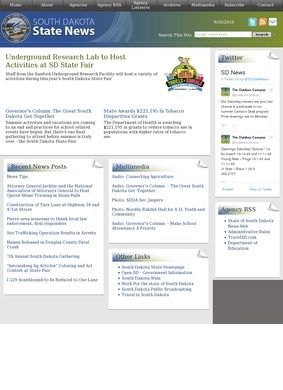
South Dakota State News is the official news portal of the South Dakota state government, sitting at news.sd.gov and linked straight back to the main SD.gov site through a "Return to SD.gov" link in its navigation. It works as the central press room for the state, pulling news releases out of individual agencies and stacking them in one place so a reader does not have to hunt across a dozen separate departmental sites.
A resident who wants to know what the Department of Public Safety put out this week, and a reporter chasing a labor announcement, both end up in the same feed.
That aggregation is the whole idea, and it is worth understanding before judging the rest. Most state agencies publish their own notices somewhere. What South Dakota State News does is collect them, so the museum reopening, the workforce session and the fatal-crash report all land in a single stream instead of scattered across the map of state government. It is a plain site doing a plain job, and the job is a genuinely useful one.
What the portal gathers
The front of South Dakota State News runs on a rotating "Latest News" carousel, and the examples on it give a fair sense of the range. A single sweep can turn up a fatal-crash report from the Department of Public Safety, coordinates and details for a Mount Rushmore "Freedom 250" event, an announcement that the South Dakota State Museum is reopening, and a notice from the Department of Labor and Regulation about a "Workforce Knowledge Session." Law enforcement, tourism, a cultural institution and a jobs program, all in the same short rotation.
Below the carousel sits a general news feed with a "See All News" link for readers who want the full run instead of the highlights, and an "Archives" section holding past releases. The archive is the part that quietly earns its keep. State announcements have a way of mattering months after they were posted, and being able to pull an older release without emailing an agency is the difference between a press page and a genuine record.
For anyone who has ever tried to track down a notice that scrolled off a department's homepage, that alone is a reason South Dakota State News is worth bookmarking.
The Latest News carousel
The carousel is doing the job a homepage should: telling a visitor, in a glance, what the state wants known right now. Because South Dakota State News draws from many departments at once, that top slot swings widely in tone. One item is a somber safety notice, the next is a civic celebration tied to a historical anniversary. It reads less like a themed publication and more like the daily output of an entire government, which is exactly what it is.
A reader looking for a single story may find the rotation a little scattershot, but that scatter is honest to the source.
The full feed and the archive
Past the rotating features, the "See All News" feed is where South Dakota State News stops being a highlight reel and becomes usable as a reference. Everything the agencies filed flows through there in order. I found the pairing of a live feed with a searchable archive to be the practical heart of the site, more so than the polished carousel up top, because it is what turns a stream of the moment into something you can return to and check against later.
A press feed you cannot search backward is only ever half a tool. South Dakota State News gives you both halves.
Accessibility, disclaimer and privacy
The footer of South Dakota State News carries the standard government housekeeping: an Accessibility Policy, a Disclaimer, and a Privacy Policy. These are easy to skip past, and most readers will, but their presence is the mark of a public body meeting the obligations expected of a state site.
An accessibility statement in particular signals that the portal is meant to work for readers using screen readers or other assistive tools, a real concern for something whose whole purpose is public information reaching everyone it is supposed to reach.
Who it is built to serve
Three audiences are obvious from the way South Dakota State News is put together. Residents get a plain-language window into what their government is doing, across public safety, cultural institutions, labor programs and civic events. Journalists and other media get a single source for official releases, which is faster than tracking each agency separately. And the wider public, anyone with a stake in a particular announcement, gets it without a paywall or a login. The content spans many agencies at once, so the site behaves as a hub for the whole executive branch instead of the mouthpiece of one department.
The value of that arrangement is easiest to see by picturing the alternative. Without South Dakota State News, following an evolving story would mean checking the Department of Public Safety, then the museum, then the labor office, each on its own schedule and its own page layout. Pulling them into one dated stream removes that legwork, and it also flattens the hierarchy: a small agency's notice sits in the same feed as a headline announcement, so nothing that got filed disappears simply because the department behind it is minor.
For a state the size of South Dakota, where a single office may cover a lot of ground, that even footing is quietly important.
For readers who want a particular slice instead of the whole firehose, South Dakota State News offers "Agency Listservs," email lists tied to specific departments, alongside a general "Subscribe" function. Someone who only cares about the Department of Labor and Regulation can follow that agency and skip the rest, which is a sensible way to handle a feed that spans this much ground. Delivery, not simply publication, is part of what the portal is set up to do.
Agency listservs and subscriptions
The listserv model fits the aggregator perfectly. Instead of forcing a reader to visit and scan, South Dakota State News lets the news come to them, filtered down to the agencies they care about. That is a small feature with an outsized payoff for the people who rely on this content: reporters on a beat, contractors watching a regulatory office, residents following a single program. It turns a broad government feed into something closer to a personal briefing, and it keeps South Dakota State News useful to people who would never think to open it cold.
Whether the portal earns a spot in someone's routine depends on how much they deal with the state. A South Dakotan who rarely thinks about Pierre will open it only when a specific story breaks, and little more than that. A reporter, a lobbyist, or a public-safety watcher gets more out of it: one place that gathers every agency's releases, a subscribe option for the agencies that matter most, and an archive that gives South Dakota State News more staying power than a typical press feed.
How often a given reader turns to the state government of South Dakota is, in the end, what decides how much use they get out of it.