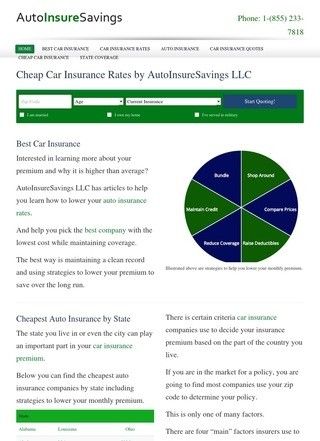
South Dakota drivers landing on AutoInsureSavings.org get rate tables broken out by city, then a set of filters by driver situation: young drivers, at-fault accidents, poor credit, DUI history. That is more granular than the usual one-size state summary, and it is the part of the site that does real work. Most of the comparison runs through a free quote engine that takes a ZIP code and pulls figures from several carriers at once, so a resident in Sioux Falls and one in Rapid City are not being shown the same generic number.
Rate tables by city and driver profile
The carriers AutoInsureSavings.org pulls in are the names you would expect in this market: Progressive, USAA, State Farm, Allstate, and others. Each of those has its own review page on the site, which means a reader can step away from the South Dakota tables and read about a specific insurer before deciding whether to request a quote through it. That structure pays off in a state like South Dakota, where USAA eligibility ties to military service and the carrier mix can differ from one town to the next. The state page itself splits coverage into tiers, putting minimum liability next to full coverage so the price gap between the legally required floor and the more protective option is visible in one place. For drivers trying to understand why their premium lands where it does, that side-by-side framing is genuinely useful.
Comparing carriers with individual review pages
Beyond South Dakota, AutoInsureSavings.org runs the same layout across all fifty states, each with its own page. The supporting library is reasonably deep: vehicle-type guides, plain explainers on what different coverages mean, walkthroughs for filing a claim, and resource pages on what to do after an accident. None of this is original research, but it is organized in a way that someone can follow without already knowing insurance jargon, and the volume of it means the operators have been at this for a while. A South Dakota driver who wants to understand what comprehensive coverage actually pays for can move to one of those explainers without leaving the site. In any business directory search, a site with this much supporting material stands apart from a bare landing page.
Supporting library across all fifty states
One thing worth being clear about is how the site makes money. AutoInsureSavings.org does not sell policies. It runs on lead generation and quote referrals, meaning when a visitor submits information through the comparison tool, that interest gets routed to insurers or their partners. This is a common arrangement for comparison sites, and AutoInsureSavings.org does not hide it, but it does shape how the rate tables should be read. The numbers are a starting point, not a binding quote, and anyone using the South Dakota page should expect follow-up contact once they hand over a ZIP code and details. A figure shown for full coverage in Aberdeen or Brookings is an estimate the engine assembles. The real price arrives only after an insurer reviews the full driver record.
How the site generates revenue
The operator is AutoInsureSavings LLC, with an address in St. Petersburg, Florida. Contact information is easy to track down, which counts for something on a site built around routing personal data to third parties. There is a phone number displayed prominently, a physical mailing address, and a footer carrying the standard set of pages: About Us, Contact, a privacy policy, and terms and conditions. For a lead-generation operation, having a real phone line and street address visible is the right baseline, and AutoInsureSavings.org clears it.
Contact information and company details
A Better Business Bureau profile exists for AutoInsureSavings LLC, though it is filed under a Memphis, Tennessee listing; the company is not BBB accredited, and no rating appears in the search result. The Facebook page has two reviews and sits as "Not yet rated." A check on Complete-Reviews.com turns up zero entries. No Trustpilot, Google, or Yelp ratings surfaced specifically for AutoInsureSavings.org. So there is almost nothing in the way of independent feedback to lean on, which is not the same as a bad track record, but it does mean a cautious visitor has little outside confirmation to go by. The address mismatch between the Florida headquarters and the Tennessee BBB filing is a small loose thread, the kind of thing that does not prove anything but does invite a second look.
Third-party reviews and reputation status
Put against what comparison sites typically deliver, AutoInsureSavings.org performs solidly on the content side. The state pages are specific, the driver-profile filters address the situations that actually move premiums in a place like South Dakota, and the explainer material is sound. Where it asks for more trust than it has earned is the reputation gap. A site that collects and routes quote requests benefits enormously from a visible trail of satisfied users, and this one does not have one yet. The contact transparency softens that: a person who hits a problem has a clear way to reach someone.
For a South Dakota driver, the practical value AutoInsureSavings.org delivers is the city-level rate breakdown and the ability to filter by an imperfect driving history before requesting quotes. That alone can save the legwork of pricing several carriers individually, and for a driver with a DUI or a recent accident, seeing how each profile shifts the number is the difference between a vague worry and a concrete range. The trade-off is the lead-gen model and the absence of third-party reviews, both of which a user should weigh before entering personal information.
AutoInsureSavings.org does what it sets out to do: take a South Dakota ZIP code, return city-specific rate ranges filtered by driver profile, and point toward named carriers. The information is structured well and the company is reachable. The missing piece is external confirmation from actual users, and until that builds up, the site rests on its transparency rather than its track record.