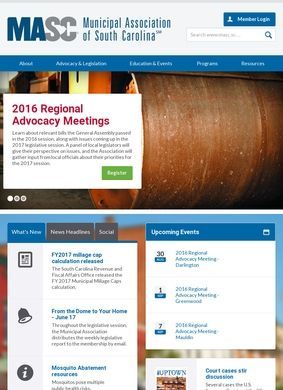
How is a South Carolina town of a few thousand residents supposed to track every bill moving through the statehouse, insure its public buildings, train a council that turned over at the last election, and still collect the taxes it is owed? Most cannot, not alone. That is the gap the Municipal Association of South Carolina exists to fill, working on behalf of all 271 incorporated cities and towns in the state at once.
The Municipal Association of South Carolina bundles four broad kinds of help, advocacy, education, training and risk management, into a single membership, and the range is genuinely wide.
What the membership delivers
Start with the political side, because it touches every town whether the town notices or not. The Municipal Association of South Carolina tracks legislation as it moves, reports back to members, convenes regional advocacy meetings around the state, and runs federal advocacy initiatives when a matter reaches Washington.
The value here is timing. A bill that changes how towns collect a tax or zone their land can pass before a part-time council ever hears of it, and the Municipal Association of South Carolina positions itself as the body watching the calendar so 271 clerks and mayors do not each have to keep their own vigil.
Advocacy under the dome
Legislative tracking is the workhorse function. Someone on staff reads the bills, flags the handful that touch municipal budgets, annexation, business licensing or zoning, and turns them into plain-language reports a busy official can act on. For a mayor with no lobbyist and no legislative staff, that reporting from the Municipal Association of South Carolina is often the only early warning a small city gets before a new law lands on it.
The regional meetings then convert that intelligence into organised pressure, since 271 towns speaking with one voice count for far more in Columbia than any of them would alone. Federal initiatives extend the same watch to Congress. It is unglamorous work, and it is probably the single strongest reason a town keeps paying its dues.
The institutes that train a council
Education is where the Municipal Association of South Carolina puts the most structure. It runs the Municipal Elected Officials Institute of Government and an Advanced Institute beyond it, a Municipal Clerks and Treasurers Institute, Business Licensing Training, Planning and Zoning training, and a Risk Management Institute. Newly elected officials rarely arrive knowing how a budget ordinance works or what the open-meetings law demands of them, and these programs exist to close that gap before a costly mistake does it for them.
Each institute is pitched at a different job inside a town hall. The Business Licensing Training and the Planning and Zoning sessions cover two areas where small towns most often stumble into legal trouble, and the Risk Management Institute ties straight back into the insurance side of the operation. The Advanced Institute exists for officials who have already cleared the basic curriculum and want to go further, which points to a program built for a full term in office, not a single afternoon of orientation.
Separate tracks for elected officials, for clerks and treasurers, and for risk suggest the Municipal Association of South Carolina has thought carefully about who needs what. I have watched plenty of statewide bodies stop at one all-purpose seminar and call it training; this catalogue goes several steps past that.
Risk pools, revenue and the rest
The money-and-risk side is dense. Through the SC Municipal Insurance Trust and the SC Municipal Insurance and Risk Financing Fund, the Municipal Association of South Carolina runs shared insurance pools that let small towns carry coverage they could never negotiate alone, backed by risk letters and written guidance.
The insurance side may be the piece that keeps the smallest towns in the fold. A single town hall trying to buy liability and property cover on the open market is a tiny account with almost no bargaining power. Pooled together through the trust, those same towns become a book of business an insurer takes seriously, which tends to mean steadier premiums and claims handling built around municipal risk instead of a generic commercial policy. The risk letters and written guidance then help a clerk avoid the exposures that trigger the claims in the first place.
Then there is Local Revenue Services, the part that most resembles a business. It brokers the business license tax, the insurance premium tax and the telecommunications tax, runs business-licensing renewals, and operates a setoff debt program that recovers money owed to a town through state channels. For a small finance office, handing that machinery to the Municipal Association of South Carolina is often cheaper and steadier than building it in-house.
Add Cable Franchise Assistance, the City Connect Market, Main Street South Carolina for downtown revitalisation, technology and cybersecurity support for a threat small governments are badly exposed to and rarely equipped for, and a trades certification program, and the whole outfit starts to look less like an association and more like an outsourced back office for local government.
There is a publishing arm on top of all of it. The Municipal Association of South Carolina puts out Uptown magazine and the City Quick Connect Podcast, maintains municipal and legislator directories that go well beyond a general business directory, and compiles compensation reports along with a grants database. The directories and the salary data are the practical standouts: a clerk setting a pay scale or a mayor hunting grant money has somewhere concrete to look.
Uptown reads as the association's running record of what matters to member towns, and the podcast covers the same ground in a format an official can play in the car between meetings. The grants database and the compensation reports are the sort of unglamorous references that quietly earn their keep: a town budgeting for the year can check what comparable municipalities pay a police chief or a public-works director instead of guessing, and a clerk chasing outside funding gets a searchable starting point rather than a blank web search.
Everything points at the same audiences: elected officials, municipal staff, and the administrative personnel who keep a town running between elections. The Municipal Association of South Carolina serves all of them, and that breadth is both its strength and the hardest thing to judge from the outside.
Here is the doubt a prospective member is left holding. The Municipal Association of South Carolina packs so much under one roof, insurance pools, tax collection, six or seven training programs, a magazine, a podcast, cybersecurity help, that no single town could plausibly draw on all of it. A large city with a full staff might use a slice and still come out ahead.
A tiny town might lean on the insurance pool and the institutes and let the rest sit idle. Whether that breadth is a genuine bargain for every one of the 271 members, or a wide net some towns pay into and barely touch, is something the Municipal Association of South Carolina cannot settle for them; each council has to work that out for itself.