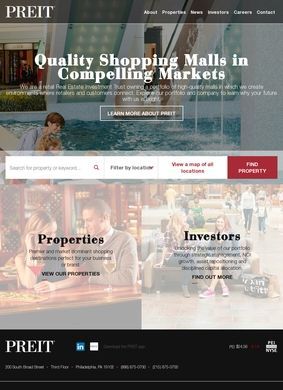
Cherry Hill Mall, Woodland Mall, the Mall at Prince George's, and Springfield Town Center make up the four flagship properties at the core of PREIT's portfolio. These are not strip plazas or aging suburban centers limping along on a discount anchor. They are large, tenant-heavy retail destinations spread across the Mid-Atlantic, and the site is built around them. The company, formally the Pennsylvania Real Estate Investment Trust, runs as a privately held REIT out of an office on Market Street in Philadelphia, and its work is the development, management, and operation of these mixed-use retail spaces.
Four flagship properties across the Mid-Atlantic
What the website sells, in a practical sense, is access to those properties. The clearest pitch is to retailers and specialty tenants looking for leasable space in high-traffic centers. If a brand wants square footage near foot traffic that already exists, this is the front door. Alongside leasing, there are advertising partnerships inside the properties (the kind of in-mall placement that brands pay for to reach shoppers on site) and a separate track for real estate investors. So the audience splits into three groups: tenants who want a location, advertisers who want exposure to the crowds those locations pull, and investors who want a stake in the underlying real estate.
Retailers and tenants seeking leasable space
The tenant roster does a lot of the persuasive work without the site needing to oversell. Apple, Target, Macy's, AMC, Sephora, Dave and Buster's, and the Cheesecake Factory all appear among the anchor and inline tenants. That mix tells you something concrete about who already trusts these centers with their physical presence. A prospective small or mid-size retailer can read that list and understand the company it would be keeping. Apple in particular does not put stores in weak locations, so its presence is a quiet indicator of how these properties are positioned in their markets.
Anchor and inline tenant roster
Outside reputation around PREIT is mostly employer-facing, not customer-facing, and that shapes how you read it. On Indeed, the corporate entity carries 3.7 out of 5 across a dozen employee reviews, while the property-management subsidiary, PREIT Services, sits lower at 2.8 out of 5 from nine reviews. Birdeye shows PREIT Services at 2.3 out of 5 from a handful of reviews. None of these are tenant satisfaction scores or shopper feedback. They are people writing about what it was like to work there, which is useful in its own way but answers a different question than "is this a good landlord to lease from."
Employee ratings versus landlord performance
The gap between the corporate score and the services-arm scores is worth noticing. The property management side has drawn more friction than the headquarters brand, at least in what employees have put on record. For a tenant, that is not a dealbreaker, but it is a reason to ask pointed questions during lease talks about how day-to-day operations are handled, who responds when something breaks, and how responsive the on-site teams are. Nothing in the public review data resolves that for you.
Why B2B operators lack public review presence
There were no Trustpilot, Yelp, Google Business, or BBB ratings surfaced in searches. For a commercial real estate operator that mostly transacts B2B, that absence is normal. People do not leave star ratings for the entity that owns the mall the way they would for a restaurant or a contractor. A business directory search turns up little beyond the employer reviews above, which is a feature of the category rather than evidence of a problem. PREIT does not appear to be hiding from feedback so much as operating in a space where shoppers rate the stores instead of the landlord.
Asset-focused site structure
The structure of the site reflects the structure of the business, and that is a point in its favor. The four properties are foregrounded, and PREIT lets the named centers and named tenants do the talking instead of burying them behind generic corporate language. A retailer can see exactly which markets are on offer: South Jersey, western Michigan, the Maryland suburbs of DC, and Northern Virginia. That geographic clarity helps a tenant figure out fast whether the footprint even fits its expansion map before picking up a phone. It also keeps the focus where PREIT clearly wants it: on the assets rather than on slogans about them.
Contact routes for leasing and investment
PREIT lists a physical headquarters address at 2005 Market Street in Philadelphia, grounding the company in a way you want from a real estate firm. A contact page handles leasing and investment inquiries, so there is a defined route in for the people the business is actually trying to reach. What you will not find front and center on the homepage is a phone number or email, meaning a casual visitor has to click through to start a conversation. For the deal-driven audience this site is built for, routing inquiries through a structured form is reasonable, even if it adds a step.
Does property management match corporate quality?
A retailer scouting Mid-Atlantic locations with established traffic will get real value from PREIT, and an investor researching the trust will find the framing and the asset list they need to start digging. The verdict carries a caveat that has nothing to do with the website and everything to do with the operating reviews: the property-management side carries weaker marks than the corporate brand, and anyone signing a lease should treat that as a prompt to vet the operational relationship carefully.
The portfolio is solid and the anchor tenants are a genuine indicator of quality. The day-to-day execution is the part the public record leaves unsettled, and that is where a prospective tenant's own due diligence has to fill in the blanks. What is published here is enough to confirm PREIT operates real assets at real scale; what it cannot settle is whether the property teams actually deliver on that scale once a lease is signed.