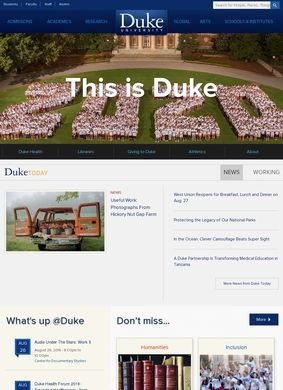
Duke University is a private research university in Durham, North Carolina, with an undergraduate core split between Trinity College of Arts and Sciences and the Pratt School of Engineering. The site opens out from there into a structure that matches how the place actually works: a residential undergraduate experience sitting alongside a dense set of graduate and professional schools. The Graduate School handles masters and doctoral study, and the professional side runs deep, covering Law, Medicine, Nursing, Divinity, the Fuqua School of Business, and public policy through the Sanford School. The Nicholas School of the Environment fills out the academic map.
Distinct schools within one university
What is useful about how this is presented is that the breadth does not blur into a single marketing haze. Each school reads as its own operation. Someone weighing an MBA at Fuqua is looking at a different institution, in practice, than someone applying to the nursing program or the divinity school, and the site lets those distinctions stand instead of flattening them. For a prospective student, that separation is the difference between a vague impression and a real sense of where they would land.
Research institutes and faculty projects
The research apparatus is where Duke University really starts to distinguish itself from a teaching college that also publishes papers. The Global Health Institute, Duke Brain Sciences, and the Innovation and Entrepreneurship programs appear as standing structures with named faculty and active projects, and the examples of active work are refreshingly specific. Space law and policy sits next to hibernation biology in the list of what faculty and students are chasing. That pairing tells you something honest about a large research university: the interests do not have to agree with each other, and the institution is wide enough to host both a legal scholar thinking about orbital governance and a biologist taking apart how an animal slows its own metabolism.
Checking out international degree campuses
The international footprint deserves to be treated as a real part of the offering. Duke University Kunshan operates in China, and Duke-NUS Medical School operates in Singapore. These are not study-abroad add-ons; they are degree-granting campuses with their own identities, and anyone reading the main site should understand that a Duke University education can physically happen on three different continents. For applicants weighing global exposure, that changes the calculation considerably.
Campus landmarks and cultural venues
The campus itself gets real attention on the site, and the named landmarks are treated with care. Duke Chapel anchors West Campus and was designed by Julian Abele, a detail Duke University keeps attached to the building rather than letting it float as anonymous Gothic architecture. Duke Gardens, currently working through a Gateway Project renovation, and the Nasher Museum of Art give the place cultural infrastructure that students and visitors can actually use, alongside performing arts venues. These are not decorative mentions; they describe what daily life on the grounds includes.
Support services for students
Student support at Duke University is laid out with enough range to matter. Financial aid and work-study sit alongside career services, alumni networks, international student support, and the residential communities that shape the undergraduate years. None of this is unusual for a university of this size, but the site treats the support structure as part of the product, which is the correct instinct. A student deciding among comparable schools tends to care as much about the aid package and the career office as about the seminar list.
Basketball tenting tradition at K-Ville
Athletics get their due, and the site is right to give them full treatment. Duke University competes at the Division I level in the ACC, and the K-Ville tenting tradition for men's basketball is presented as the genuine student institution it has become. Tenting is one of those campus customs that outsiders find hard to believe and insiders organize their winter around. Including it is a sign that Duke University understands its own culture is part of what it offers, not separate from it.
Sustainability commitment on campus grounds
The sustainability commitment runs through the campus material as well, tied to climate goals and green space management. Given how much of the site leans on its grounds, from the Gardens to the chapel lawns, the stated emphasis on managing that green space reads as consistent rather than tacked on. A campus that markets its physical beauty has a clear reason to back a maintenance philosophy that protects it.
If there is a fair caution, it is the one that applies to any institution this large: the main site can only point you toward the schools and centers, and the substance lives one or two clicks deeper, inside Fuqua or the medical center or the Sanford School. The top-level pages are a directory of doors more than a destination in themselves. That is the right design for an institution with this many constituencies, but it does mean a casual visitor should expect to drill down before forming a real opinion of any single program. Finding Duke University listed in a business directory and clicking through to the official site is a reasonable starting move; the official site then hands off to the individual schools, which is where the real information lives.
Taken as a whole, Duke University comes across on its own site exactly as its standing would suggest: a comprehensive research university that handles undergraduate teaching, professional training, and frontier research, with a campus and a set of traditions it clearly values. The material is specific where it counts, from named buildings and their architects to named research themes, and that specificity is what separates a credible institutional presentation from a generic one. Overall, Duke University gives prospective students, researchers, and partners enough detail to form a grounded picture, and the picture is a credible one. Whether the sprawl of a full research university with global campuses and a dozen professional schools matches what a given applicant is after is a question the site cannot answer, but it gives them the information to work it out themselves.