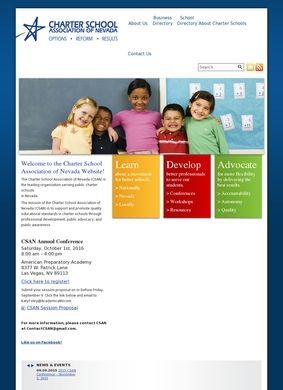
Nevada has nearly 90 public charter schools, and the Charter School Association of Nevada exists to hold that whole network together. The site spells out three things it does for those schools, and the structure of the work tells you a lot about who the group is talking to: school leaders, classroom teachers, families, and the people trying to open or grow a charter. Start with the School Finder, a directory of charter schools across the state, and you get a sense that this is meant to be a working tool, not a billboard. The Program Finder sits alongside it for sorting through what the association runs.
The first pillar is academic support. That covers professional development for charter leaders and teachers, plus instructional resources the association describes as innovative. The wording matters less than the intent: a small charter school rarely has the budget to build its own training pipeline, so a statewide body that pools that effort is doing something concrete. Whether the materials are genuinely fresh or simply repackaged best practice is the kind of thing you would only learn by sitting through a session, and the site does not pretend otherwise. It lays out the offering and lets the schools judge.
Advocacy is the second pillar, and it is where the Charter School Association of Nevada gets more pointed. The association does lobbying and policy work aimed at the political and regulatory environment for charter students, families, and operators, at both the local and the state level. One detail it raises in support of that work is funding: Nevada's charter students, on average, receive less public money than students in district schools. That is a specific grievance with a number attached, and it explains the advocacy posture better than any mission statement could. If you run a charter and feel underfunded, this is the part of the organization you would lean on.
Does a school need an association like this?
Operations is the third pillar, and it reads as the most hands-on of the three. The Charter School Association of Nevada offers guidance for opening a brand new charter or expanding one that already exists, including operational best practices. Launching a school is a forbidding administrative project, full of compliance steps and decisions that a first-time operator has never faced. A body that has watched dozens of schools go through it can shorten that learning curve, and that is precisely the gap the operations support is trying to fill.
So the answer depends on where a school sits. An established charter with a strong central office might use the Charter School Association of Nevada mainly for the policy fight, treating the training and operations help as a bonus. A founding group with three staff and a lease they are nervous about would probably lean on all three pillars at once. The association seems aware of that range, which is why the offering is split into parts you can take separately instead of one bundled program everyone is forced to accept.
The site carries a few more pieces worth noting. The Charter School Association of Nevada puts a Member Dashboard behind a login, which signals that membership comes with material the public pages do not show, presumably the deeper professional development and member-only resources. A blog runs education updates, and an FAQ section handles the recurring questions. None of these are flashy, and that is fine. I tend to trust an association site more when it spends its space on a working directory and a member portal than on stock photography and slogans, and this one leans the practical way.
It is worth being honest about what a visitor cannot judge from the outside. The quality of the professional development, the actual win rate of the advocacy work, the depth of the operations guidance, all of that lives inside the membership and the relationships, not on the public pages. What the Charter School Association of Nevada makes plain is its scope and its priorities, and those are coherent. Academic, advocacy, operations: the three pillars cover the lifecycle of a charter school reasonably completely, from the day someone decides to open one through the years of keeping it funded and staffed.
The funding argument deserves one more line, because it frames the rest. When the Charter School Association of Nevada points out that its students get less per head than district peers, it is not making an abstract complaint. That gap shapes class sizes, teacher pay, and how much a school can spend on the very training the association then turns around and provides. The academic and operations pillars, read in that light, look partly like the association trying to compensate for a shortfall it is simultaneously lobbying to close. That is a sensible way to organize the mission, and it gives the advocacy real stakes.
For families, the site is less of a destination, though the School Finder is genuinely useful if you are weighing charter options across Nevada and want them in one place. The bulk of the Charter School Association of Nevada is built for the people running and starting schools, which is the right call. An association tries to serve its members first, and parents benefit downstream when those schools are better supported.
One practical note: the .org address was not loading on a recent visit, while the .info version of the site was the live one for the same group. If you go looking for the Charter School Association of Nevada and the first link fails, try the alternate address before assuming the organization has gone quiet. The content on the working site is the same body of material described above.
What you make of the Charter School Association of Nevada really comes down to your seat at the table. The pillars are clear, the funding rationale is specific, and the tools (School Finder, Program Finder, member portal) are the kind a working organization keeps rather than decorates with. The harder questions, how good is the training, how much does the lobbying actually move, how thorough is the help when you are opening a school for the first time, are ones no website can settle. The published evidence points to a coherent mission with real stakes; the proof of delivery lives inside the membership.