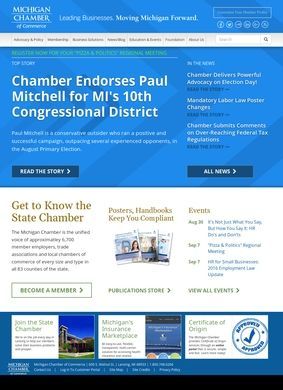
A bill moves through the Michigan legislature that would change how a Lansing manufacturer handles overtime, and the owner has maybe a week to figure out whether it helps or hurts. That is the exact moment the Michigan Chamber of Commerce is built for. Its core work is legislative advocacy on behalf of businesses operating in the state, and the site does not bury that. The tagline it leads with calls itself the most influential voice for business in Michigan, which is a big claim, but the structure underneath it is consistent with an organization that spends its days reading bills before they pass and telling members what is coming.
Legislative advocacy and the chamber PAC
What I found useful is how concrete the policy side is. Rather than vague talk about supporting a pro-business climate, the site tracks specific legislative priorities and key bills, which means a member can see what the organization is fighting for and against in a given session. There is also a Chamber PAC for political giving, so the advocacy runs past research and testimony into money directed at campaigns the membership wants to back. You can agree or disagree with that approach to influence, but it is stated plainly, and a business deciding whether to join can weigh it honestly.
How business policy committees set positions
The policy machinery is the spine of the whole operation. Business policy committees give members a channel into the positions the Michigan Chamber of Commerce takes. A statewide group representing companies of every size has to reconcile competing interests, and without that committee structure those tensions would get papered over. A small retailer and a large manufacturer do not always want the same tax or labor outcome, and the committee process is how those differences get resolved before the organization speaks with one voice in Lansing.
Tracking key bills for busy owners
Tracking key bills is where the Michigan Chamber of Commerce pays for itself for a busy owner who has no time to monitor committee hearings. Legislation that touches employment, taxation, or regulation tends to surface here with enough framing that a non-specialist can understand the stakes. The PAC sits alongside this as the more pointed instrument: research and testimony shape the argument, and the political giving is meant to back the lawmakers who agree. It is a transparent two-track approach, and the site does not pretend the giving does not happen.
Member directory and networking benefits
Membership also comes with visibility. The member directory and networking pieces let businesses find one another, and the member spotlights put individual companies forward. For a firm that wants to be known among other Michigan employers, that exposure is a real benefit on top of the policy work, though it is the kind of thing every association offers and should not be the reason anyone joins.
Business solutions for members
Where the Michigan Chamber of Commerce gets more practical is the business solutions tier, and this is the part that turns a policy association into something a smaller company can justify paying for. HR support and employment law assistance head the list, which is genuinely valuable for any business too small to keep an employment lawyer on retainer. Pair that with the labor law resources and publications, and a member gets a working reference for the questions that come up constantly: classification, leave, termination, the routine compliance traps.
Benchmarking pay and pooled insurance programs
The rest of the Michigan Chamber of Commerce toolkit is specific enough to take seriously. Access to Salary.com survey data helps members benchmark pay, which is hard to do well without buying expensive data on your own. There is a workers' compensation insurance program, a 401(k) retirement plan branded MIMEP, and utility bill review services that look for billing errors most companies never catch. These are the kind of pooled benefits that justify the cost of membership for a mid-sized employer, since the savings on one or two of them can cover the dues.
Inside chamber events and training
On the development and connection side, the Michigan Chamber of Commerce runs signature events including Chamber Day and the Michigan ATHENA programs, plus webinars and professional training. The MiBiz360 Talent and HR Summit series rounds out the calendar with a focus on hiring and retention, which is the problem most Michigan employers name first. Taken together, the events are not filler; they map to the same talent and policy themes the rest of the site organizes around.
Weighing the breadth of membership benefits
One honest reservation about the Michigan Chamber of Commerce: a statewide association by nature spreads itself across many priorities, and a single business will care about a fraction of what is on offer. A restaurant owner may want only the HR line and the labor publications, while a manufacturer leans on the policy advocacy and the workers' comp program. The breadth is a strength for the membership as a whole, but anyone evaluating it should look past the long menu and price out the two or three benefits that fit their situation.
Set against a national group like the U.S. Chamber of Commerce, the Michigan Chamber of Commerce makes a different and arguably stronger case for a company whose fights are in Lansing rather than Washington. A national body has more reach on federal policy and a larger member network, but it cannot track a state overtime bill or testify in a Michigan committee the way a statewide chamber does. For a business whose customers, employees, and regulators are inside Michigan, the local advocacy plus the pooled HR, insurance, and retirement programs make this the more directly useful of the two, and the events keep the membership grounded in the people it represents.