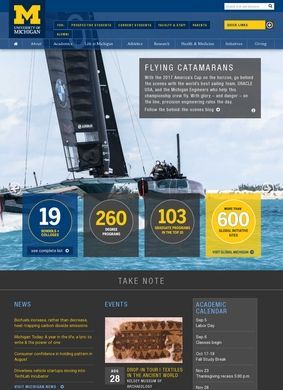
Nineteen schools and colleges sit under one roof here, and the University of Michigan homepage tries, mostly with success, to make that sprawl navigable instead of overwhelming. The top of the site sorts everything into a handful of sections: About, Academics, Life at Michigan, Athletics, Research, Health and Medicine, Initiatives, and Giving. It reads less like a marketing splash and more like a directory built for people who already know roughly where they are headed.
What I appreciate is that the site does not pretend every visitor is the same person. A row of "For:" links splits the audience into prospective students, current students, faculty and staff, parents, and alumni, and each path pulls you toward the tools that group actually uses.
The Quick Links bar is the workhorse. It drops you straight into the Academic Calendar, Canvas for coursework, the campus Directory, university email (with a separate line for the UMHS health-system accounts), the Library Catalog, Maps and Directions, the full Schools and Colleges list, and Wolverine Access for student records and registration. This is the part of the University of Michigan operation that thousands of people hit daily, and putting it one click from the front door is the right call.
Those two rows, the audience filters and the Quick Links, do most of the practical work on the page. Everything below them is content that changes; everything in them is the machinery that stays put. It is a sensible division, and it keeps a returning visitor from having to relearn the site every semester.
What the site surfaces day to day
Beyond the navigation scaffolding, the homepage is built to move. Rotating story content keeps the research front and center, and the examples are specific enough to be worth reading.
Research that gets a public face
Recent highlights include work on Great Lakes ecosystems, silk-based materials being tested for 6G networks, and the long-running Saturday Morning Physics series that opens lectures to the general public. These are not vague gestures at "innovation." They are named projects with a real subject, and that specificity does more to convey what a research university does than any summary paragraph could. A curious reader with no campus affiliation can land here and come away having learned something concrete.
The mix also signals range. One item is deep-water ecology, the next is telecommunications physics, and the framing treats a Saturday lecture for families with the same seriousness as a materials-science breakthrough. That breadth is the University of Michigan telling you, without saying it outright, how many directions its research actually runs. A prospective graduate student weighing a program can read these features and get a truer sense of what happens in the labs than any recruitment page would offer.
News that points outward as well as inward
There are two distinct news channels here. A "News" feed carries the institution's own reporting through Michigan News and The University Record, the internal paper of record. Separately, an "In The News" section aggregates outside coverage, pulling mentions from Science Magazine, WDET Radio, Bridge Detroit, and MarketWatch.
That second feed is the more telling one. Plenty of institutional sites only republish their own press releases. Linking out to how the wider press covers the University of Michigan shows a willingness to be seen through someone else's lens, and it gives the reader a fuller picture than a self-authored feed alone. Embedded video rounds this out: commencement recaps, honorary degree ceremonies, and athletics-flavored "MGoGrad" segments for anyone who wants the moving-picture version.
Happening at Michigan and the events calendar
The "Happening @ Michigan" calendar is where the site stops being an overview and starts being useful in the immediate sense. It lists dated, specific events: music performances, museum tours, a biomedical AI learning session. Someone in or near Ann Arbor can use it to plan an actual afternoon.
It also quietly widens the audience. Much of a university site speaks to enrolled students and staff, but a public museum tour or a concert is an invitation to the surrounding community. The calendar treats the campus as a place the general public can step into, which is a fair reflection of what the University of Michigan, as a large public institution in a college town, really is.
One more inclusion is worth noting on its own terms. The site keeps a dedicated link for reporting sexual misconduct, discrimination, and harassment, placed where it can be found rather than buried. For an institution this size, giving that route a permanent, visible home is a meaningful choice about priorities. It is the sort of thing that could easily be tucked into a policy sub-page nobody reads, and the University of Michigan chose the opposite.
If there is a limitation to name, it is the inherent one of any homepage covering something this large: no single screen can represent nineteen colleges, a health system, an athletics program, and a sprawling research enterprise in equal measure. The University of Michigan handles the compression about as well as the format allows, leaning on the audience filters and the Quick Links to let each visitor carve out their own slice instead of forcing one flattened view on everyone.
The homepage sends the health system and its email onto their own track from the start, which tells you how much of the University of Michigan operation lives on the medical side. Health and Medicine gets its own top-level section, sitting alongside Academics and Research as a peer rather than a footnote, and the separate UMHS email line in the Quick Links reinforces that this is a hospital-and-university hybrid, not a college with a clinic attached.
Anyone arriving with a clinical question, a patient portal login, or a research-hospital appointment is pointed to the medical track early instead of wandering through academic pages first.
Read end to end, the site is organized for people with a task in front of them. The prospective student checking the Academic Calendar, the alumnus tracking down a directory entry, the resident hunting for a Saturday lecture, and the reporter looking for the latest research story all have a clear path, and the University of Michigan keeps those paths from tangling.
The rotating research features are the part I would point a stranger to first, because a silk-to-6G-to-Great-Lakes spread on the front page tells you more about the place than the section labels ever could. The page rewards a second look, since the stories rotate and the events calendar refreshes, and a return visit rarely shows the exact same face twice.