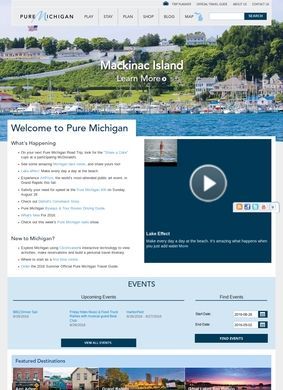
Live webcams pointed at Michigan beaches, ski runs and downtown skylines stream right on the official state tourism site. Anyone can check real conditions before committing to the drive. It is an odd, practical touch for a government marketing arm, and it hints at what Pure Michigan is built to do.
The site belongs to the Michigan Economic Development Corporation, so its purpose is plain: pull travelers toward the state and hand them every reason to go. A tourism board could coast on stock photography and slogans; running live cameras is a small promise that the place looks this good right now, straight off the lens and not from some flattering archive shot.
The planning tools carry most of the load. A destination finder narrows the state down by what a person actually wants to do, an interactive regional map splits Michigan into its distinct corners, and an event search gathers festivals and seasonal happenings onto a single calendar. The finder and the map are meant to work together: pick an interest, land on a region, then drop into the towns inside it, so a person who starts with nothing more than a free weekend and a full tank ends up with somewhere real to point the car.
A printable travel guide can be ordered for anyone who still likes paper in the glovebox, and an e-newsletter pushes updates to people who opt in.
None of it is exotic. It is the plumbing a trip-planning site needs, sitting in the open where a first-timer can reach it without hunting through menus. What Pure Michigan does well is put the whole spread in one findable place, so a visitor is not bouncing between a dozen tabs to piece a trip together.
The state, sorted by experience
Content on Pure Michigan is arranged by the kind of trip a traveler has in mind instead of a flat alphabetical list of towns. Family-friendly outings, outdoor adventures and trails, urban exploration, dining, and seasonal activities each get their own lane. That structure suits how people really plan, since most arrive with a mood or an occasion in their head before they have settled on a place. Someone after a quiet week on the water and someone chasing a weekend of restaurants and nightlife take two different doors into the same site, and both doors are marked.
Under those categories the site stacks trip ideas and full itineraries, road-trip guides, accommodation listings, restaurant recommendations, and the festival calendar. The itineraries do the connective work, stringing individual stops into a route a traveler can follow instead of leaving them to assemble the pieces alone. Road-trip guides fit Michigan well, given a state whose distances and long shoreline reward a car and a loose plan. The accommodation and dining listings widen the picture, so a single visit can settle where to sleep and where to eat alongside what to see.
The seasonal angle deserves its own mention. Michigan is a different destination in deep winter than at the height of summer, and Pure Michigan keeps both versions live, so a family weighing a beach week and a couple planning a ski weekend each find current material instead of one frozen snapshot of the state.
The festival calendar ties the whole thing to a clock. A traveler who wants a reason to go on a particular weekend can search the events, find a fair or a music series in a given town, and build the trip around it instead of arriving into a quiet week with nothing on. That timing layer is what turns a browsing session into a booked date.
There is a catch worth naming. Whether the restaurant and lodging picks reflect genuine quality, or simply which businesses chose to take part, is left for the reader to work out. This is not a neutral business directory weighing every option equally; it is a site built to promote a place, and Pure Michigan is exactly that kind of site.
Accessible travel and virtual tours
Accessible travel gets real estate here, not a token line buried in a footer. Pure Michigan carries accessible-travel options as a browsing category and backs the category with virtual accessibility tours, which let a visitor preview a location before deciding whether it will work for them.
That preview matters more for this audience than for most. A traveler planning around mobility limits, sensory needs or a wheelchair often cannot afford to gamble a long drive on a venue that turns out to be unusable, and a virtual walk-through of the space removes a real chunk of that guesswork.
It is one of the more concretely useful features on the whole site, and it reads as an actual accommodation instead of a checkbox. The destination finder and the accessible-travel filter working in tandem mean a wheelchair user can shortlist places that have already cleared the bar, then confirm them with a tour before booking anything.
Meetings Michigan
Alongside the leisure material sits Meetings Michigan, a separate division aimed at business and meetings travel. This is where the economic-development mission shows its hand. Planners looking to bring a conference or a corporate gathering into the state get their own track, kept apart from the family-vacation and road-trip content so neither audience wades through the other's material.
Keeping the two streams distinct is a sensible call. A meeting planner comparing venues and a family picking a lake town want almost nothing in common, and folding both into one feed would have served each of them worse. The division signals that the state treats convention business as its own line of work, with its own front door, while the main Pure Michigan site stays pointed squarely at the holidaymaker.
Beyond the core site, Pure Michigan runs across Facebook, Instagram, Pinterest, TikTok, Twitter and YouTube, so the trip ideas and destination photography spill onto whatever platform a given traveler already scrolls through. The material is built to travel, and the seasonal webcams give those feeds something fresh to point at through the year.
The audience spans families weighing a summer week up north, couples after a food-and-wine weekend, outdoor people mapping trails, and anyone who has to confirm a destination is genuinely accessible before loading the car. Pure Michigan gathers all of them under one roof and hands each group a defined place to start, which is a fair amount for a single site to manage without feeling scattered.
The doubt that lingers is one of vantage point. Everything on Pure Michigan is curated by the outfit whose job is to fill the state's hotels and restaurants, which means the enthusiasm is genuine and the incentive is never neutral. A traveler still has to verify that a listed restaurant is open, that an itinerary is current, and that a recommendation reflects merit and not simply a business willing to be featured, and the site gives no obvious way to tell the difference from the inside.
The breadth is genuine, the tools work, and the accessible-travel effort stands out. Whether the picture a visitor comes away with is the honest one or the polished one is the question Pure Michigan cannot answer about itself.