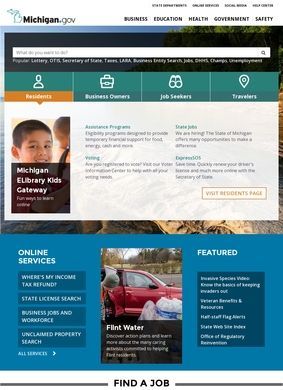
Almost every routine interaction a person has with Michigan state government (renewing a license plate, enrolling in Medicaid, forming an LLC) runs through a single domain. The State of Michigan portal pulls together the online work of every executive branch department into one place, and the sheer breadth of what sits behind the front page is what defines it. This is less a website than a switchboard, routing residents, business owners, job seekers, and out-of-state filers to whichever agency owns their problem.
A single portal for many departments
That consolidation is the point and also the challenge. A site that has to answer for the Secretary of State, health and human services, insurance regulation, business licensing, unemployment, and civil rights all at once cannot be tidy in the way a single-purpose service is. What the State of Michigan has done instead is build on a shared login layer and a department-by-department structure, so that the State of Michigan portal feels less like one giant app and more like a directory of doorways. Whether that works for any given visitor depends a lot on how clearly they already understand which department handles their task.
Secretary of state services covered
The Secretary of State section carries the heaviest everyday traffic, and it shows in how much it covers. Driver licenses and state ID cards, vehicle registration and titles, voter registration and election information, plus the less glamorous machinery of Uniform Commercial Code filings and lien searches all live here. There is also a set of industry services aimed at driver education providers, agricultural vehicle operators, and driver testing businesses, along with accommodations for military members and veterans. The SOS pages are clearly built to absorb the volume of people who only ever touch government through their car and their vote.
Business formation through LARA and DIFS
Business formation runs through the Department of Licensing and Regulatory Affairs. Anyone setting up a corporation or LLC, changing a resident agent or registered office, or chasing a professional license will end up in LARA's territory, which also fields complaints against licensed professionals. The Department of Insurance and Financial Services sits alongside it, regulating banks, credit unions, insurers, agents, and mortgage lenders, and pairing that oversight with consumer protection and financial education material. One office decides who gets to operate; the other watches how they behave once they do. The State of Michigan has placed both agencies in close proximity on the portal, which for regulated businesses is a practical convenience.
Health and human services programs
Health and social programs are handled by MDHHS, and the list there is long enough to feel its own weight. Medicaid enrollment, child welfare licensing, weatherization assistance, mental health services, dental and prescription drug programs, cancer screening, family planning, and a route for complaints against child caring institutions. These are the services people reach for at difficult moments, and the State of Michigan has grouped them under one departmental umbrella, avoiding the fragmentation of separate agency sites. The grouping is logical even if the volume of links can be a lot to take in on a first visit.
Unemployment benefits and job listings
On the work side, Labor and Economic Opportunity runs unemployment insurance through the MiUI platform, which also handles quarterly wage reports, new business registration, and tax filings for employers. Workforce development sits in the same department, alongside a state employment section listing government jobs across IT, administrative, and executive roles. The State of Michigan covers both ends of the labor relationship in one departmental corner: the person looking for work and the agency doing the hiring.
MiLogin single sign-on system
The piece that ties much of this together is MiLogin, the single sign-on system for individuals and organizations. Instead of requiring separate credentials for unemployment, business filings, and health programs, the State of Michigan funnels access through one account. For anyone who deals with more than one agency, that is a genuine convenience. A unified login is the kind of infrastructure decision easy to overlook but quietly determines whether the whole portal feels coherent or fragmented. The investment shows in how department-to-department hand-offs feel less jarring than they otherwise would.
Civil rights and environmental data access
The State of Michigan portal also reaches into civil rights, transportation, and public safety records, and surfaces environmental data through MiTracking. These connect through their respective agencies, leaving the central pages from growing unwieldy by rehousing what already lives elsewhere. A visitor sometimes hands off from the State of Michigan hub to a more specialized agency environment, and the consistency of that experience varies by corner.
Is the portal built for browsing?
Worth saying plainly: the State of Michigan portal is built around tasks, not around browsing. Someone who arrives knowing they need to register to vote, file a wage report, or check on a Medicaid application will generally find a path. Someone arriving without a clear errand may find the density harder going, because the State of Michigan is organized by departmental logic, and the navigation follows that structure, not the questions a confused resident would tend to form.
Learning the departmental org chart
That departmental framing is the recurring tension across the whole thing. It is comprehensive and authoritative, and for the transactions people need it for it is the correct destination, often the only legitimate one. A person who does not already know that business entity filings belong to LARA, or that unemployment lives under Labor and Economic Opportunity, has to learn the org chart a little before the site fully opens up. Search and the MiLogin dashboard soften that, but they do not erase it. A few of the deeper LARA and DIFS pages still feel written for professionals rather than first-time filers.
For businesses operating in Michigan, the value is concentrated. The combination of LARA for formation and licensing, DIFS for regulated financial activity, and the MiUI side of LEO for employer obligations means a company can handle most of its compliance life cycle through the State of Michigan without chasing scattered offices. Out-of-state entities that need to file or register in Michigan get the same channel. This audience, the people who return on a schedule and learn its layout out of necessity, is where the State of Michigan portal performs most reliably.
Residents have a broader but shallower relationship with the State of Michigan portal. Most will visit a few times a year, around a license renewal, an election, or a benefits question, and for those moments the site does its job. The depth of MDHHS programs means the State of Michigan can carry someone through more than the obvious transactions, into weatherization help, prescription drug programs, or family planning services many residents did not know were available in one place.
The overall picture is favorable but measured. As the authoritative source for Michigan government services, the State of Michigan portal is the right place to start and finish almost any official errand in the state, and the unified login plus the deep departmental coverage make it more than a link farm. The honest caveat is that its structure follows bureaucracy rather than intuition, so the experience rewards visitors who arrive with a specific task and a rough idea of which department owns it. Treated as a tool for getting something done, it performs well. Treated as a place to wander and discover, it asks more patience than many visitors will want to spend.