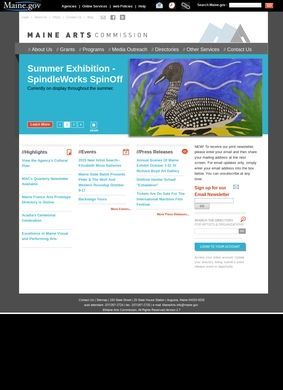
Percent for Art is the kind of line item that tells you what the Maine Arts Commission really does. State capital construction projects set aside a slice of their budget for public art, and the commission steers that money into murals, sculpture, and installations that end up in schools, courthouses, and other public buildings around the state. It is a quiet, durable mechanism, and it sits alongside a grant operation that reaches individual artists through fellowships and arts organizations through project funding.
Grants and fellowships for artists
Grants are the spine of the site. An artist looking for a fellowship, or a small nonprofit trying to fund a single season of programming, will find the Maine Arts Commission application paths laid out here. The commission also runs an apprenticeship program that pairs master folk artists with emerging practitioners, which is a more specific and more interesting commitment than the usual broad call for proposals. Folk and traditional arts get real attention, not a token mention buried three clicks down.
Arts in education programs
The education work is substantial. Arts in Education connects teaching artists with K-12 classrooms, and the commission keeps a roster of those artists so schools can find someone who fits. Poetry Out Loud, the statewide student recitation competition, runs through the same office, giving the calendar a recurring event that students and teachers can plan around year to year.
Creative practice in healthcare
Less expected, and to me one of the more compelling threads, is Arts in Health, which places creative practice inside healthcare settings rather than treating art as an after-hours leisure pursuit. Pair that with the Shared Tables Shared Stories community gatherings and you get a picture of an agency that thinks of art as something that happens in waiting rooms and at dinner tables, never confined to galleries. The reach goes wider still: emergency resources for artists in crisis, veteran artist support, and accessibility initiatives all have a place on the site, which is more breadth than a casual visitor would expect from a state commission. Each of those threads gets its own landing area with eligibility notes, so a visitor is not left guessing whether a given program is meant for them.
Online directories and calendars
For day-to-day usefulness, the practical tools matter as much as the programs. The Maine Arts Commission maintains an online artist directory that functions as a working business directory for arts professionals, a teaching artist roster, and an event and opportunity calendar that aggregates calls for artists across the state. These are the pages a working artist will return to more than once, and the value of any directory comes down to whether it is kept current. The brief does not tell me how fresh the listings run, so that is the one thing worth checking before relying on it for a deadline.
Professional development for artists
The Creative Career Lab rounds out the offering with professional development aimed at artists trying to treat their practice as a livelihood. That framing tends to be missing from arts pages, which lean toward exhibition and prestige and skip the part where rent has to be paid. Press releases and a newsletter handle the announcement side, so anyone who wants to track new grant cycles or program launches has a way to stay current without refreshing the homepage every week. It is a sensible spread of resources, and it covers the gap between inspiration and the unglamorous business of getting paid.
Public art funding mechanism
What holds the whole thing together is a clear sense of audience. The Maine Arts Commission serves several constituencies at once, and the site is built accordingly: individual artists, arts organizations, educators, schools, healthcare institutions, and communities spread across a large and largely rural state. Serving all of them from one site risks a sprawl that buries the thing you came for, and the sheer number of Maine Arts Commission programs means some navigation patience is required. That is the cost of doing this much.
Multiple audiences, one site
The Maine Arts Commission earns a genuine recommendation with one honest qualifier. The range of programs is strong, from the Percent for Art mandate to the artist emergency resources, and the agency clearly does more than write checks. The site is a destination an artist, teacher, or organization in Maine should bookmark and return to. The caveat is purely practical: the usefulness of the directories and the calendar depends on how often they are updated, and a first-time visitor would do well to confirm that what they are reading reflects something current before building a plan around it. On substance, the commission delivers; the only open question is upkeep, and that is something the visitor can settle with a minute of clicking through live listings.