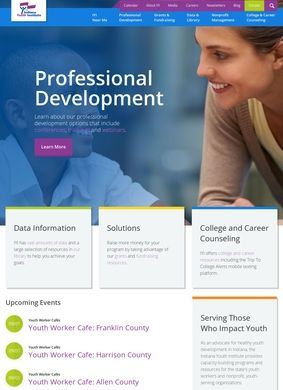
A youth worker in a small Indiana town can sit down at The Indiana Youth Institute's site and pull up EBSCO academic databases, the kind of paywalled research collections most people only reach through a university login. Academic Search Complete, Child Development and Adolescent Studies, Sociology Source Ultimate, and a general Reference Center are all handed over free. For a sector that rarely has a research budget, that single feature is the surprise, and it sets the tone for what The Indiana Youth Institute is.
This is a statewide nonprofit whose job is to improve outcomes for children across Indiana by strengthening and connecting the people, organizations, and communities that work with young people. It does that on two fronts at once: as a data house and as a training and support hub. The two reinforce each other, and the site is organized so a visitor can move between them. The Indiana Youth Institute has arranged things so the research feeds the training and the training feeds the organizations it consults, which keeps the whole from reading like three unrelated products under one roof.
What the institute puts in front of youth workers
The offering is wide, and it rewards a slow read over a quick scan. Data sits on one side, professional development and organizational support on the other, and a community vision called FIVE by 50 ties the whole thing together: the idea that every child should have five supportive adults in their life by the year 2050.
That number is a useful lens for the rest of the site, because almost everything The Indiana Youth Institute publishes points back toward putting more capable adults around Indiana's children.
The data operation, from KIDS COUNT to the County Dashboard
The research side is the strongest part. The Indiana KIDS COUNT Data Book is the annual statewide report on child well-being, and in its latest edition Indiana came in ranked 29th, a middling figure that gives the institute its central problem to work on. Around that book sits a Data Hub of youth-related indicators and an interactive County Dashboard that lets a user drill down to their own county instead of settling for a state average.
For a policymaker or an advocate building a case, county-level numbers are the difference between an argument that lands and one that stays abstract. The dashboard is genuinely interactive, not a static PDF dressed up as a tool, and that difference is what lets a local advocate assemble a county case in an afternoon instead of a week.
Then there are the EBSCO databases already mentioned, which turn The Indiana Youth Institute from a publisher of its own figures into a gateway to the wider academic literature. A youth worker researching adolescent development does not have to hit a paywall or fake a student affiliation. That is a practical, unglamorous service, and it is the sort of thing that separates an organization that talks about supporting the sector from one that actually spends money doing it.
Training, cafes, and worker well-being
On the professional-development side, The Indiana Youth Institute runs webinars, conferences, and trainings aimed squarely at youth workers, plus local Youth Worker Cafes that exist for networking rather than instruction.
There is College and Career Readiness training and consulting for people guiding students toward what comes after school. The mix covers both the formal, sit-in-a-conference-room kind of learning and the looser, meet-your-peers kind, useful in a field where isolation is a real problem. The Indiana Youth Institute's Youth Worker Cafes in particular fill a gap that formal training misses, giving people in a scattered, underpaid field a low-stakes reason to compare notes with peers who understand the work.
The Youth Worker Well-Being Project deserves its own mention. It addresses the stress and burnout that run through the sector, and its presence says something about how The Indiana Youth Institute reads its audience. Youth work chews people up, and an organization that builds a whole project around the well-being of the workers themselves, alongside the kids, is paying attention to a problem most funders would rather ignore.
Affiliate roles and named initiatives
The Indiana Youth Institute also carries a set of named initiatives that extend its reach past its own walls. MENTOR Indiana is the state affiliate of MENTOR: The National Mentoring Partnership, a role the institute has held since 2008, which plugs Indiana into a national mentoring network.
Promise Indiana is a postsecondary-readiness initiative pointed at getting students prepared for college and career. Consulting for youth-serving organizations and a set of grant opportunities round out the support on offer, so a small nonprofit can lean on The Indiana Youth Institute for expertise, funding leads, and a mentoring framework at the same time. The 2008 start date on the MENTOR Indiana affiliation matters, because a relationship that has run that long signals the national partnership trusts the organization to represent the state, not a badge picked up last year.
Taken together, these programs explain how one organization tries to move a statewide number. It works through other organizations. The consulting, the affiliate roles, and the grants are all ways of strengthening the groups already on the ground, which is a more durable approach than trying to serve every child directly. Educators, policymakers, and community advocates all sit within the audience alongside the frontline youth workers.
Standing and how to reach it
On credibility, the outside marks are good where they exist. Charity Navigator gives The Indiana Youth Institute a full four-out-of-four-star rating, which is the strongest independent signal here, since Charity Navigator grades on finances and accountability rather than sentiment. A GuideStar nonprofit profile exists as well, though no numeric score showed up for it. The organization is also listed as Indiana's state affiliate on the national KIDS COUNT Data Center, which is less a review than a confirmation that the wider network treats it as the official state partner.
No consumer review-site ratings from the likes of Yelp, Google, or Trustpilot turned up, which is unsurprising for a policy-and-training nonprofit; those platforms are built for restaurants and retailers, not statewide child-advocacy groups, and their absence says nothing against the institute. What is missing on the consumer-review front is more than covered by the Charity Navigator score, the rating that actually speaks to how an organization like this one handles the money it is given.
Contact is straightforward and openly posted. There is a phone line, an email address, a downtown Indianapolis address, and a contact form, plus county-based Outreach Manager connections that route a visitor to a specific person for their part of the state. That last piece fits the organization's whole model. A youth worker in one county is not left emailing a general inbox but pointed at the manager who covers their ground. Someone who first came across the name in a business directory listing finds the same phone line and address waiting, no extra digging required.
That structure quietly answers the usual complaint about statewide nonprofits, that they are hard to reach from the far corners of the state, and it fits an organization built to work through local people.
Weigh the pieces and the shape is clear enough. The Indiana Youth Institute is a research and capacity-building organization first, a direct-service provider second, and the free academic databases plus the county-level data are the parts a working professional will use most. The 29th-place ranking in the latest KIDS COUNT book is the figure the whole apparatus is built to move, and the data, the trainings, the mentoring affiliate, and the FIVE by 50 vision all bend back toward that one number.