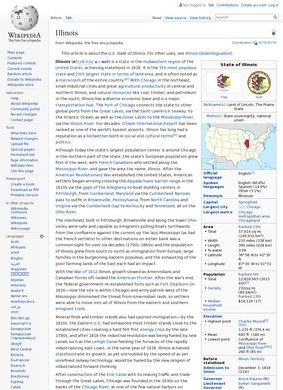
Three U.S. presidents are tied to one state, and Wikipedia-Illinois puts that front and center: Abraham Lincoln, Ulysses S. Grant, and Barack Obama all belong to the Illinois story, and the entry treats that as a fact to document rather than a point to brag about. Wikipedia-Illinois reads like a working reference, dense with figures and citations, covering the state from its pre-European past through to its present-day government. If you came looking for one place that holds the whole picture of Illinois, this is close to it.
History from Cahokia to statehood
The history section is where Wikipedia-Illinois does its most thorough work, and it does not start where most people expect. Before any French trappers or British administrators, there was Cahokia, the mound-building civilization near present-day Collinsville, now a UNESCO World Heritage Site. The article walks through that pre-Columbian settlement, then the French colonial period, British rule, the territorial years, and statehood on December 3, 1818, when Illinois became the 21st state. That sequence resists the usual habit of treating American state history as beginning with European arrival. The page gives the older settlement its due space and connects it to the wider historical record without making a fuss about doing so.
Geography and regional divisions
Geography gets similarly concrete treatment in Wikipedia-Illinois. The state covers 57,914 square miles, making it the 25th largest, and the article fixes its borders with the rivers and lake that define it: Lake Michigan to the northeast, the Mississippi to the west, the Wabash and Ohio to the south and southeast. There is even the small, oddly satisfying detail that the highest point is Charles Mound at 1,235 feet, a reminder that Illinois is not a state defined by elevation. The entry divides the state into three regions: the northern Chicago metro area, the central agricultural belt, and Southern Illinois, noting the climate shift from humid continental in the north to humid subtropical further down. That regional framing is genuinely useful, because Illinois is one of those states where the north and the south can feel like different places entirely.
Population, government, economy
On population and government, the numbers are laid out plainly. Roughly 12.7 million people live there, making it the sixth most populous state. Springfield is the capital, Chicago is by far the largest city, and the state runs on a bicameral General Assembly with J.B. Pritzker as the current governor. Wikipedia-Illinois keeps the capital-versus-largest-city distinction clear, which is worth doing, since plenty of readers assume Chicago is the seat of government when it is not. The article also folds in the economic shape of the state: the fifth-largest GDP in the country, leaning on agriculture, with corn and soybeans named outright, alongside manufacturing, services, and a notable nuclear power capacity.
Sourcing and verifiable data
Economics is where Wikipedia-Illinois quietly earns trust, because it pins a number to the claim. The median household income is given as 80,300 dollars, with the year of the figure attached, which is exactly the kind of sourcing discipline that separates a reference entry from a summary someone wrote from memory. Numbers like that age, and the article is honest about when they were measured. The inline citations throughout let a reader trace where a given figure came from, and the reference list at the bottom is where the entry stops being a narrative and becomes a research tool. That shift from readable prose to verifiable source list is what makes the page worth bookmarking and returning to repeatedly.
Education and cultural institutions
Education and culture get their own attention in Wikipedia-Illinois, and the names carry real heft on their own. The University of Chicago, the University of Illinois system, and Northwestern University all appear, giving a quick sense of the academic gravity of the state without overselling it. Cahokia Mounds returns here as a cultural landmark as much as a historical one, which is a smart piece of internal cross-referencing. The article does not pad these mentions with adjectives. It names the institutions, places them, and moves on, which is the right instinct for a reference that wants to be consulted, not admired.
Beyond the headline sections, Wikipedia-Illinois keeps going into areas that often get neglected in state overviews: law, politics, infrastructure, transportation, sports franchises, and a roster of notable people. The transportation and infrastructure material gives Illinois its proper role as a national crossroads, which is easy to forget if you only think of the state in terms of Chicago and farmland. Illinois sits at the intersection of rail lines, interstate highways, and river freight routes that connect the coasts to the interior, and the article captures that without turning it into a geography lesson. The notable-people section is the kind of thing readers drift into and lose half an hour to, and that is a feature, not a flaw.
What makes Wikipedia-Illinois work as a starting point is the scaffolding around the prose. External links point to government and academic sources, so the entry functions as a hub with outward links, not a closed summary. Navigation to related state articles means a reader comparing Illinois with its neighbors can move sideways without searching again. The content also exists in multiple languages on the same platform, which extends the audience well past English readers. For a free reference, that reach extends Wikipedia-Illinois to an audience well beyond what an English-only resource could manage.
There are limits worth naming, and they are the limits of the format itself. A general state overview cannot go deep on any one subject. The history of Cahokia, the structure of the General Assembly, the economics of Illinois agriculture: each of these has scholarship far richer than a single encyclopedia section can contain, and Wikipedia-Illinois is best understood as the doorway to that scholarship rather than a substitute for it. The article is also only ever as current as its last edit, and figures like population and median income shift between updates. A reader who needs the latest number should treat the cited year as the real authority and chase the source directly.
Wikipedia-Illinois handles the breadth of the state well, and the sourcing is meticulous enough to be useful citation by citation. Where the page has a built-in ceiling is the gap between coverage and depth: it tells you, accurately and with references, that the state has the fifth-largest GDP, a significant nuclear capacity, and three regions that barely resemble each other, but it cannot tell you why any of those things came to be in more than a paragraph. For a reader who wants the shape of Illinois, that is enough. For a reader who wants to understand it, the page is honest enough to keep pointing elsewhere, and that honesty is its most underrated quality as a reference.