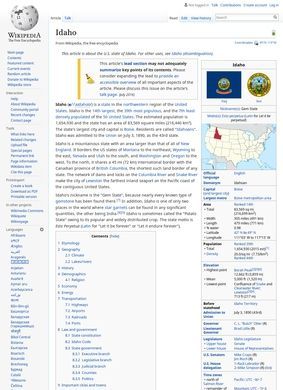
One open page can tell you a surprising amount about a U.S. state before you ever look at a map. Wikipedia: Idaho opens with what most visitors arrive looking for: statehood on July 3, 1890 as the 43rd state, Boise as the capital, and a land area of 83,569 square miles placing it 14th largest in the country. The infobox at the top pulls official symbols, government structure, and headline demographic figures into a single scannable block, so someone wanting the two-line answer and someone ready to read for an hour are both served from the same starting point.
Mapping geography and federal land
The geography section earns its depth. It traces borders, mountain ranges, and river systems, with the Snake and Clearwater both getting attention, and it names Borah Peak as the high point at 12,661 feet. Federal land is broken out properly: national parks, monuments, and wildlife refuges listed alongside state parks. Climate is handled by region with actual temperature data, the sort of detail a casual reader skips and a student or a family planning a move will stay for. None of this is padding; it holds together as a working introduction to a physically varied state.
Tracing history from settlement to statehood
The history coverage runs from prehistoric settlement through the Native American tribes tied to the land, including the Nez Perce, Shoshone-Bannock, and Coeur d'Alene, then through the territorial period to statehood. That ordering puts the people who were there first ahead of the administrative story, and Wikipedia: Idaho does so without flattening either into a throwaway paragraph. The pre-statehood sections feel genuinely researched, not assembled from the standard template.
Population and energy statistics
Demographic material is current enough to be useful. Population sits at roughly two million on the 2025 estimate, and the page breaks down racial and ethnic composition, language, and religion with supporting statistics. Economics is concrete: Idaho grows about a third of the country's potatoes, and the page does not bury that figure. Income and sales tax rates are stated plainly. One number stands out across the whole entry: 75 percent of the state's energy came from renewable sources in 2022. That is a specific, sourced claim rather than a general impression, and the difference matters: a reader can pull a sourced figure into a citation, whereas an unsupported claim forces a second round of searching. Wikipedia: Idaho earns its usefulness precisely by including numbers with attributed years, giving any downstream user a clear starting point for verification.
State services from transport to education
Government, transportation, education, public health, sports, and culture each get their own section in Wikipedia: Idaho. The three branches are described, current officeholders named, and the state constitution summarized. Transport coverage stretches across highways, airports, railroads, and ports. The education section separates K-12 from higher education. None of it is exhaustive on its own, and it is not meant to be. Each section points outward to a fuller subsidiary article, so Wikipedia: Idaho works as a hub that routes readers toward where the real depth is held. The structure keeps the main page navigable while the subsidiary pages carry the load of specialization.
Who the page serves
A school project pulling basic facts will find them fast. A reporter checking the potato figure or the renewable energy share has a sourced number to chase. A traveler scoping out national parks gets a starting map and a list of names to search next. Wikipedia: Idaho is not pitched at one audience, and it mostly holds all of them without slumping into vagueness. The protected federal areas alone point toward enough secondary reading to keep a curious person busy for an afternoon, and the lake and river entries do the same for anyone building a trip around water. Maps, photographs, and navigational templates sit throughout, and interlanguage links open the same material in dozens of other languages. Nothing is gated behind registration.
Checking accuracy of dated statistics
The caveat is the one that follows any encyclopedia entry on a subject this large. A state is a moving target. Population estimates shift, officeholders change, tax rates get revised, and the 2022 energy figure is already a few years behind whatever the current mix looks like. Wikipedia: Idaho carries its facts well at the moment of reading, but a moment is all any version of it can promise. The more specific a number, the faster it ages. Anyone using the page to inform a decision should treat the dated statistics as a prompt to verify, not as a final word. That gap between what the page says and what is true right now is the only real limitation on an otherwise well-structured resource.