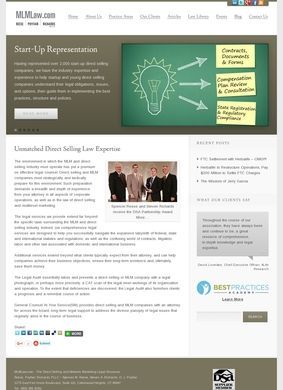
Multilevel marketing companies need somewhere to turn when a regulator questions their income claims or a foreign distributor agreement falls apart. The answer that mlmlaw.com puts forward is Grimes & Reese, P.L.L.C, a law firm that has done nothing but direct selling and network marketing law since 1996. That single-industry commitment is rare enough that it shapes how the rest of the site reads. Most firms that touch this area treat it as a sideline within a broader commercial practice. Here it is the entire practice, and the site is built around proving that point.
Four practice areas
The firm sorts its work into four areas, and the breakdown is specific enough to be useful before anyone picks up a phone. Sales and marketing covers product claims, labeling, advertising, promotional material, contests and sweepstakes, and intellectual property, which is the cluster of issues that tends to draw regulatory attention in this industry.
The international column handles selecting foreign counsel, cross-border IP, and contracts for products sold abroad, a real concern for any seller that expands past the United States, and an area where Grimes & Reese, P.L.L.C clearly expects its clients to grow. Contracts is its own pillar: distributor agreements, supplier and vendor deals, manufacturing, real estate, and telecommunications. The fourth area is training, where Grimes & Reese, P.L.L.C prepares legal sessions for employees and distributors on the two topics that get MLM companies into trouble most often, income and earnings representations and product claims.
That last category is worth dwelling on. A distributor who overstates what a product cures, or what a recruit can earn, creates liability that lands on the company. Building training around those exact pressure points shows the lawyers behind Grimes & Reese, P.L.L.C have watched the same problems recur across many clients and decided prevention is cheaper than defense. Whether a given company needs that depends on its size and sales culture, but the logic is sound.
Client roster and recognition
The client roster is the part that will make people sit up. The site says Grimes & Reese, P.L.L.C has represented more than 2,000 direct selling companies, and it names some that anyone in the field would recognize: doTERRA, Herbalife Nutrition, Arbonne, 4Life Research, Melaleuca, FreeLife, and Oxyfresh Worldwide. Those are not small accounts. A firm of this size landing repeat work from companies of that scale counts for a lot, since large MLM operators have in-house counsel and outside options and still choose to bring specialized matters here. The named attorneys are Kevin D. Grimes and Spencer M. Reese, with a third lawyer, Steven A., appearing in directory listings without a full surname recorded.
Law library resources
Beyond the casework, the site doubles as a reference point. There is a Law Library section, and the firm posts legal news updates tracking developments that affect the industry, the most recent being the FTC non-compete rule. Keeping that feed current is a modest effort that tells a visitor something. A firm like Grimes & Reese, P.L.L.C that maintains that feed is reading the same filings its clients should be worried about, and is willing to put some of that thinking out in public where prospects can judge the quality before hiring. It also tells a visitor the site is tended rather than abandoned, which is not a given for professional firms whose web presence often freezes years out of date.
Is the #1 claim reliable?
The branding leans hard on a single claim. The header calls the firm "The #1 Resource for MLM Legal Assistance," which is the kind of superlative no outside body confirms. Read it as marketing and move past it. The substance underneath, a quarter century of focus and a recognizable client list, does more than the headline does, and a reader can weigh the evidence without taking that line at face value.
Contact hours and office location
On the practical question of reaching the firm, the contact details are refreshingly direct. A phone number sits up front, the hours are posted as Monday through Friday, 9am to 5pm Mountain Time, and there is both an email link and a contact form. A physical address is given in South Jordan, Utah. One small wrinkle is geographic: the firm describes itself as Idaho based, out of Idaho Falls, while the contact details point to a Utah office. That is not a contradiction so much as a detail a careful client would want to clarify, since a firm can keep more than one location, and the listing sits under Idaho while the published address reads Utah.
Checking outside reviews
Outside validation is where the picture gets complicated, and it is worth being honest about it. The firm has a profile on FindLaw and a listing on LawInfo through its Lead Counsel program, with attorney verification noted on the latter. What is absent is the consumer-facing layer: no star ratings or review counts surfaced on Google, Yelp, the Better Business Bureau, or comparable platforms. For a consumer business that absence would be a red flag. For a boutique firm like Grimes & Reese, P.L.L.C, whose clients are companies and not individuals, it is closer to normal, because corporate legal work rarely generates the public reviews that a restaurant or contractor collects. The named clients function as the real reputation indicator here, and they say more than a handful of star ratings would.
The site is candid that it serves a spectrum, from startups taking their first compensation plan to market through to multinationals managing legal exposure across borders. A new MLM founder unsure how to word an earnings disclosure and an established brand defending a labeling decision are very different clients, and the four-pillar structure is broad enough to hold both. The risk in serving that wide a range is dilution, but the long client history suggests Grimes & Reese, P.L.L.C has managed it by staying narrow on industry while flexible on company size.
Caveats for prospective clients
A few caveats keep this grounded. The site is a marketing presence, so the claims it makes about itself are unverified by anyone but the firm, and a prospective client should confirm the 2,000-company figure and the named representations through their own diligence. The absence of independent consumer reviews means a first-time hirer cannot lean on crowd-sourced reassurance and will have to evaluate the lawyers more directly, through references, a consultation, or the published work in the Law Library. None of that undermines the listing; it just means the homework falls on the visitor.
Taken together, the entry for Grimes & Reese, P.L.L.C reads as a credible specialist practice that knows exactly what it does and has the track record to back the focus. The practice areas are described with enough specificity to be verified, and the client names are the sort that are hard to claim without consequence if false. The headline oversells; the substance does not need to. A direct selling company with a real legal exposure and a need for counsel that lives in this corner of the law full time has a clear case for Grimes & Reese, P.L.L.C. The depth of specialization at Grimes & Reese, P.L.L.C is uncommon, and for regulatory matters that depth is the point.