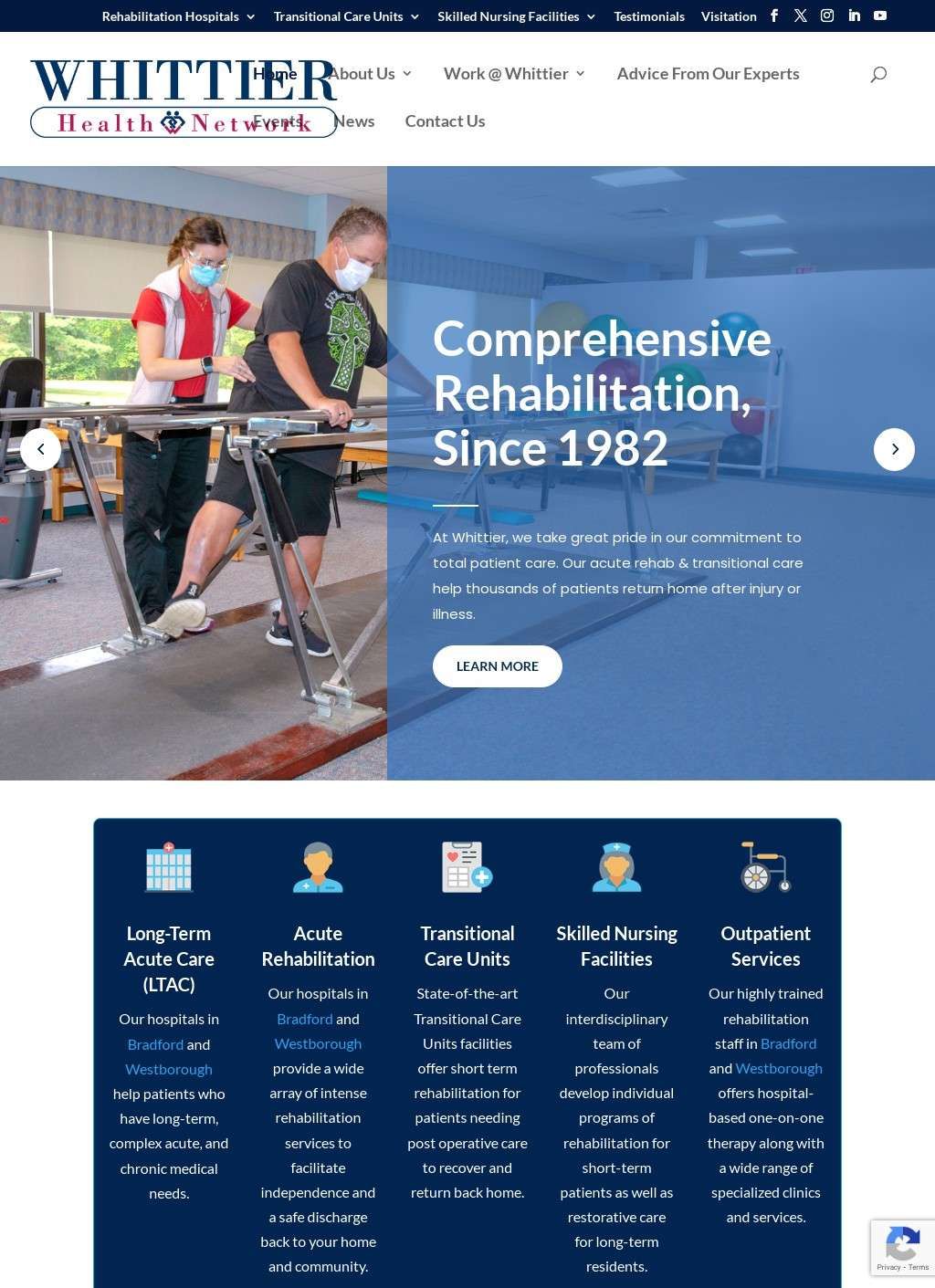
Where does someone go after a stroke, a bad surgery, or a long stretch on a ventilator, when they need more than a nursing home but are not ready to go home? Whittier Health Network was built for exactly that gap. The Massachusetts system, running since 1982, operates two inpatient rehabilitation hospitals, one in the Bradford section of Haverhill and one in Westborough, and it handles the cases that fall between acute hospital care and ordinary recovery. Both campuses provide acute inpatient rehabilitation alongside Long-Term Acute Care, the level reserved for patients whose medical needs stay complicated even after the immediate crisis has passed.
Stroke rehabilitation and ventilator weaning
The clinical range is the most convincing thing on the site, because the conditions named are the ones that genuinely require specialist hands. Stroke rehabilitation sits next to pulmonary rehabilitation and ventilator weaning, which is a slow, technical process that most general facilities are not equipped to manage. Wound care and prosthetics and orthotics round out the picture, so a patient learning to use a new limb and a patient being weaned off breathing support can both be treated inside the same network. That breadth is not padding. Each of those programs answers to a distinct kind of patient, and listing them with specifics points to a real care line with depth behind it, not a surface summary where only the headline names show up.
Transitional care units on both campuses
Between the hospital admission and going home, each site runs a Transitional Care Unit for post-operative and post-acute recovery. This is the part of the journey people rarely plan for: the surgery went fine, but the body still needs structured, supervised time to come back. Placing those units on both campuses means a patient in central Massachusetts and one near the New Hampshire border can find the same step-down level close to home. Family visits are part of how someone heals, and proximity is not a small thing when the stay stretches into weeks.
Outpatient therapy options
Outpatient services extend the reach past the inpatient walls. Physical, occupational, and speech therapy are the expected core, and the addition of aquatic therapy is worth noting because warm-water work suits patients whose joints or weight-bearing limits make a standard gym floor painful or impossible. Someone who has finished an inpatient stay at Whittier Health Network can keep going on an outpatient schedule through the same organization, which spares the awkward handoff to an unfamiliar clinic that often stalls recovery.
Why call one organization instead of many?
The stated mission is regional: eastern and central Massachusetts, served by a connected set of programs rather than a single building. For a family scrambling to arrange care for a relative who has just been told they need weeks of rehabilitation, that regional framing is practical. It tells them there is one organization to call instead of a scattered list of unrelated clinics, and that the level of care can shift as the patient improves without starting the search over.
How to reach admissions
Reaching Whittier Health Network is straightforward, and that counts for a lot when the person making the call is stressed and short on time. A central admissions line is published, which is exactly the number a discharge planner or worried relative needs first. Beyond that, the site breaks out separate main, outpatient, and transitional care phone numbers for both the Bradford and Westborough campuses, so a caller is not forced to guess which department they want or get bounced around a switchboard. An online inquiry form is there for anyone who would rather start in writing.
Employee and patient reviews
Outside opinion is sparser than the clinical detail on the site, and most of what exists comes from staff, with patient voices underrepresented. On Glassdoor the network carries about 101 employee reviews averaging four out of five, and Indeed shows more than 126 employee ratings, again from the workforce side. Those are useful in their own way: places that treat clinical staff well tend to deliver steadier care, and a four-star employer score in a demanding field is not nothing. Patient-facing feedback is less common, though Birdeye lists a dozen reviews at a strong 4.6 out of five. The numbers are small enough that they should be read as a hint, not a verdict.
One detail deserves a level head. Whittier Health Network appears with the Better Business Bureau but is not BBB accredited and shows no rating there. That is a neutral fact more than a strike against it. Many established healthcare providers never pursue BBB accreditation because their oversight runs through state health departments and clinical licensing bodies, which govern healthcare quality directly; a business-rating service does not. A reader should not mistake the absent BBB rating for a quality signal in either direction.
Against the obvious alternative, a family in this part of Massachusetts will often weigh a freestanding rehabilitation provider against the rehab arm of a large general system such as Spaulding Rehabilitation, which carries the Mass General Brigham name and a long research reputation. Spaulding has the brand recognition and the academic gravity.
What Whittier Health Network offers in return is concentration: two purpose-built campuses, the full step-down ladder from Long-Term Acute Care through transitional units to outpatient therapy, and specialist lines like ventilator weaning and aquatic therapy under one roof, with admissions you can actually reach on the first try. Whittier Health Network does not try to be a general hospital, and that focus is the whole point. For a patient whose recovery is complex and likely to be long, Whittier Health Network is a serious and credible option, and the published information makes a strong case for putting it on the shortlist.