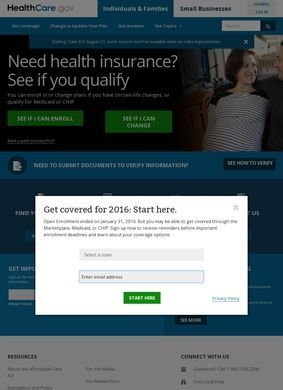
Most people land on HealthCare.gov once a year, during a narrow window, and only because they have no employer plan and no other obvious way to buy coverage. That is the specific job this site does: it runs the federal Health Insurance Marketplace created under the Affordable Care Act, for the roughly thirty-plus states that never built their own exchange. Run by the Centers for Medicare and Medicaid Services within HHS, it is the front door to subsidized individual and family health insurance for tens of millions of people who fall outside workplace plans.
Plan shopping and enrollment features
The core function is plan shopping and enrollment. You enter income, household size, and location, and the site sorts plans into the Bronze, Silver, Gold, and Platinum tiers, laying out premiums, deductibles, copays, and out-of-pocket maximums side by side. It also checks whether covered doctors and prescription drugs sit inside a given plan's network, which is the detail that actually decides whether a cheap premium is worth taking. For anyone who just wants a number before opening an account, the "See Plans and Prices" quick search returns estimates without forcing a full sign-up first, and that lowered barrier is a sensible piece of design.
Checking eligibility for subsidies
Money is the other half of the pitch. The site screens eligibility for premium tax credits and cost-sharing reductions based on income and household, which for many applicants turns a sticker price they would never pay into something manageable. It handles the calendar too: Open Enrollment dates, and the Special Enrollment Periods triggered by qualifying life events like losing a job, having a baby, or moving. If your income is low enough, it routes you toward Medicaid or CHIP instead of a marketplace plan, so the site functions as a triage point rather than a single dead-end product.
Translating health insurance language
Health insurance is a language of its own, and a lot of the value in HealthCare.gov is in translating it. There is a glossary that explains deductibles, networks, out-of-pocket maximums, and the rest in plain terms, plus educational pages aimed at first-time buyers who have never had to compare coverage on their own. That teaching layer matters, because the people most likely to need the federal exchange are often the ones with the least prior exposure to how any of this works.
Finding local navigators and assisters
The help does not stop at reading material. HealthCare.gov runs locator tools that point applicants to local navigators, assisters, and licensed agents or brokers who guide them in person at no charge. That combination of self-serve tools and human backup is the right shape for a service where a wrong choice costs real money and real access to care. There is also multi-language support and translated resources, along with accessibility features, which for a federal service covering the whole country is a baseline HealthCare.gov clearly takes seriously.
Reconciling tax credits after enrollment
Tax season gets its own attention as well. Anyone who took a premium tax credit has to reconcile it later against Form 1095-A, and HealthCare.gov walks through that step so the credit received during the year lines up with what the return says it should have been. It is unglamorous, and it is exactly the kind of downstream detail that trips people up months after they thought enrollment was finished.
Who can use HealthCare.gov?
Small employers are covered too, though more thinly. The SHOP marketplace gives small businesses a path to offer group coverage, and while it sits off to the side compared with the individual experience, its presence rounds out who HealthCare.gov is meant to serve. Individuals, families, and small employers all have a lane here, even if the individual lane is plainly the one the whole thing is built around.
State exchanges and service limits
The one structural quirk worth flagging is that HealthCare.gov is not universal. States that operate their own exchanges redirect you to their sites, so a resident of California or New York will find themselves bounced elsewhere. That is by design, but it does mean HealthCare.gov is a national brand that only fully serves part of the country, and a first-time visitor can be forgiven for expecting it to handle every state directly.
As a reference point outside of enrollment, the blog and newsroom carry deadline reminders and policy updates, which is useful during the crunch and easy to ignore the rest of the year. The information holds up because it comes straight from the agency that administers the program, so the rules, dates, and eligibility logic on HealthCare.gov are the authoritative version instead of a secondhand summary. When the subject is your own coverage, going to the source instead of a comparison-site interpretation is worth the trip.
The verdict is straightforward and a little conditional. For anyone in a federal-exchange state who needs individual or family coverage and might qualify for subsidies, HealthCare.gov is essentially non-optional and does its job well, with genuine effort put into plain-language explanation and human help. The caveats are modest rather than disqualifying: the state redirects can confuse, the small-business side is lightly developed, and the interface still asks a fair amount of patience during peak enrollment. None of that changes the bottom line. When you actually need it, HealthCare.gov is the place you go, and it earns that standing by being clear about cost, coverage, and who qualifies.