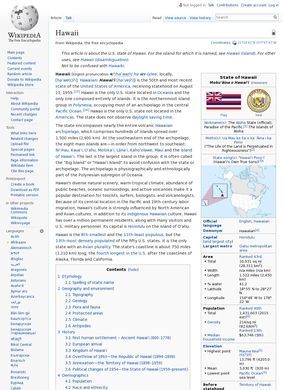
Someone planning a first trip across the islands, or settling an argument about whether Hawaii is one island or many, usually wants the basics fast and accurate: how the place is laid out, how it came to be a state, what makes its population unlike anywhere else in the country. That is the job this page does. The Wikipedia Hawaii article opens with the orientation a curious reader needs, then keeps widening the frame until almost every reasonable follow-up question has an answer waiting a click away.
Geography by the numbers
The geography section does real work. Wikipedia Hawaii lays out 137 volcanic islands strung across roughly 1,500 miles, with Mauna Kea climbing to 13,796 feet and a coastline near 750 miles, the fourth longest of any U.S. state. Those are the figures people get wrong in conversation, and having them stated plainly, with citations sitting right there, is the practical value of the thing. The climate is described as tropical with real regional variation, worth noting for anyone who imagines the whole archipelago shares one weather pattern. None of this is padded out. It reads like a reference that respects the reader's time.
Tracing the timeline from settlement to statehood
History gets similar treatment, and Wikipedia Hawaii handles it with more care than a casual visitor might expect. The article traces Polynesian settlement somewhere between 900 and 1200 CE, James Cook's European contact in January 1778, the unification of the islands under Kamehameha I in 1810, the 1893 overthrow of Queen Liliuokalani, and statehood on August 21, 1959. That last sequence is the part many summaries gloss over or sanitize. Here the overthrow is named for what it was, sitting in the timeline alongside everything else, an editorial choice that builds trust in a general reference. A reader can follow the chain from precontact society to annexation to the fiftieth state without being handed a tidy patriotic arc.
Population diversity and life expectancy
Demographics is the section that tends to surprise people, and the Wikipedia Hawaii entry leans into it. The state is described as the most racially diverse in the country, with an Asian American plurality, the largest Buddhist community in the nation, and the highest state life expectancy at 80.7 years. These are not throwaway statistics. They reshape how someone pictures the place, and the page presents them without spin, then points toward the deeper articles where the numbers come from. The same goes for the coverage of culture, economy, government, and military history, each given enough room to be useful and a path onward for anyone who wants the full story.
Environmental risks behind the postcard
What lifts Wikipedia Hawaii above a simple travel summary is the environmental material. The article does not stop at beaches and volcanoes. It addresses the extinction pressure on endemic species, the two national parks at Haleakala and Hawaii Volcanoes, and the way climate change is hitting water supply, raising wildfire risk, and pushing sea levels up. It also names 31 federal hazardous waste sites tied to the military presence on the islands. That is uncomfortable detail, and a weaker reference would leave it out to keep the postcard intact. Its inclusion here is what separates a serious encyclopedic treatment from a tourism brochure, and it is a real reason to send people to this page rather than a glossier alternative.
Inside the infobox and citation system
The scaffolding around the prose is worth a mention too. An infobox carries current state statistics and the sitting government officials, so a reader checking who holds office or what the population figure is can grab it without reading the whole piece. Maps and photographs break up the text and anchor the geography in something visual. The citation and reference apparatus is extensive, which is the quiet engine of the whole exercise: claims are sourced, and a reader who doubts a figure can chase it down. For a topic that draws as much romantic mythology as Hawaii does, that discipline counts for a lot.
Connecting to other Hawaii articles
Reach is another genuine strength. The Wikipedia Hawaii article connects out to 221 language versions, so a Japanese or German speaker landing here is one link from a comparable treatment in their own language. It also threads down into subordinate articles on the individual islands, the major cities, the flora and fauna, and the survival and use of the Hawaiian language. The result is less a single page than the front door to a whole shelf of material, organized so the casual reader and the deep diver both find their level. A student writing a report and a tourist deciding which island to visit can both start here and end up somewhere appropriate to their need.
Editorial caution for Wikipedia readers
The familiar caution about Wikipedia applies, and it would be dishonest to skip it. This is collaboratively maintained under editorial policies, meaning quality is real but not fixed. A high-traffic article like Wikipedia Hawaii tends to be watched closely and corrected quickly, yet any given sentence reflects whoever last edited it and whatever sources they leaned on. The figures here are the kind that shift over time, population, life expectancy, the roster of officials in the infobox, and a reader checking long after a major census or election should confirm that the page has caught up. The citation trail makes that verification possible, which is the honest answer to the reliability worry: the page hands you the tools to check it, which is more useful than any assurance of accuracy.
Starting point for general readers
For most purposes the Wikipedia Hawaii page is hard to beat as a starting point. It is free, it loads for anyone, and it covers the state from its volcanic bones to its statehood politics to its climate exposure with a consistency that a patchwork of travel blogs cannot match. The breadth is the selling point. A reader rarely has to leave to get oriented, and when they do leave it is along a clearly marked link to something more specific.
Balancing depth with current scholarship
The reservation is the one that shadows every general reference. Depth and currency are not guaranteed to move together. On a subject this politically and ecologically charged, the overthrow, the land questions, the militarized sites, any single passage in the Wikipedia Hawaii article can lag behind current scholarship or tilt toward whichever editors are most active. A reader treating it as the final word rather than the first stop is trusting a document that, by design, is never finished. That openness is a genuine feature of how Wikipedia works, and on a page this closely watched, it produces a reasonably reliable result, though one that rewards a second source on anything consequential.