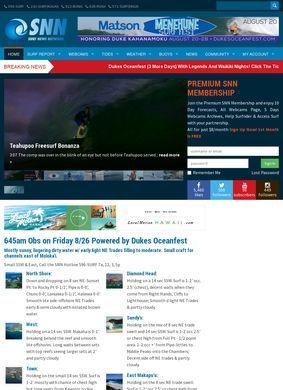
Surf News Network is a Honolulu-based surf information service that has covered Hawaiian waves since 1999. It exists to answer one practical question for anyone going in the water around the islands: what are the conditions going to do over the next week and a half. Surf News Network puts 10-day forecasts at the center of everything, broken out by island, so a surfer on Oahu and a surfer on Kauai are not staring at the same generic regional blob. Maui, Kauai, the Big Island and the lesser-trafficked spots each get their own treatment, and the forecasts lean on a credible source: Pat Caldwell, the NOAA analyst whose surf write-ups have been a Hawaii fixture for years, with his reports folded into the platform alongside real-time readings.
10-day forecasts by island
Surf forecasting is easy to get wrong and hard to do well. Pulling Caldwell's NOAA analysis into the mix, layering on tide tables, weather, and marine warnings, and then feeding it with live buoy spectral data is a serious approach, not a decorative one. The buoy spectral readings in particular show that whoever built Surf News Network understands the difference between a number that says "3 feet" and a wave-period breakdown that tells you whether those 3 feet will be lined-up groundswell or mushy windswell. Wave-forecasting tools sit alongside the raw data for people who want to interpret it themselves. For most users, though, the draw is simpler and more visceral.
Live cameras at North Shore breaks
The webcams are that draw. Surf News Network runs live cameras at Pipeline, Sunset Beach and Laniakea, which is to say at the exact stretch of the North Shore that the entire surfing world watches every winter. A morning glance at the Pipeline cam before making a drive across the island is the sort of thing that turns a casual visitor into a daily one, and Surf News Network clearly knows it. Pairing those cams with the numerical forecast closes a useful loop: you read what the models predict, then you look at the water and check whether the prediction is holding. That combination is more honest than either piece alone.
News coverage and community features
Beyond the forecasting core, Surf News Network spreads into a few other lanes. There is a news section that follows competitive surfing, including World Surf League events, so the contest-watching crowd has a reason to drop by between swells. A community photo gallery called the Surfer's Wall takes user submissions, which gives the place a social pulse and a reason for locals to keep returning with their own shots. The forecasting is not limited to surfers either: dedicated sections serve sailors and divers, two groups who care just as much about swell, wind and marine conditions but rarely get tailored coverage. That broadening is sensible, because the underlying buoy and weather data already supports those audiences.
Phone hotlines and contact options
One detail that dates the operation in a charming way, and also speaks to its roots, is the set of phone hotlines. Surf News Network still runs recorded surf-report lines: 808-596-SURF for Oahu, plus 241-SURF for Kauai, 572-SURF for Maui and other island numbers. Dial-a-wave services were how surfers got their reports before smartphones, and keeping them alive in 2026 is part nostalgia, part genuine utility for anyone without a data connection at a remote break. It also doubles as the clearest contact route into Surf News Network, since those numbers are front and center across the site.
Premium membership and mobile app
For people who want more than the free tier, Surf News Network offers a premium membership at $8 a month. It covers extended forecasts, webcam archives and community features. The price is modest, and the value proposition is honest: if you surf or sail in Hawaii regularly, archived cam footage and longer-range forecasting are the sort of things that pay for themselves quickly, and if you are a tourist passing through once, the free forecasts and live cams probably cover you fine. Surf News Network also puts a mobile app on Android, sitting past 10,000 downloads and rated 4.22 out of 5 from roughly 250 ratings on AppBrain, which is a respectable score for a niche regional utility; the numbers point to an app that does the basic job without annoying people.
Contact transparency is decent without being thorough. The hotlines are everywhere, a contact form is present, and the physical address turns up readily enough through outside listings: 1541 S Beretania St, Suite 2 in Honolulu, with a second Ewa Beach address surfacing on the company's BBB entry. A visitor can find all of it within a few clicks. The phone-first posture fits the product, since a surf service practically invites you to call for a report, though a visitor who prefers email or a quick web message has to settle for the form. It is a moderate showing, leaning hard on the phone channel that has defined the brand since the dial-a-wave days.
The outside reputation is where Surf News Network has a quiet footprint. Beyond the app's AppBrain score, independent reviews are sparse: Yelp carries only four with no aggregate star figure surfacing, and a stray ShowMeLocal listing shows a perfect score off a single review, which tells you almost nothing. The Better Business Bureau lists the company but has not accredited it and shows no rating. For a service that has been operating for more than two decades, that might look odd until you consider how surf forecasting gets used. People pull up the cam, check the swell, and get on with their day without filing a review afterward. The app ratings, where users do leave feedback, are the most useful data point here, and they are good.
What Surf News Network gets right is focus. It does not try to be a global surf empire; it owns Hawaii, ties its forecasts to a credible NOAA source, and pins live cameras to the breaks people genuinely want to see. The expansion into sailing and diving forecasts is a logical use of data Surf News Network already holds, and the cheap subscription plus the surviving phone lines show an operation that serves both the smartphone surfer and the holdout who still dials a number. The competitive news and the Surfer's Wall add community texture on top of the utility.
The honest verdict is that this is a solid, purpose-built regional resource whose main weakness is one of visibility, not substance. The forecasting depth and the cam lineup are the real selling points, and they perform. The faint independent-review trail keeps it short of a slam-dunk endorsement, and the phone-heavy contact setup will not suit everyone. Still, for surfing, sailing or diving anywhere in the Hawaiian islands, Surf News Network is worth bookmarking, and the eight-dollar tier is an easy call for anyone in the water often. As a single-region specialist, Surf News Network does its job well and makes no pretense of doing anything else.