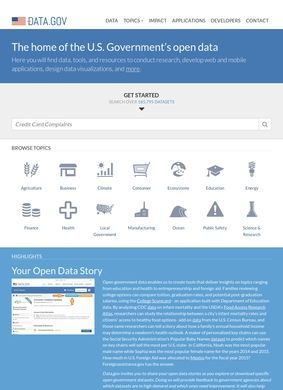
Where does a person go to find every federal dataset on air quality, farm subsidies, or hospital pricing without hunting through a dozen separate agency websites, each with its own layout and its own idea of where to hide a download link? Data.gov is the answer the United States built for exactly that. It is the federal government's open portal for public datasets, and it points to more than 362,000 of them pulled together from agencies across the government.
The scale registers first. What registers second, and matters more the longer you use it, is that the whole thing is designed to be searched, filtered, and downloaded by anyone who cares to, then reused for research, application development, visualization, or plain evidence-driven decisions.
The heart of the operation is the Data Catalog, hosted at catalog.data.gov, a searchable repository where the datasets themselves live. Visitors can browse by organization, so the output of a single agency sits together in one view, and they can dig into geospatial collections when a question is tied to a specific place.
On the way in, the portal surfaces Most Viewed and Recently Added datasets, a small courtesy that spares you a cold-start search when you have no idea what is current or what other people are already pulling. That kind of signposting is the difference between a portal you can use in five minutes and one you abandon after two.
Browsing by organization sounds mundane until you have tried to find something without it. Federal figures come from hundreds of bodies, each with its own mandate, and being able to open a single agency and see everything it has published is how a researcher works out whether the numbers they need even exist. The geospatial collections do the same job along a different axis, gathering the mapped material that a planner or an environmental scientist reaches for when the question is about a location instead of a category.
What sits around the catalog
A catalog alone would already be useful. The site wraps a handful of things around it that turn a pile of files into something closer to a working reference. There is a Metrics section that reports on dataset usage and trends, so you can see how the collection is growing and which parts of it people actually reach for.
There is an Open Government area that ties the portal back to the transparency and accountability mission it was built to serve, and a User Guide for people who need help getting from a search box to a file they can open in the tool of their choice.
None of this is flashy, and it should not be. Data.gov reads like infrastructure, which is the correct register for a site whose job is to hand you raw material and then get out of the way. It is run by the General Services Administration, and the plumbing shows in a good sense: the emphasis falls on findability and reuse instead of presentation. You will not find a homepage engineered to keep you scrolling.
Data.gov gives you a front door to hundreds of thousands of datasets and a set of tools for narrowing them down, and it trusts you to know what you came for.
Metrics and the two sibling sites
Two related sub-sites do real work off to the side, and they are easy to miss if you only ever hit the main search box. Resources.data.gov collects management tooling, written guidance, case studies, and skills-development material, aimed squarely at the people inside agencies who have to publish and curate it well in the first place. Strategy.data.gov carries the federal open-data action plans and their progress reports, which is where the policy behind the whole effort gets spelled out in the open.
Neither is a place a casual visitor strictly needs. For a data officer, a civic technologist, or a researcher tracking how the policy behind it is meant to function, these corners of the wider Data.gov project matter in a way the catalog alone does not.
The distinction between those two sub-sites is worth drawing. Resources is the how-to layer, the practical toolkit for the people doing the publishing. Strategy is the why and the when, the record of what the government committed to and how far along it is. Read together they explain the machinery that keeps the catalog filled, and few public archives are willing to expose that much about their own operations.
The Metrics section deserves a second mention on its own terms. Analytics on how datasets get used is a rare thing for a public repository like this to publish about itself, and it gives the catalog a feedback loop that most government archives simply lack. You can see where attention goes, which tells you something about both the datasets and the questions the public keeps asking.
Who reaches for it, and why
The audience is broad by design. Data.gov serves the general public, policymakers, developers building civic or commercial applications, and researchers who need government figures they can actually cite. A developer might pull a dataset straight into an app. A journalist might use it to check an agency's own numbers against the claims that agency makes in public. A student might just be looking for something real to analyze instead of a textbook toy set. The portal does not pick a favorite among them, and that neutrality is part of why it holds up across such different uses.
Set it next to the worse-organized public archives I have waded through over the years and the single biggest thing Data.gov gets right is friction: it removes a lot of it by putting one search box in front of a collection that would otherwise be scattered across the entire executive branch.
It also links out to social presences on Twitter and GitHub, which is where people who want to follow changes to the platform, or flag a problem with it, can go to do that. The GitHub link in particular signals a portal that treats its own code and issues as public business.
It helps to be clear-eyed about what the portal is and is not. Data.gov is an index and an access layer. The quality, freshness, and documentation of any individual dataset still depend on the agency that produced it, and that varies more than anyone would like. Some entries are meticulous, with clear field descriptions and recent updates. Others are sparse, a bare title over a file you have to open to understand. It is honest about being a catalog rather than a curator, which means the burden of judging a dataset's fitness stays with the person downloading it.
For most serious users that is the right division of labor, since no central team could vouch for the internal quality of hundreds of thousands of files produced by hundreds of separate offices.
Weighed as a whole, Data.gov is one of the more quietly valuable things the federal government publishes. The breadth is genuine, the search works, and the surrounding sections (Metrics, Open Government, the User Guide, the two sibling sites) give it more depth than a bare file dump would have. A single portal that consolidates 362,000-plus datasets and lets a stranger download any of them is a real public good, and Data.gov delivers on that premise without dressing it up or asking anything in return.
With a catalog this size, the answer to whether Data.gov has what you need is usually yes; the harder question sits one layer down, in whether the agency behind a given dataset has kept it current and documented enough to build on. Data.gov guarantees you can find the file. It does not, and cannot, guarantee that the file is polished once you open it.