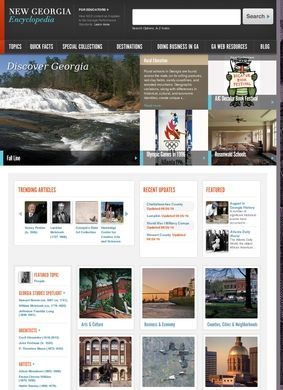
A free digital reference devoted entirely to the history, culture, and society of the state of Georgia, the New Georgia Encyclopedia runs as a searchable database of articles and media, built so a reader can arrive with a single name, place, or event and leave with a sourced entry on it. There is no paywall and no account to create; the whole reference is open on the web.
What separates it from a general write-up, or from a business directory listing with a phone number and hours, is who stands behind it. The project comes out of a partnership among Georgia Humanities, the University of Georgia Press, GALILEO, UGA Libraries, and the Office of the Governor.
A statewide reference produced through university presses and library systems carries a different kind of authority than an open-edit page, and the New Georgia Encyclopedia was built to be the standard scholarly account of the state. That institutional weight is the reason to trust one of its entries over the first result a search engine throws up.
Its audience is layered. Classroom teachers and their students make up a designated core, the general public forms the wider ring, and writers and researchers treat it as a first stop for anything Georgian. One reference tries to serve all three at once, and the way it is put together, plain search sitting next to curated extras, is what lets it manage that.
Inside the encyclopedia
The material is organized into ten topic areas, and the spread is deliberately wide. Among them are Arts and Culture, Business and Economy, Education, Government and Politics, History and Archaeology, and Sports and Outdoor Recreation.
That range means the New Georgia Encyclopedia reaches from colonial settlement and archaeology to the state's music, its industries, its schools, and its outdoor life, all under one roof. A reader chasing one subject can slide sideways into an adjacent one without ever leaving the collection.
Ten topic areas and the searchable database
Search is the heart of the New Georgia Encyclopedia, and the topic areas are how you browse when you cannot name exactly what you are after. Every article sits inside its category and links out to related media, so the ten areas work as ten doors into a single collection. For a general reader, this is the shortest path from a vague question about Georgia to a specific, written answer with a source attached. Students doing a report and adults settling an argument reach for the same tool the same way.
The named areas hint at how far the coverage runs. History and Archaeology anchors the deep past, Government and Politics tracks the machinery of the state, Business and Economy follows its industries, and Arts and Culture along with Sports and Outdoor Recreation cover the parts of Georgia people live in and spend their weekends on. Four further areas fill out the ten, so a single query often crosses several categories at once, which is where the searchable database proves more useful than a plain list of pages.
The site also surfaces trending and recently updated entries, which keeps the New Georgia Encyclopedia from reading like a set of pages frozen at publication. Articles get revised as scholarship changes, and the New Georgia Encyclopedia marks which ones have been touched. A reference that visibly maintains itself is easier to rely on than one that went quiet years ago.
Collections and exhibitions
Above the level of the single entry, the New Georgia Encyclopedia curates themed Collections and mounts online Exhibitions. The Collections gather related items around a subject, among them a Stamp Collection and one built around "Frankie Welch's Americana." These are smaller, focused groupings that let a reader browse a topic as a set instead of hunting entry by entry. It is the sort of thing a curious visitor stumbles into and stays with, and it gives the reference a browsing mode that a straight lookup tool would miss.
The Exhibitions are the more ambitious of the two forms. One of them, "The New South and the New Slavery: Convict Labor in Georgia," takes on a genuinely hard chapter of the state's past in a long-form format built for depth instead of a quick lookup. Handling convict labor squarely, in a reference funded in part through state institutions, is a real editorial choice, and it signals that the New Georgia Encyclopedia is willing to document uncomfortable history rather than smooth it over. For a student or a curious adult, the exhibitions are the parts most worth slowing down for.
Classroom resources for grades 2 and 8
The teaching mission is stated plainly. The New Georgia Encyclopedia aligns resources to Georgia Standards for grades 2 and 8, which turns a lookup database into material a teacher can plan a lesson around. Interactive quizzes and playlists sit next to the articles, giving students a way to check what they have taken in and giving teachers something ready to assign.
That grade-level focus tells you who a large slice of the audience is. Educators and their students, especially in those benchmark grades, are served on purpose, and the New Georgia Encyclopedia hands the general public the same vetted material underneath. A giving portal supports the work, the ordinary footing for a nonprofit humanities project of this scope. None of the core content sits behind that ask; the donations underwrite what everyone else reads for nothing.
The natural thing to weigh it against is Wikipedia, where most people land first when they want a quick fact about Georgia. Wikipedia is broader and faster, and for a one-line answer it usually does the job. Its coverage of a particular Georgia town, artist, or piece of legislation, though, can be sparse, uneven, or written by whoever happened to show up.
The New Georgia Encyclopedia trades that breadth for depth and vetting: fewer subjects, every one about Georgia, each handled through university and library partners. For a passing global fact, Wikipedia is the convenient choice, and it will keep being the first click for most people. For work where the source and the scholarship matter, and above all for Georgia classrooms held to state standards, the New Georgia Encyclopedia is the steadier ground to stand on. The two are not really competing for the same job, and knowing which one a given question calls for is most of the value here.