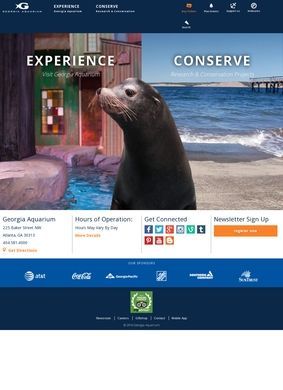
You have a rainy Saturday in Atlanta, two restless kids, and a few hours to fill before dinner. The downtown attraction that answers that problem most directly sits on Baker Street, and Georgia Aquarium has built itself around exactly that kind of visit: a full day under one roof, weatherproof, with enough variety that nobody in the group runs out of things to look at. It ranks among the largest aquariums in the world, and the scale shows in what it can keep on display.
Whale sharks and other headline animals
The headline animals are the ones worth planning a trip around. Whale sharks swim through the central tank, which puts Georgia Aquarium in rare company; few facilities anywhere can house them. Beluga whales, bottlenose dolphins, sea lions, penguins, sea otters, manta rays and sharks fill out the roster. That mix benefits a family with a wide age spread, because the toddler fixated on penguins and the teenager who wants to see a shark are both covered without anyone having to compromise.
Encounter programs with marine life
Plenty of visitors are content to walk the galleries, but the deeper draw at Georgia Aquarium is the encounter programs. Structured sessions with dolphins, sea lions, penguins, belugas, sea otters, and sharks or rays each put guests closer to the animals than a standard ticket allows. For the adventurous, the "Journey with Gentle Giants" swim and dive programs go a step further, letting people get in the water with the whale sharks. That is the sort of experience that turns a single outing into a memory people talk about for years, and it is priced and gated accordingly.
Daily rhythm with shows and dining
Included with admission are the live dolphin and sea lion presentations, which give the day a rhythm: galleries between scheduled show times, a place to sit, something timed to build the visit around. The Coastline Cafe handles lunch on site, and a gift shop catches everyone on the way out. None of this is unusual for a major attraction, but it is the practical scaffolding that keeps a long visit from falling apart.
Flexible ticketing options
Ticketing is built to flex around how often you plan to come. General admission runs on dynamic pricing, so the cost moves with demand and dates. The Annual Aqua Pass membership covers unlimited visits and folds in conservation benefits, which changes the math for anyone within driving distance who expects to return more than twice. Group tickets, field trip packages, hotel bundles and CityPASS options fill in the gaps for travelers and organized parties. Georgia Aquarium rewards planning on price: families who buy on the right day or commit to a pass will pay noticeably less than walk-up guests on a peak afternoon.
Education programs beyond typical museums
The education side is more substantial than the typical museum add-on. School field trips, homeschool programs, Camp H2O summer camps, virtual field trips and professional development for teachers form a real program. The virtual field trips extend the reach past anyone who can physically get to Atlanta, which is a sensible use of the institution's animal collection. Educators looking for marine science content have a genuine partner in Georgia Aquarium rather than the usual tokenized classroom tie-in.
Adult programming and event hosting
Adults without children have their own track. Glow Nights are after-hours, adults-only events, and seasonal programming like Haunted Seas and the holiday calendar keeps the venue active across the year. Private event hosting with catering opens the space for receptions and corporate functions. The result is a place that does not depend entirely on the daytime family crowd to stay busy.
Mobile app and animal webcams
For trip logistics, a few features pull their weight. The mobile app handles navigation through the building and ticket access, useful in a venue large enough to get lost in. Live animal webcams let curious visitors check in between trips or scout exhibits before going. Conservation research runs in the background, with volunteer and internship opportunities for people who want to be involved beyond a single ticket. Georgia Aquarium stays open every day of the year, generally 9 am to 9 pm with seasonal shifts, so the planning window is wide.
Built for repeat visits
What is clear across all of it is how completely Georgia Aquarium is set up for repeat use. A one-time tourist gets the whale sharks and the shows; a local family gets a pass that pays off over a season; a teacher gets a curriculum-shaped program; an adult crowd gets an evening event with the lights down. The membership and the dynamic pricing both push toward returning rather than treating the visit as a once-and-done. Georgia Aquarium has stocked the place with enough distinct experiences that a second or third trip still has something new in it.
Premium experiences with whale sharks
The encounter programs and the in-water whale shark dives sit at the top of that ladder for anyone willing to pay for proximity, and the central tank alone, with whale sharks drifting past at eye level, is reason enough to spend an afternoon at Georgia Aquarium.