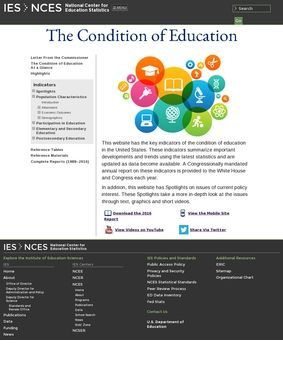
Produced by the National Center for Education Statistics, the federal statistical arm of the U.S. Department of Education, The Condition of Education (COE) is an annual report on the state of American education mandated by Congress. That legislative origin is visible in the texture of the document: it reads less like a position paper and more like a ledger, organized around indicators, tables, and definitions so a reader can find a number and trace where it came from. The 2024 edition sits alongside an archive of earlier years, all in PDF, with reference tables and a glossary attached so the terms mean the same thing from one section to the next.
Structure across six education domains
The report is built around six broad areas, and the structure reflects its ambitions. Family characteristics come first, covering household structure and parental involvement in schooling. Then preprimary through secondary education, which is the heaviest chapter: enrollment counts, NAEP assessment results, graduation rates, staffing, school finances, and safety figures. Postsecondary education follows, with college enrollment, financial aid, who teaches, institutional types, and campus crime data. After that come population characteristics and economic outcomes, the part that links attainment to employment and earnings, which is where a lot of policy arguments get settled or unsettled.
International comparisons and school safety
The last two domains widen the lens. International comparisons benchmark U.S. enrollment, assessment scores, attainment, and per-student spending against other countries, the kind of context that keeps domestic numbers honest. School crime and safety gets its own dedicated treatment, tracking violent incidents, victimization, weapons on campus, disciplinary actions, and the security practices schools have put in place. That separation is sensible, because safety data often appears as a footnote elsewhere, and here it stands on its own with room to breathe.
Geographic focus and spotlight indicators
Beyond the standing six, The Condition of Education (COE) carries two recurring features worth singling out. "Education Across America" pulls a geographic thread through the data, with particular attention to rural communities that often get averaged out of national figures. "Spotlight Indicators" are the deep dives, picking a live issue and following it past the headline number: teacher shortages and pandemic recovery are the examples on offer, and those are exactly the topics where a single statistic tends to mislead without the surrounding detail. Together they keep The Condition of Education (COE) from reading as a static annual snapshot and give it a reason to be read cover to cover, not mined for one figure.
Data sources and research infrastructure
What distinguishes The Condition of Education (COE) is the data machinery sitting underneath it. The numbers draw on the Common Core of Data, which covers roughly 100,000 public schools, plus the Early Childhood Longitudinal Study, the National Teacher and Principal Survey, and NAEP. These are not casual sources; they are the surveys and censuses that most serious education research in the country already depends on. When The Condition of Education (COE) reports a graduation rate or an attainment gap, it is reporting from the same wells that academics and government analysts pull from, which is the whole point of having a national statistics center do the work.
Tools for exploring education statistics
The wider NCES platform extends the report into tools a reader can operate directly, and this is where The Condition of Education (COE) stops being a report you read and becomes a starting point for your own questions. College Navigator lets you look up individual institutions. The School District Navigator does the same at the district level. There are dashboards for state-level figures, achievement gaps, and the School Pulse Panel, plus an International Data Explorer for cross-country work. For anyone who wants to go past the prepared tables, DataLab supports custom cross-tabulation, so you can build a comparison the published report never spelled out. The progression is deliberate: read the summarized indicator, then pull the underlying data at whatever resolution you need.
Using the report as reference material
That said, the breadth is also the thing a newcomer should brace for. This is a large body of material, and the six domains each branch into dozens of indicators, so someone arriving with a narrow question can spend a while orienting before landing on the right table. The glossaries and source guides exist precisely to soften that, and they do help, but The Condition of Education (COE) rewards patience more than it rewards a quick skim. It is a reference work in the truest sense, the sort you return to and read in layers.
How different audiences access the data
The audiences NCES names for The Condition of Education (COE) are policymakers, researchers, educators, journalists, and the general public, and the report genuinely works for all five at different depths. A journalist can pull a clean national figure with a citation behind it. A researcher can trace that figure to its survey and then to DataLab. A school administrator can sit somewhere in between, using the dashboards without ever opening the PDF. The layering is intentional: summary on top, tables beneath, raw instruments at the bottom.
Descriptive findings without policy recommendations
It is worth saying plainly that The Condition of Education (COE) is descriptive, not prescriptive. It will tell you that enrollment shifted or that earnings rise with attainment; it will not tell you what to do about either. For a reader expecting recommendations or advocacy, that can feel like the report stops short. For everyone else it is the strength, because the numbers arrive without a thesis attached, and you can carry them into whatever argument you are actually having. The Condition of Education (COE) draws the picture and leaves the interpretation to you, which is the right division of labor for a national statistics agency.
The Condition of Education (COE) also benefits from continuity. NCES has been collecting education statistics since 1867, and that long run matters for a longitudinal report more than for almost any other kind. When The Condition of Education (COE) shows a trend line, the line has decades of consistent methodology behind it, so the movement reflects real change in schools rather than a change in how someone decided to count. That kind of stability is hard to assemble and easy to take for granted. The data infrastructure behind The Condition of Education (COE) is what makes it the fastest path to anchoring a claim in primary sources: the alternative is working back through secondary material that all traces here anyway.