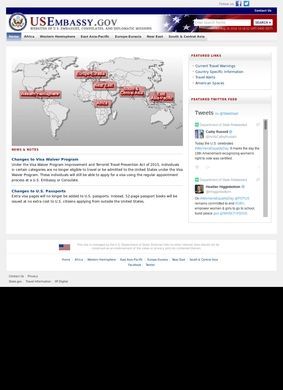
Where does someone go when they need a U.S. visa interview in Manila, or have to renew a passport while living in Berlin, or want to know whether it is safe to travel to a particular country right now? USEmbassy.gov is the answer to all three. It is the U.S. Department of State portal that gathers links and information for every embassy, consulate, and diplomatic mission the United States operates around the world. The job it does is narrow and deliberate: figure out which country you are in or care about, and route you to the right mission with the right instructions.
Country-by-country embassy index
The backbone is a country-by-country index. Pick a nation, and USEmbassy.gov sends you to that specific embassy or consulate site, where the local detail lives. This is more useful than it sounds because U.S. visa and consular procedures are not uniform. Appointment systems, document checklists, fees, and wait times differ from post to post. A central hub that points to the correct local page, instead of forcing you to guess at the right URL, removes a step that trips up a lot of first-time applicants who end up on the wrong mission site and waste days before realizing it.
Comparing visa and citizen services
On the services side, the portal covers the two halves of consular work. For foreign nationals, there is visa guidance covering both immigrant and nonimmigrant categories, with redirects into appointment scheduling and the CEAC application system, plus country-specific document requirements. For Americans abroad, the American Citizens Services section draws the most attention. It covers emergencies, arrest or detention, deaths abroad, notarial services, overseas voting through UOCAVA, and Social Security questions. These are not everyday topics, and they tend to surface at the worst possible moment, so having them collected in one place with plain explanations has real practical value.
Beyond links to alerts and programs
USEmbassy.gov carries more than links. The site publishes travel advisories and security alerts issued by the State Department, emergency contact numbers for citizens in crisis, and a running feed of press releases, news, and public diplomacy content from missions worldwide. It also surfaces educational and exchange programs, Fulbright among them, for people thinking about study or research connected to the United States. None of that is deep editorial content, but it is more than a pure redirect engine.
Inside the State Department network
The portal connects outward to the broader State Department ecosystem, notably travel.state.gov, which handles the deeper passport and travel mechanics. That layering makes sense. A single site cannot hold every form, fee schedule, and local quirk for nearly two hundred countries, so USEmbassy.gov leans on aggregation: get the user oriented, then hand them off to the authoritative page for their situation. One useful detail is that the individual embassy sites are multilingual, so a foreign national applying for a visa in their home country is not stuck reading everything in English.
Reducing confusion for consular help
What the central site does well is reduce ambiguity. Anyone facing a consular problem usually does not know the exact name or web address of the post responsible for their country, and a wrong turn can cost days. USEmbassy.gov is built to prevent that wrong turn. Modest as that sounds, it is a genuinely practical function for people who are already stressed about the situation that sent them looking in the first place.
Limits of a router-based portal
There are limits worth naming. Because the hub is mostly a router, the experience can feel like a series of redirects before you reach anything actionable, and the depth of content varies considerably from one mission to the next. Some embassy sites are thorough and well-maintained; others are sparse and out of date. Someone expecting to complete a task entirely on USEmbassy.gov will instead find themselves bounced to a local site, then often to a third-party scheduling or application system. That is the nature of how the State Department structures things, but it does mean USEmbassy.gov is a starting point, not a destination. The portal cannot fix problems that live on the individual mission sites, and it does not try to.
Who should use USEmbassy.gov?
Three groups have a clear reason to use it. U.S. citizens living or traveling overseas who need consular help or emergency contacts. Foreign nationals working out where and how to apply for a visa. And anyone tracking official travel advisories or mission news for a specific country. For each group, USEmbassy.gov does its assigned job: accurate orientation and a clean hand-off to the right resource. The verdict is positive but measured. It is not a content-rich experience, and it will rarely be the only page you visit to finish what you came to do. Treat USEmbassy.gov as the map and the local embassy site as the territory, and it works exactly as intended.