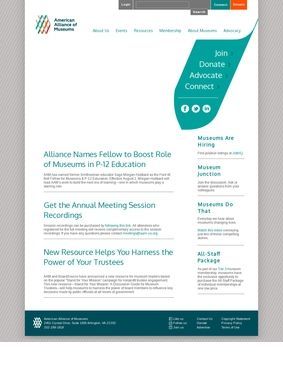
American Alliance Of Museums is the only national organization that speaks for the entire museum field in the United States, covering every discipline at once: art galleries, history museums, science centers, zoos, aquariums, botanical gardens. That breadth is the first thing worth grasping, because most professional bodies pick a lane and stay in it. Here the remit stretches across an estimated 35,000 institutions and the roughly 726,000 jobs they sustain, which means a curator in a small county historical society and a director at a major metropolitan art museum are nominally served by the same outfit. The site reflects that scope without much fuss, organizing itself around what a museum worker would come looking for.
Membership tiers explained
Membership sits at the center, and it is tiered with some thought. Individuals can join, institutions can join, and there are separate vendor and ally categories for the firms that sell goods and services into the sector. The practical effect is that a freelance exhibit designer, a 200-year-old museum, and a company that manufactures display cases all have a defined relationship with the American Alliance Of Museums. A lot of the deeper resource content sits behind a member login, which is the usual trade in this kind of body. That paywall seems reasonable given how specialized the material is, though anyone browsing as a non-member should expect to hit a sign-in wall fairly often.
Accreditation program builds trust
The accreditation program is what gives American Alliance Of Museums its real weight in the field. It runs on peer review, meaning a museum that wants the credential opens itself to examination by people who run comparable institutions, and the standard is not handed out casually. Alongside it sits a body of ethics and professional-standards documentation, including a core-documents verification process that checks whether a museum has the foundational governance papers a serious institution is expected to keep. For a board member or a funder trying to judge whether an organization is run properly, that framework is a genuine reference point.
Inside the resource library
Quite a lot of concrete material, as it turns out. There is a resource library running past 1,500 listings, plus toolkits, research reports, and guides aimed at the day-to-day problems of running a museum. Two publications anchor the editorial side: Museum magazine, which covers the field broadly, and Exhibition, a journal focused on the craft of putting shows together. American Alliance Of Museums also runs a bookstore stocked with professional titles, the sort of specialized texts that a general retailer would never carry. None of this is filler. It is the literature of an occupation, gathered in one place.
Comparing career and networking tools
The career and data tools are where American Alliance Of Museums proves most useful to someone mid-career. JobHQ is a dedicated job board for museum roles, and museum-specific openings rarely surface on mainstream sites. There is salary survey data, useful both for a worker negotiating pay and an institution setting a budget. Affinity communities and professional networking round it out, giving people who share a specialty, such as registrars, educators, or conservators, a way to find each other across institutions. Put together, these turn a membership card into something a person uses through a whole career.
Events and advocacy work
Events are the other pillar, and they are not modest. The Annual Meeting and MuseumExpo is described as the largest museum-sector conference in the country, the kind of gathering where the whole field converges for a few days. The Museum Summit is a separate, more concentrated event. And then there is advocacy, which American Alliance Of Museums treats as core work. Museums Advocacy Day brings members to Capitol Hill every year to press the case for the sector directly with legislators, a tangible exercise of the collective voice a national body is supposed to provide. For institutions that depend partly on public funding and policy, that channel is one of the more practical reasons to belong.
It is worth being clear-eyed about who this is built for. American Alliance Of Museums is built for people inside or adjacent to the profession, not for a casual visitor planning a weekend at a gallery. Someone hunting for ticket prices or exhibition listings at a particular museum is in the wrong place and will leave quickly. The audience is the working field: directors, curators, educators, registrars, trustees, students heading into museum work, and the vendors who supply them. Measured against that audience, the offering is dense and coherent, which is the right outcome for an organization that has to be useful to a one-room local museum and a national institution in the same breath.
A search of ratings platforms turns up no notable independent reviews of American Alliance Of Museums, which is unsurprising for a professional association of this kind. American Alliance Of Museums does not operate in a space where Yelp-style crowd ratings apply. Its standing in the field rests on its accreditation program's peer-review credibility and its 50-plus years of continuous operation, both checkable through institutional records and published accreditation rosters.
If there is a fair caution, it is the same one that applies to most membership organizations: the value depends heavily on actually using what is behind the login, and a casual sign-up that never opens the resource library or attends an event will feel like dues spent for a logo. The accreditation seal, the salary data, the advocacy reach, and the publications all reward people who engage with them consistently. American Alliance Of Museums gives an unusually complete picture of what it is and does, and the structure holds together, so the burden shifts squarely onto the member to make use of it.
Someone whose work is genuinely tied to the museum field, whether running an institution, advising one, or supplying it, will find American Alliance Of Museums a denser and more practical resource than the site's clean surface suggests. The organization is not trying to be anything it is not, and that clarity about purpose is itself a kind of credential. American Alliance Of Museums has built something substantial; whether a given person draws enough on it to justify belonging is a question the published evidence answers pretty directly.