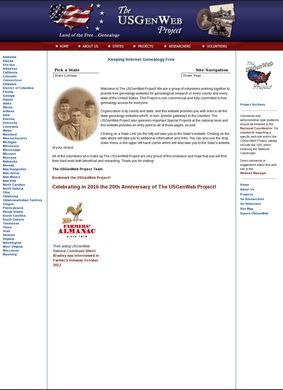
You have a great-great-grandmother's name, a county somewhere in Ohio, and a death date that might be off by a decade. The national databases give you a tidy hint and then a paywall. What you actually want is the underlying record: the obituary someone typed out from a brittle newspaper, the cemetery transcription a local volunteer walked the rows to make, the 1880 census page for one specific township. That gap between a database hint and a primary source is exactly where The USGenWeb Project lives, and it has lived there for a long time.
County sites organized by local volunteers
The structure is geographic, which matches how genealogy research usually breaks down once you get past the first easy generations. You pick a state from an interactive menu, then drill down to a county, and each county has its own site run by a local volunteer webmaster. There are more than 3,000 of these interlinked sites covering every U.S. state and county. That number is the whole point. A county clerk's old land records, the maps that show how township lines shifted, photographs, obituaries, immigration records, census data, all of it sits with the people closest to the source instead of in one central pile sorted by an algorithm.
Variation in coverage and curation quality
What the local pages hold varies, and any honest account of the project has to say so. Some counties are deep, with years of accumulated transcriptions and well-kept indexes. Others depend entirely on who volunteered and how much time they had. This is the natural cost of a network maintained by individuals one county at a time. The upside is curation by someone who knows the area: a person who can tell that two spellings of a surname are the same family, or that a "missing" township is filed under an older name.
From geographic browsing to network search
For all the local autonomy, this is not a loose pile of unrelated pages. The USGenWeb Project runs under a National Coordinator and a Web Management Team, with the county webmasters working inside that frame. A site-wide search sits on top of the geographic browsing, so a researcher who knows a name but not a place can start from the other direction. The two approaches cover the two situations most people actually find themselves in: knowing the where and hunting for the who, or knowing the who and hunting for the where.
Archives as durable backup for transcriptions
The USGenWeb Archives runs alongside the county sites as a separate body of transcribed documents. Think of it as the supplementary stack: material that has been keyed in and saved so it survives independently of any one county page. Combined with the per-county collections, it gives the project two layers of the same mission, primary material made readable and kept available, with the archives acting as a more durable backstop for documents that have already been transcribed.
Beyond the records themselves, there is guidance on method. The research help covers family history methodology, how naming conventions worked and changed, immigration patterns, and document preservation. A beginner often fails to find an ancestor not because the record is gone but because they are searching a name that was spelled four ways, or expecting a town to exist that was absorbed into another county. Reading the how before diving into the what cuts a lot of dead ends. For someone who has hit a wall, the methodology pages in The USGenWeb Project are where to start, not the county list.
Everything is free, with no registration and no payment. For a field where the large commercial services charge real money and gate the good material behind a subscription, that changes who gets to do this work. A student, a retiree tracing a line for the first time, a researcher in another country trying to find where a family left from: none of them has to pay to reach the transcriptions a volunteer in the right county put online. The non-commercial footing shapes the whole character of what The USGenWeb Project produces.
The volunteer model has a real consequence worth weighing honestly. Coverage and freshness depend on people donating their hours, so depth is uneven and some county pages will feel dated next to a polished commercial interface. A researcher used to slick, instantly searchable platforms may find parts of the project plain or even clunky. Set against that is something the commercial sites struggle to match: locally sourced primary material, transcribed by people who care about getting their own county right, given away without charge. The trade is depth-of-local-knowledge against uniformity-of-polish, and for serious record work the former usually wins.
The USGenWeb Project does not try to be a one-click answer machine, and it would be a mistake to expect it to behave like one. A newcomer can browse from a state down to a county and read the help pages first. An experienced genealogist can go straight to a known county for the specific transcription they need, or run the search across the network when the trail has gone cold. It is a reference network built to put you next to the original document rather than next to a summary of it, and that distinction is the reason researchers keep coming back.
Where The USGenWeb Project stands out is the corner of genealogy that commercial databases skip. The big services are good at connecting trees and surfacing hints. They are far weaker at county-level texture: the obituary nobody scanned, the cemetery row nobody indexed, the land record that only ever existed on paper in one courthouse. By organizing thousands of volunteer-kept county sites under one coordinated network and giving the result away, The USGenWeb Project fills that exact space. The work it offers is the kind that takes a person walking a cemetery or sitting with a microfilm reader, and that work does not scale to an algorithm.
Outside the project itself, public web searches return no third-party review platforms with a meaningful count of user ratings for The USGenWeb Project, which is common for free nonprofit genealogy resources that operate below the review-site radar. The genealogy community reference is the usage: the network has been running since 1996 and remains a standard citation in genealogical methodology guides. That longevity is a practical track record worth more than a star count on a platform built for restaurants.
So the question for any researcher is less whether The USGenWeb Project is worth consulting and more how it fits the search at hand. If your ancestors lived in American counties and you need the underlying records rather than a tidy summary of them, the project's 3,000-plus county sites give you access to volunteer-sourced primary material that the subscription databases simply do not carry. It is not perfect, not complete, and not always current, but on county-specific genealogical depth it has no real equivalent.