Suppose you want to read Melville the way his contemporaries might have, or you have grown tired of paperback editions of Faulkner that fall apart after one reading and carry no notes worth the name. That is the gap The Library Of America has spent decades filling. The flagship LOA Series now runs past 300 hardcover volumes, each one a durable, well-made collection of an American author or a defined body of work, set in clear type on acid-free paper with sewn bindings meant to last. A reader who buys one of these is buying something closer to a reference edition than a disposable trade copy.
Genres gathered across the flagship series
The range of writers gathered here is wide and deliberate. Fiction sits alongside poetry, memoir, journalism, drama, history, and science fiction, which means the catalog does not stop at the obvious canon. You find the expected figures, but also reporting, plays, and genre work that mainstream literary publishers tend to let drift out of print. For someone building a serious personal shelf, that breadth is the whole point: a single source where the texts have been edited carefully and the volumes are designed to match.
Additional imprints for poetry and ebooks
Beyond the main line, two other imprints round out what The Library Of America offers. The American Poets Project puts out compact poetry volumes, smaller and lighter than the big hardcovers, which suits a reader who wants individual poets without committing to a doorstop. LOA eBook Classics brings selected titles into digital form for people who read on a screen or want to carry a stack of books on one device. Purchasing is flexible too. Books can be bought one at a time, in boxed sets that group related authors or periods, or through a subscription that delivers volumes on a schedule, which is a sensible route for anyone who wants the collection to grow without remembering to reorder.
Weekly free reading features on the site
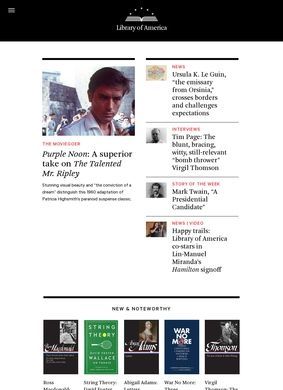
What lifts the site above a plain storefront is the free material it keeps open to everyone. "Story of the Week" pulls a weekly selection straight from the LOA archive and posts it at no cost, so a curious visitor can read a complete short piece before deciding whether to buy anything. "Writer of the Week" pairs with this through author profiles that give context on the lives and work behind the volumes. There is also a News and Views section carrying articles, interviews, and a mix of audio and video, which gives the whole operation a current pulse instead of a static catalog. The weekly story alone is reason enough to keep the page bookmarked, since it functions as a rotating introduction to writers a person might otherwise never open.
Behind the LOA online event series
The programming extends offline, or at least off the printed page. The Library Of America runs online public events under the LOA LIVE banner, the kind of talks and conversations that connect readers with editors, scholars, and writers. For teachers, there is an education section with classroom resources built around integrating these texts into lessons. The volumes are well suited to courses but can be daunting to assign without support, so the teaching scaffolding fills a real gap for instructors who want students reading reliable editions rather than pulling whatever turns up on a search.
Mission and structure of the nonprofit
It helps to know what The Library Of America is. Founded in 1979 and based in New York, it operates as a nonprofit literary publisher rather than a commercial house chasing bestseller margins. Its stated purpose is preserving and disseminating American literature, and the structure of the site reflects that. Membership through the "Guardians of American Letters" program and various donor options exist to support the mission, so a reader who values the work can contribute to keeping out-of-print writing available. The audience is plainly mixed: general readers who want lasting editions, educators assigning serious texts, libraries building durable collections, and supporters who care about American literary heritage as a thing worth maintaining.
What keeps everything under one focus?
The whole enterprise has a clear-eyed consistency to it. The Library Of America does one job, publishing definitive editions of American writing, and it organizes everything around that job. The free archive feeds curiosity, the imprints cover different formats and price points, the education tools serve schools, and the membership side keeps the nonprofit funded. There is no clutter of unrelated ventures, which makes the site easy to navigate once you understand its shape.
Comparing Library of America to Penguin Classics
If a reader is weighing where to spend money on classic American texts, the natural comparison is the Penguin Classics or Norton Critical line. Those serve a real need and cost less per title, with strong introductions and the convenience of cheap paperbacks for a single course or a casual read. Where The Library Of America pulls ahead is permanence and completeness: the editions are built to survive decades, they often gather an author's work into a coherent set, and the texts are prepared with the care of a preservation project. For a one-semester assignment a Norton edition may be the smarter buy, but for anyone assembling a library meant to outlast its owner, The Library Of America is the stronger and more deliberate choice.