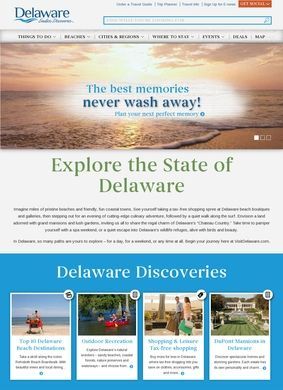
Can one website cover a whole state worth of trips without turning into a phone book of links? Delaware Tourism, the official portal run by the Delaware Tourism Office, tries to answer that, and the answer here leans yes. The site splits the state into four geographic regions and reaches down to individual cities and towns, so a visitor lands somewhere with a sense of where Wilmington sits relative to the beaches and where the historic towns fall in between. The structure is built around a handful of plain top-level sections, and each one is doing real work rather than padding a menu.
Things to do split into five categories
Start with Things To Do, which is the section most travel sites get wrong by piling attractions into one undifferentiated heap. Delaware Tourism breaks it into attractions, outdoor activities, hidden gems, tax-free shopping, and family experiences. In a state with no sales tax, a category built around shopping is a genuine draw for visitors who plan around it. Paired with the regional breakdown, the hidden gems label points people away from the obvious coastal crowd toward smaller spots. A traveler who only knows the state for its beaches gets nudged toward the inland and northern parts, which is exactly what a state-wide promoter should be doing.
Dining events and accommodation finder
Food and drink gets its own home with dining and culinary guides, and the Events section that Delaware Tourism maintains is a searchable calendar of happenings across the whole state. A working calendar is harder to maintain than it looks, and for trip planning it is often the single most useful tool on a tourism site, since dates anchor a visit far more than a list of attractions does. Places To Stay handles accommodation through a finder, and the Plan section pulls together trip-planning tools alongside seasonal guides for spring, summer, fall, and winter. The seasonal split is sensible for a place where the beach towns swing hard between a packed July and a quiet February, and it gives returning visitors a reason to look again at a different time of year.
How do four regions link together?
It helps that the four-region framing is more than a cosmetic label. Delaware is compact enough that a single visit can cross from the northern, more urban edge near Wilmington down to the southern beaches in a couple of hours, and the site treats that geography as a connected whole instead of a set of isolated stops. The multiple-city coverage means a planner can build a route that strings together a historic town, a meal, and a stretch of coast without bouncing between three unrelated pages. For a state often passed through on the way to somewhere bigger, that framing quietly argues for staying put a few days, and the seasonal guides reinforce it by giving the off-peak months their own reasons to visit.
Beach towns and historic sites
The coastal coverage is where Delaware Tourism puts real weight. There are dedicated beach sections for six coastal towns, and named attention to places like Rehoboth Beach and Lewes, both of which carry the kind of recognition that pulls in regional weekend traffic. Historic sites get their own highlights too, which keeps the site from reading as purely a sun-and-sand pitch. Lewes in particular has a long colonial history, and pairing it with the beach material gives the southern coast a fuller identity than a typical boardwalk roundup. Delaware Tourism also links out to all six of the state's counties, so the geographic spine runs from the broad regional view down to county-level detail without losing the thread.
Serving sports teams and family reunions
Beyond the general traveler, the portal carries content for audiences a casual visitor would never notice. There is a Sports Planners section aimed at the people who organize tournaments and athletic events, a group-travel planning area, and material specifically for family reunions. Those are the bookings that fill hotel blocks midweek and in shoulder seasons, and a state office is exactly the right body to court them. A separate Tourism Industry portal serves trade and business partners, which means Delaware Tourism does work aimed past the everyday tourist: it acts as the connective tissue for the state's hospitality businesses. A World Cup section rounds this out, covering travel tied to that international event, which fits given the tournament's North American staging and the spillover it brings to nearby states.
Inside the blog's social media reach
The blog Delaware Tourism runs is more substantial than the usual afterthought. It publishes destination guides, event coverage, and itinerary ideas, which is the format that helps someone turn a vague interest into a real plan. Itinerary suggestions in particular tend to be the most-used pages on sites like this, because most people want a ready-made shape for a weekend more than they want to assemble one from scratch. The social presence is wide, with channels on Facebook, Instagram, YouTube, Pinterest, and TikTok. That spread suggests the office is reaching different age groups where they already are, and the video-heavy platforms fit a destination that sells itself on scenery and atmosphere.
Booking off-site through third-party links
One honest limit is worth flagging. Delaware Tourism hosts no e-commerce or booking engine on the site itself. Accommodation and activity links route out to third-party providers, so anyone expecting to reserve a room or buy tickets in one continuous flow will instead be handed off elsewhere. For an official state portal this is a defensible choice, since a government office has no business competing with the hotels and operators it promotes, but it does mean the site is a planning and discovery layer that stops short of the transaction. A visitor should treat Delaware Tourism as the map and the calendar, then expect to finish the booking on someone else's page.
Taken together, the site does the core job of a state tourism portal with real discipline. The regional and county structure keeps a geographically compact and varied state legible, the beach and historic coverage reflect what Delaware actually trades on, and the planner-focused sections show an office thinking about the business of tourism beyond its postcard. Delaware Tourism is not trying to dazzle, and it does not need to. The seasonal guides, the searchable events calendar, and the itinerary-led blog are the parts a real trip-planner will lean on, and they are present and organized.
Final assessment of Delaware tourism
The handoff to outside booking sites is the one friction point worth naming plainly. Delaware Tourism is informational throughout, not transactional from end to end, and a visitor expecting to reserve a room or buy tickets in one continuous flow will be sent elsewhere to finish. For a free, official planning resource that is a fair trade: Delaware Tourism remains the front door to the state even if the actual reservations happen somewhere down the hall. On the strength of its structure, its planner tools, and a blog that goes further than a state office strictly needs to go, Delaware Tourism deserves a solid recommendation with that single caveat noted.