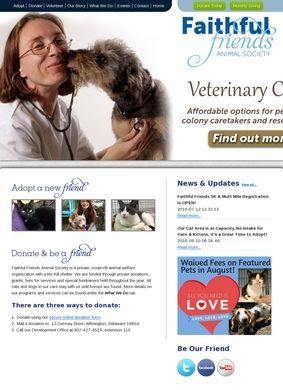
Faithful Friends Animal Society is a nonprofit, no-kill animal welfare organization in New Castle, Delaware. The work splits along two lines that most shelters keep separate: finding homes for dogs and cats, and running an actual veterinary operation open to the wider community. Both live on the same site, and the range is wider than the word "shelter" suggests.
Adoption, foster, and long-term care
The adoption program covers dogs and cats through the usual route, but Faithful Friends Animal Society backs it with a foster network that places animals in real homes instead of holding them in kennels, and a sanctuary arm for the long-term residents that are hard to place. That last piece is the one many groups quietly skip. An animal that has aged out of easy adoptability still has somewhere to go here.
No-kill is the line that defines the place. Faithful Friends Animal Society does not put an animal down for being old, slow to adopt, or simply inconvenient, which is exactly what makes the sanctuary arm necessary in the first place. Refuse to euthanize for space, and the hard cases have to live somewhere.
Faithful Friends Animal Society also works the other side of the equation, with help for surrender and relinquishment, plus lost-pet resources for people trying to recover an animal. A dog ambassador program and a pet therapy program round out the community-facing side. It reads like Faithful Friends Animal Society has thought about the whole arc, from an animal coming in to one going out to a family that needs support keeping the pet it already has.
Those smaller programs fill in the edges. The pet therapy and dog ambassador efforts push the work past the shelter walls, and the lost-pet resources try to reunite strays with their owners before they ever turn into intake. None is the headline service, but together they point at an organization treating animal welfare as a community job instead of a building where pets get dropped off.
Low-cost veterinary care
The veterinary side is where Faithful Friends Animal Society does something a plain rescue does not. A dedicated Community Veterinary Clinic offers spay and neuter surgeries, routine exams, vaccine clinics, and dental care, with low-cost community veterinary care as the stated point. Vaccine clinics and dental care sit next to the surgeries, and dental disease is one of the most under-treated problems in animals whose owners cannot afford a private practice.
For a household that cannot absorb a full-price vet bill, a low-cost clinic run by a nonprofit is a concrete difference, and it also cuts the intake pressure that unspayed and unvaccinated animals put on the shelter itself. The two halves of Faithful Friends Animal Society feed each other.
Support past the kennel door
A free pet food bank, one of the quieter things Faithful Friends Animal Society runs, sits alongside the clinic, aimed at owners who are struggling to feed their animals and might otherwise give them up. That is prevention doing the work that adoption would otherwise have to. Keeping a pet fed and in its own home is cheaper and kinder than taking it in, rehabilitating it, and placing it again with a new family.
There is also a phone counseling line the organization calls Pet Life Line, for pet-care and behavioral questions, run on a separate number from the main shelter. Behavioral trouble is one of the most common reasons people give up an animal, so a counseling line aimed straight at it targets a real cause instead of a symptom.
Pet Life Line and the food bank
Taken together, Pet Life Line and the food bank point at the same strategy: stop the surrender before it happens. A worried owner can call for behavioral advice, and a broke one can get food, and either intervention can be the thing that keeps an animal out of the system.
Faithful Friends Animal Society also runs animal-welfare advocacy and policy-reform work, with volunteer openings and advocacy alerts for people who want to push on the legislative side. The site carries the practical sections a functioning nonprofit needs, including Donate, Volunteer, Events, a blog, a shop, and careers.
How it holds up outside its own pages
The outside record is mostly strong, with one honest caveat. Charity Navigator gives Faithful Friends Animal Society, matched by its Delaware registration and New Castle location, a full four-out-of-four-star rating, which is the number a donor checking financial accountability actually wants to see. On Yelp the organization carries 35 reviews with a batch of photos, and BringFido lists a perfect five out of five, though that last score rests on a single reviewer, so it counts for less than the number alone suggests.
The caveat sits on the employer side. Indeed hosts 17 employee reviews, and the tone there is mixed: search results show praise for how staff treat the animals alongside at least one former-employee complaint about management. That is a workplace signal, not a service one, and a donor or adopter can weigh it accordingly. It says something about the internal experience, less about whether an adoption or a clinic visit goes well.
None of that dents the core number. For a donor weighing where a contribution actually lands, the four-out-of-four Charity Navigator rating is the figure that counts most, and Faithful Friends Animal Society holds it cleanly. The 35 Yelp reviews and the batch of photos add real consumer texture on top, while the single perfect BringFido score is better read as a footnote than a trend.
One point deserves care. A separate and differently named group, Faithful Friends Animal Sanctuary in Salisbury, North Carolina, also appears on Charity Navigator with a weaker two-out-of-four rating. It is a distinct organization with its own registration, and its middling score should not be pinned on the Delaware Faithful Friends Animal Society, which is the one under review here.
Contact is easy, and the transparency around it is a point in favor of Faithful Friends Animal Society. The shelter office and the Community Veterinary Clinic share a New Castle address, the main line, the Pet Life Line, and the clinic each have their own phone number, and an email is published directly. Three separate phone lines for three separate functions is the kind of setup that tells a caller the operation is actually staffed and organized rather than run off a single voicemail.
So the picture is a nonprofit doing more than its category demands, with a top charity-accountability rating, a functioning low-cost clinic, and prevention programs that attack the reasons animals get surrendered in the first place, set against a modest patch of mixed employee feedback that a supporter can read for what it is.
Faithful Friends Animal Society gives an adopter, a volunteer, and a donor three different reasons to walk in the door, and the case for any of the three rests on the same record: a nonprofit that backs its no-kill mission with a real clinic and a charity rating that holds up.