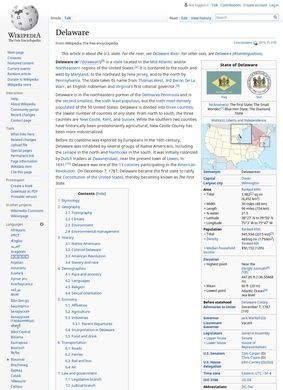
This is the Wikipedia encyclopedia entry for Delaware, the small mid-Atlantic state on the northeastern Delmarva Peninsula, sharing borders with Maryland, Pennsylvania, New Jersey, and the Atlantic. The page opens the way most state articles do on the site: a summary box with the basics, then a long body fanning out into geography, history, economy, government, and the rest. What makes it useful is the density of verifiable fact packed into a state most people could not place on a blank map.
Delaware's geography and county layout
The geographic groundwork is laid early and clearly. Delaware is the second-smallest state in the country at roughly 2,490 square miles, and the article does not let that number sit alone. It explains the three-county arrangement: New Castle in the north, Kent in the middle, and Sussex along the southern coast, the fewest counties of any state in the union.
Population density without a big city
Coverage of population follows the same pattern. The 2020 census figure of about 990,000 residents places it 45th by population yet sixth by density, and the article points out that no single city tops 100,000 people, with Wilmington as the largest and Dover as the capital. Those two facts together tell you more about how the state actually feels than a paragraph of description would. A place this dense yet without a single large city is unusual, and the page lets the reader draw that conclusion rather than stating it outright.
Behind Delaware's corporate law dominance
If one section of the Wikipedia: Delaware article demands more attention than the rest, it is the economy material on corporate registration. More than half of all NYSE-listed corporations and over three-fifths of the Fortune 500 are legally incorporated in Delaware, a concentration driven by the state's corporate law and its specialized Court of Chancery. The article frames this as the central fact of the modern Delaware economy, which is the right call. A reader who came only for that detail leaves understanding why a state of under a million people punches so far above its size in American business.
From Dutch settlers to first state
The historical contrast between the industrial north and the agrarian south turned out to be more illuminating than expected, because it quietly explains a lot of the present-day economic and political divide without ever spelling it out as a thesis. The page handles the colonial backdrop with the same economy of words, crediting Dutch and Swedish settlers before the English, and giving Delaware its familiar nickname. December 7, 1787, the day it became the first state to ratify the U.S. Constitution, is the hook the whole "First State" identity hangs on, and the Wikipedia: Delaware entry states it plainly and moves on without turning the moment into a flourish.
Government leadership and coastal climate
The government section keeps current without losing the structural detail. Readers learn that Delaware is run under a Democratic governor, Matt Meyer, and sends two Democratic members to the U.S. Senate, alongside the note that its three counties form the leanest county structure in the nation. Climate gets a shorter, sensible treatment: humid subtropical overall, milder along the coast and cooler in the north. None of this is padded. The Wikipedia: Delaware entry says what is true and stops, which is harder to do well than it looks, and the restraint is part of why the page reads as trustworthy rather than promotional.
Why does proportion matter in this entry?
What the Wikipedia: Delaware page does best is proportion. The corporate-law material, easily the state's most distinctive feature, gets real room, while climate and basic geography get the few lines they need. A weaker reference would flatten everything to the same length and leave you unable to distinguish what deserves attention. Here the editorial judgment shows through, and it reflects what someone researching the state would actually want to know first.
Inside culture and infrastructure sections
The breadth is genuine. Beyond the headline sections, the Wikipedia: Delaware entry runs through culture, infrastructure, education, and notable people, the standard scaffolding of a state article on the site. A student writing a report, a journalist checking a population figure before filing, and a researcher chasing the incorporation statistics can all start at the Wikipedia: Delaware entry and get an accurate footing. The internal links and citation apparatus, which the page carries as a matter of house style, mean nobody has to take a single claim on faith.
What the summary leaves out
There are limits worth naming. An encyclopedia summary compresses, and on a topic as layered as Delaware's corporate-law regime or its colonial handovers between European powers, the Wikipedia: Delaware article points the way more than it exhausts the subject. Anyone needing depth on the Court of Chancery's case law, or the mechanics of why incorporators flock to Wilmington, will follow the references out to primary and scholarly sources. That is the article working as designed. It is a map to the territory, not the territory, and it never pretends otherwise.
Comparing Delaware's entry to other states
Read against other state entries on the same platform, this one fares well. The figures are specific, the dates are pinned down, and the framing keeps the genuinely unusual fact, the incorporation dominance, at the center where it belongs. A reader who knew nothing about Delaware would come away able to explain why a state this small is named in the fine print of so many American companies, where its people actually live, and how its three counties split it into distinct regions. The Wikipedia: Delaware page earns trust the slow way, by being precise where precision is cheap to verify.
For most purposes, the Wikipedia: Delaware article is the sensible first stop and often a sufficient one. Quick fact-checking, an orientation before deeper reading, a refresher on the basics of the First State: it handles all of these without friction. The writing is plain, the organization predictable in the helpful way, and the substance accurate to the limits of any general reference. If a fault stands out, it is only that the surface coverage occasionally tempts you to think you have the whole picture when the footnotes are quietly inviting you further.
The Wikipedia: Delaware entry also has a less obvious use: people who already know Delaware but want one clean place to confirm a single number or date. The population rank, the square mileage, the ratification date, the share of Fortune 500 firms incorporated there, all are stated once, clearly, and sourced. That reliability under spot-checking is the quiet test any reference has to pass, and the Wikipedia: Delaware article passes it.