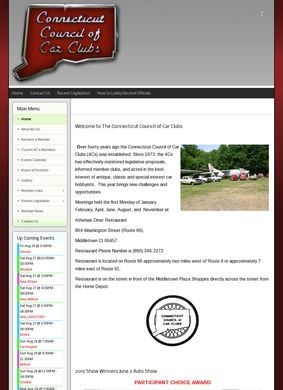
One page on this site walks through how Connecticut assesses collector cars for tax purposes: a schedule that drops the assessed value to 10 percent of MSRP once a vehicle hits fifteen years, with a minimum floor of 500 dollars kicking in at twenty years and beyond. That is the sort of detail a hobbyist with a 1968 muscle car in the garage actually needs, and it tells you what the Connecticut Council of Car Clubs is really about. This is not a photo gallery of chrome and fins. It is an advocacy body, running since 1973, that tracks the laws which decide whether owning an old car in the state stays affordable.
Structure of the statewide club network
The Connecticut Council of Car Clubs, known as the 4Cs, works as an umbrella organization. Individual car clubs across the state join it, and the council then represents their shared interest at the legislative level, mainly around antique, classic, and special-interest vehicles. A visitor gets a clear picture of the structure quickly. There is a directory of current member clubs, a path for a new club to join, and a legislative section that reads like the practical core of the whole operation.
Tracking bills that affect collector cars
That legislative tracking is where the Connecticut Council of Car Clubs earns attention. Instead of vague reassurances, it posts updates on proposed motor-vehicle and titling bills and explains how tax-assessment rules affect people who own collector cars. Alongside it sits an advocacy section with plain guidance on how to contact elected officials. For someone who has never written to a state representative and would not know where to start, that combination of what is being proposed plus how to respond is genuinely useful. It turns a hobby site into something closer to a working resource.
Calendar of cruise nights and car shows
It does, though the balance leans toward the organizational side. The Connecticut Council of Car Clubs maintains an event calendar covering cruise nights and car shows, which is the fun part of belonging to a club network, and it gives casual enthusiasts a reason to check in even if they never plan to attend a meeting. The calendar sits comfortably next to the heavier legislative material, so the site serves both the person who just wants to find a Saturday show and the club officer watching a titling bill.
Inside the meetings and membership process
Meeting information is handled openly too. The Connecticut Council of Car Clubs holds regular business meetings and publishes agendas, which suits an organization that answers to its member clubs. A member-links page lets those clubs request that their own websites be added, handled through email, and there is a linked Facebook community group under the name connecticutcouncilofcarclubs for anyone who prefers to follow along on social media. None of this is flashy. It is the plumbing of a volunteer-run nonprofit, and it is laid out in a way that anyone can follow.
Who is this for, concretely? Two groups. The first is an established car club somewhere in Connecticut weighing whether to affiliate, wanting to know what representation it gets and who else is already in. The second is the individual owner of an antique or classic vehicle who cares about the tax and titling rules and wants a voice on them. The Connecticut Council of Car Clubs speaks to both without pretending to be a general-interest motoring destination, and that focus is a strength.
How to reach the council directly?
On contact, the group is easy to reach by ordinary means. A contact page sits right in the main navigation, a phone number is printed plainly, and the landing page names the diner in Middletown where the meetings happen, which doubles as a physical anchor for the organization. Email is handled through a spam-protected link on the member-links page instead of a printed address, which is standard practice and no mark against them. Between a listed number, a stated meeting place, and a contact form, someone who wants to talk to the Connecticut Council of Car Clubs has more than one clear route.
Absence of third-party ratings
On outside reputation, a search does not turn up star ratings or review counts on Google, Yelp, Trustpilot, or similar platforms. The Facebook group exists but shows no public rating. The clearest outside mention comes from a dealership blog, Meadowland GMC, which describes the Connecticut Council of Car Clubs favorably as an influential car club council in the state, though with no score attached. So the third-party evidence is light and mostly descriptive. For a regional nonprofit that runs on volunteers and dues, that absence is unsurprising. Groups like this rarely accumulate consumer reviews, because there is no product to rate and no storefront to check in at. A missing star rating here just means the organization has not been through the review mill; its standing rests on longevity and on what it actually publishes.
An organization operating continuously since 1973 has outlasted plenty of local clubs. The site itself is the main evidence of that: updated legislative notes, a live event calendar, and current meeting agendas all point to something that is still functioning, not a page frozen years ago. A prospective member can judge the Connecticut Council of Car Clubs by whether those sections look maintained, which is a fair test in the absence of a rating average.
Weighing the site's plain design
The honest weaknesses are modest. The design is plain and utilitarian, and if you arrive hoping for polished feature articles or a deep photo archive, this is not that. The email-by-request approach on member links adds a small step for clubs that want to be listed. And because outside reviews are scarce, a first-time visitor has to do a little of their own homework, chiefly by reading the legislative and meeting pages to confirm the group is as active as it claims. None of these are dealbreakers. They are the ordinary limits of a volunteer nonprofit that spends its energy on advocacy instead of web polish.
Weighed together, the Connecticut Council of Car Clubs comes across as a credible, purpose-built resource for the collector-car community in one state. It knows exactly who it serves, it publishes the kind of specific legislative information that owners cannot easily find elsewhere, and it makes itself reachable. The Connecticut Council of Car Clubs will reward the visitor who needs substance over spectacle.
A Connecticut car club weighing affiliation can already see, from the published pages alone, what representation involves and how legislative alerts reach members before ever picking up the phone. An owner of an antique or classic vehicle gets the same benefit from the legislative and event pages, which lay out enough to know whether a current bill affects their car. The published material carries the case here, not a sales pitch.