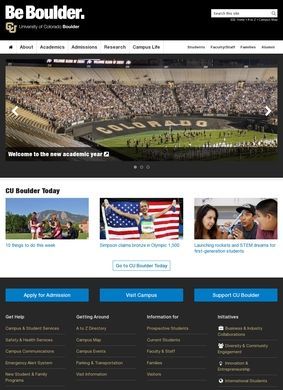
Picture a high school senior trying to figure out whether a single school can hold a future in aerospace engineering, a roommate headed for law, and a third friend who wants to study music performance. That spread of ambitions is where University of Colorado Boulder makes its case quickly, and it does so without forcing anyone to pick a different campus. The site fans out into colleges and schools that cover engineering, arts and sciences, business, education, law, architecture, journalism, music, and environmental design, so all three could plausibly land in the same place. With more than 270 fields of study and over 5,160 listed courses, the catalog is wide enough that the harder problem becomes narrowing down, not finding something to study.
Degree structure and research status
What I appreciated reading through it is that the breadth is backed by structure instead of slogans. At University of Colorado Boulder, degrees are sorted by level, so a prospective student can see undergraduate majors and minors in one lane and graduate work, both master's and doctoral, plus certificates, in another. Founded in 1876, the institution carries the designation of Colorado's flagship public research university and sits in the Association of American Universities, the consortium of leading North American research institutions. That membership is not decoration. It signals the kind of doctoral output and research funding that shapes what an undergraduate can actually plug into.
Research focus areas
The research story is where University of Colorado Boulder reads as more than a teaching mill. The site points to work in quantum technology, cybersecurity, planetary defense, water treatment, infectious disease, chronic pain treatment, and workforce development. That last item stands out because the connection to jobs and regional economies is something research universities in this bracket often bury or skip entirely.
Federal research partnerships
Boulder's geography does real work here too. The university runs multiple institutes and centers, including labs affiliated with NIST and partnerships with NOAA, a reflection of the town sitting inside a dense federal research corridor. For a student in physics, atmospheric science, or engineering, proximity to those agencies is the difference between reading about an experiment and walking into one. Roughly 35,000 students share that environment, a number large enough to sustain niche programs yet drawn from a real mix: first-year and transfer students, graduate cohorts, international enrollees, and returning adults coming back to finish or restart.
Admissions paths for different students
University of Colorado Boulder does not pretend everyone arrives the same way. Graduate admissions and international student resources get their own featured paths, which spares people from digging through pages written for eighteen-year-olds when their questions are about visas, funding, or transferring research credit. A self-paced and term-based online learning option is folded in as well, so the catalog is not strictly tied to moving to Colorado.
Academic support services
Support around the academics is handled plainly. Tutoring centers, academic advising, and the online programs are presented as ongoing services, the sort of scaffolding that tends to decide whether a heavy course load is survivable. None of it is dressed up; it is listed because it exists, and that restraint is welcome.
Life beyond the classroom
Beyond coursework, the campus side of University of Colorado Boulder fills out what daily life looks like. Athletic venues, performance halls, museums, and dining services all appear, which gives a visitor a sense of a place that runs concerts and exhibitions alongside lectures. A music school with actual performance halls is a different proposition from a music program squeezed into shared classrooms, and the site lets you see that distinction.
Portals for every campus audience
A site of this scope could easily collapse into a glorified business directory of departments, but University of Colorado Boulder splits its portals cleanly by audience: prospective students get admissions, financial aid, and campus visit scheduling; current students get course registration, health services, and orientation; faculty, staff, and alumni each have their own doorways. Anyone who has wrestled with a sprawling institutional website will recognize how much friction that removes. You are not forced to read everyone else's announcements to reach your own.
Limits of a single homepage
If there is a limit to what the homepage conveys, it is the usual one for an institution this size. A single visit cannot tell you whether your specific department is thriving or coasting, and the breadth that makes University of Colorado Boulder attractive in the abstract also means the experience varies enormously from college to college. The published material is honest about scope but cannot answer the granular questions that decide a particular student's four years.
Verify before you enroll
So the verdict lands as a confident yes with a caveat about homework. As a public research university, University of Colorado Boulder offers genuine range, serious research infrastructure rooted in its federal-lab surroundings, and an admissions structure that respects how different applicants actually arrive. A prospective engineer chasing quantum or aerospace work has obvious reasons to look closely, and so does the returning adult weighing an online certificate. What the site cannot do is substitute for talking to people inside the specific program you want. Use University of Colorado Boulder as the solid starting map it is, then go verify the corner of it that counts.