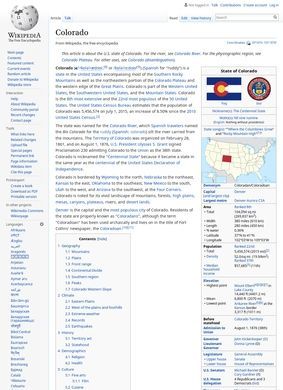
Wikipedia: Colorado is the encyclopedia's main reference article on the U.S. state admitted to the Union on August 1, 1876, the 38th state, nicknamed the Centennial State because it joined a century after the Declaration of Independence. The page puts the founding facts up top, then fans out into geography, population, history, government, and economy, each section deep enough to answer a real question without forcing a reader off to a dozen other pages first. If you want a single starting point for understanding Colorado, this is a defensible one.
Mapping Colorado's terrain and elevation
The geography coverage is solid. Colorado is the 8th-largest state by area at 104,185 square miles, landlocked, and stretched across an unusual mix of terrain: the Southern Rocky Mountains, the Colorado Plateau, the high plains to the east, and even desert dunes. The key numbers are present and easy to find. Mount Elbert tops out at 14,440 feet, and the state holds 53 peaks above 14,000 feet, the famous "fourteeners" that draw climbers from across the country. That kind of figure is exactly what a student or a casual reader comes looking for, and the page delivers it without padding.
There is no struggle to locate the basic dimensions of the state, which is more than can be said for a lot of reference material online. Wikipedia: Colorado also covers climate and culture in their own sections, so a reader chasing one narrow thread can usually find a dedicated block of prose instead of scraps scattered through the article.
Population concentrated along the Front Range
Population gets a similarly clean treatment in Wikipedia: Colorado. Roughly six million people live in the state on the 2025 estimate, ranking it 20th nationally, and the article makes a point that explains a lot about how the place works: about 84 percent of residents are packed into the Front Range Urban Corridor. Denver is both the capital and the largest city. That single concentration statistic does more to frame the human geography than a paragraph of description would, and it sits where you would expect it, near the demographic data and the state symbols.
Tracing history from Native settlement to statehood
History is handled chronologically and with a long horizon. Wikipedia: Colorado traces Native American habitation back at least 13,500 years before moving into the Pike's Peak Gold Rush of 1858 to 1862, the silver and gold boom that followed, and statehood in 1876. The decision to start the timeline well before European arrival is a sign of an article maintained by people who care about getting the framing right and refuse to reduce the state to its mining-era highlights. The boom years are covered, but placed in proportion against the much longer human presence, which is harder to do well than it looks. The result is a history section that reads as a whole story instead of a gold-rush highlight reel.
Government leadership and economic sectors
The government section is current, naming Jared Polis as the sitting Democratic governor and laying out the state's structure and congressional delegation. Pages like this live or die on whether someone keeps the officeholders updated, and Wikipedia: Colorado reads as actively tended on that front. A stale governor name is the first thing that erodes trust in a state article, and Wikipedia: Colorado has avoided that trap. The economy section is broader than a single headline industry, breaking the state down across government and defense, mining, agriculture, tourism, and manufacturing. Wikipedia: Colorado also notes that the state ranks among the top in the country for educational attainment, employment, and healthcare quality, the sort of comparative claim that gives a reader a sense of where Colorado stands without overselling it.
Inside the Four Corners Monument
A few distinctive details give Wikipedia: Colorado texture beyond the standard template. The Four Corners Monument gets its due as the only point in the country where four states meet, a genuine piece of trivia that also happens to be geographically real and worth knowing. Ski resort culture is covered as part of the tourism and lifestyle picture, which makes sense for a state whose mountain economy and identity are so tied to winter recreation. The sectioning is the quiet strength of the page, and it is what separates a useful reference from a wall of text.
Behind the article's citation apparatus
What makes the page trustworthy as a starting point is the citation apparatus running underneath all of it. The factual claims, the population figures, the elevation numbers, the historical dates, are footnoted, so a researcher who needs to go deeper has somewhere to go and a way to check the source without taking the summary on faith. For students in particular, that scaffolding is as important as the text itself, because it turns Wikipedia: Colorado into a launch pad toward primary and secondary material. The page functions less as a final answer and more as an organized index pointing toward the primary and secondary sources, which is the most a general reference should ever promise.
It is worth being clear-eyed about what Wikipedia: Colorado is and is not. It is an encyclopedic overview, broad by design, and it will not substitute for a specialized source when someone needs granular detail on, say, Colorado water law or the specifics of a single mining district. The breadth that makes it useful as a first stop is the same breadth that keeps any one topic from being exhaustive. For most readers, that tradeoff is the right one, and the page is honest about its own scope by linking out to the deeper articles where the narrow questions belong.
The writing stays in the register you want from a reference: factual, sectioned, and free of the promotional tone that creeps into so many state and tourism pages. Numbers are given with their units, ranks with their context, and the historical narrative moves without editorializing. That restraint is part of why Wikipedia: Colorado works for a general audience and for a student writing a report. Nobody is being sold a vacation here; they are being given the facts and pointed toward the sources behind them.
Comparing the Wikipedia page to Colorado.gov
Compared to a state government portal like Colorado.gov, the two serve different needs. The official portal is the place to go for live services, current statutes, agency contacts, and the practical business of dealing with the state. Wikipedia: Colorado is the better choice when the goal is understanding: the long history, the geography, the shape of the economy, the demographic story told in one continuous, cited article. For background reading and a quick path to the underlying sources, Wikipedia: Colorado is the more efficient starting point, and the official site is left to do what only the official site can do.