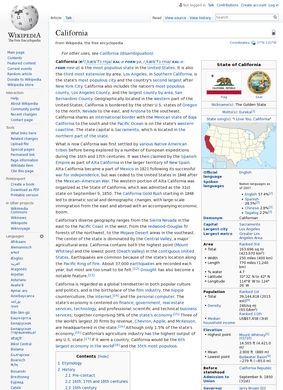
California takes its name from a 1510 Spanish novel, where it described an island ruled by a warrior queen named Calafia. That strange piece of trivia sits near the top of Wikipedia: California, which tells you something about how thorough the article wants to be. Most people land on this page for a quick population figure or a fact about Hollywood and tend to stay longer, because the page keeps pulling on threads. The etymology alone runs from a fictional Amazon paradise to the actual peninsula early explorers mistook for that island.
Structure of the state reference entry
What Wikipedia: California delivers is a full encyclopedic treatment of the U.S. state, organized the way you would expect: history, geography, demographics, economy, government, and the assorted state symbols at the end. The history section does not flinch. It walks from pre-colonial indigenous societies through Spanish colonization beginning in 1542, the period of Mexican rule from 1821 to 1848, U.S. annexation, and the 1848 Gold Rush. It also documents the California genocide against Native populations, which is the sort of inclusion that separates a serious reference entry from a tourism pamphlet. A reader who only knows the state through movies and beaches will find the harder parts of its past laid out without softening.
Geography gets concrete treatment. The Pacific coastline, the Sierra Nevada, the Mojave Desert, the Central Valley, and the range of climate zones are all covered, and one detail stands out: California carries roughly two-thirds of the earthquake risk in the entire United States. A student or journalist can lift that figure straight into a paper or article and trust it enough to cite, because it sits inside Wikipedia: California with its sourcing apparatus attached.
Current population figures by language
The demographics inside Wikipedia: California are current and specific. Population is given as 39.3 million, with 56.1 percent English-only speakers and 28.3 percent Spanish speakers, and the major metropolitan areas are named: Los Angeles, the San Francisco Bay Area, and the Inland Empire. Numbers like these are why the page functions as a default starting point for anyone doing research on the state. They are stated plainly, with the context a reader needs to interpret them, and they connect outward to deeper articles on each region. For anyone using this as a business directory alternative for state-level economic context, the demographic and regional breakdowns are genuinely useful anchors.
Economic ranking and major industries
Economically, Wikipedia: California makes the case that the state would rank as a major world power on its own. It describes the state economy as the largest of any in the U.S. and the fourth-largest globally if California were an independent country, built on three pillars: the Hollywood film industry, the Silicon Valley technology sector, and a large agricultural base. That framing is useful because it ties the abstract ranking to industries a reader can picture. The article goes beyond asserting the size of the economy and names what drives it.
Government coverage in Wikipedia: California is up to date in the way the encyclopedia tends to manage well, listing Governor Gavin Newsom, the structure of the state legislature, and the state's federal congressional representation. For a reader trying to understand how the state is run, or who currently runs it, that section answers the immediate questions and points toward the more detailed political articles. The state symbols round things out, the official bird, flower, tree and the rest, which is light material but the expected furniture of any state reference page.
Access formats across multiple languages
The practical mechanics deserve mention. Wikipedia: California is available in more than 230 languages, can be downloaded as a PDF, and offers a print version. All of it is free and released under Creative Commons licensing, so a teacher can hand it out, a researcher can archive it, and a translator can work from it without negotiating rights. For a single-page reference, that reach is genuinely useful, and it is the practical difference between a page you read once and a page you build other work on top of.
Depth limitations of a single survey article
The honest tension in any Wikipedia: California visit is depth versus settledness. The page is broad, well-structured, and the numbers are recent, but it is also a single survey article straining to hold an enormous subject. A reader who needs more than an overview will spend most of their time clicking through to the sub-topic articles on history, geography, and culture, because the main entry can only gesture at each. The page is a map of California's depth more than the depth itself, and it makes no secret of that. The wikilinks are the whole point of how it is meant to be used.
Currency of facts on a public reference page
There is also the question that hangs over any heavily edited public reference: a population figure of 39.3 million and a sitting governor are exactly the sort of facts that shift, and a page this prominent attracts both careful editors and the occasional agenda. The genocide documentation and the precise demographic breakdowns point toward a current version in responsible hands, and the citation trail gives a reader the means to check. Whether the specific number you read today still holds next month, and whether the framing on the more contested historical passages stays as measured as it reads now, is something no snapshot of the page can promise. That is the live doubt a careful reader carries into Wikipedia: California, and it is the right one to hold.