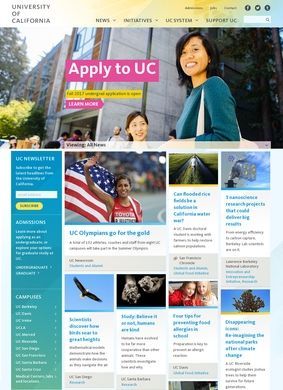
Ten campuses share one undergraduate application here, and that single fact tells you a lot about how the University of California organizes itself online. A high school senior fills out one form and can aim at Berkeley, UCLA, San Diego, Davis, Santa Barbara, Santa Cruz, Irvine, Riverside, and Merced in a single sitting, with San Francisco rounding out the system on the graduate and health-sciences side. The systemwide site sits above all of it as the front door, pointing visitors toward the individual campus sites once they know which direction they are headed.
Organizing ten campuses through a shared application
What the site does well is sort a sprawling institution into things a person can actually act on. Prospective students get admissions information and the shared application. Transfer students from California community colleges get the pathways laid out, which matters more in practice than most people expect, since a large share of University of California graduates start at a two-year college and move up. Current students, faculty, and researchers each have their own routes through the same hub, and the job postings are gathered in one place rather than scattered across ten payroll offices. The structure mirrors the institution: federated, with a coordinating center.
The site looked like it might just be a shallow layer over ten separate fiefdoms, but the research material is denser than that. The systemwide news feed and the advocacy initiatives give the University of California a public voice distinct from any one campus, which fits an institution that negotiates budgets with the state and explains itself to the legislature on a regular basis.
Research infrastructure for national impact
The research footprint is where this stops being a school portal and starts looking like something closer to national infrastructure. The site surfaces work in CRISPR gene editing, earthquake early warning systems, and high-performance computing. Those are not vanity projects. Earthquake early warning in particular is the kind of applied science that a public university in a seismically active state is well placed to run, and it has direct consequences for people who will never set foot in a lecture hall.
Federal laboratories and energy science
The University of California also manages three federally funded national laboratories on behalf of the U.S. Department of Energy. That stewardship relationship is unusual and it changes how you read the whole operation. A visitor can scan the site for admissions deadlines, but the same organization is also running facilities that sit at the center of American energy and weapons science. The site does not oversell this; it links to it, which is the right instinct.
Healthcare and agricultural services across California
Healthcare is the other arm that surprised me in scale. Six academic health centers, five cancer centers carrying the NCI comprehensive designation, and thousands of affiliated clinics mean the University of California is one of the larger care providers in the state, not a campus infirmary writ large. For a patient researching where to go for a complex diagnosis, the link from the systemwide hub to those centers is a practical entry point, and the NCI designation is a meaningful marker of cancer-care depth that the site is right to name.
From farm advisory to food supply networks
Then there is agriculture, which a lot of people forget the University of California even touches. UC Cooperative Extension operates in all 58 California counties, putting advisors on the ground for pest management and crop development. The farmers it supports grow roughly a third of the vegetables and three-quarters of the fruits and nuts consumed in the country. That is a staggering figure, and it reframes the institution as something embedded in the state's food supply, reaching well beyond its classrooms. The Extension model, county by county, is old-fashioned public service that still works.
The constituencies the site tries to serve are genuinely varied: prospective and current students, faculty, researchers, patients, agricultural producers, policymakers, and the broader California public. Serving that many audiences from one hub is a hard design problem, and the answer the University of California settles on is to act as a router. It does not try to be the destination for every task. It tries to get you to the campus, the portal, or the program that is. For a system this size, that restraint is the correct call.
The social presence is broad too, spanning Facebook, Twitter, Instagram, TikTok, YouTube, and LinkedIn. A university system reaching teenagers on TikTok and policymakers on LinkedIn from the same brand is covering a wide age and interest range, and the spread points to a communications operation that takes each audience on its own terms instead of pushing one feed everywhere.
If there is a tension in the site, it is the inherent one of any hub: depth lives on the campus sites, so a visitor who wants real detail about a specific program or clinic will click through and leave fairly quickly. That is the nature of the thing more than a flaw. The systemwide layer is a map, and a good map is judged by how fast it gets you off itself and onto the road you needed.
Taken together, the University of California presents itself as four or five large public functions stacked under one name: teaching, research, health care, agricultural extension, and public advocacy. Most people only ever interact with one of those functions, and the site is built so that you can ignore the other four without friction. A prospective freshman never has to think about the national labs; a farmer in Tulare County never has to read an admissions FAQ. The University of California holds those audiences apart cleanly, which is harder than making everything visible at once.
What the University of California offers depends entirely on who is asking. For an applicant it is the shared form and the campus comparison. For a researcher it is the labs and the published work. For a patient it is the route to a cancer center. For a grower it is the county advisor. The site builds trust by being honest about its role and by linking outward rather than hoarding attention. How useful it is to any given visitor comes down to which of its many functions overlaps with why they arrived, and the University of California has organized itself so that answer is rarely hard to find.